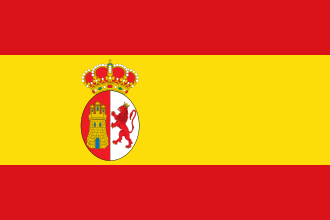
The Captaincy General of Cuba was an administrative district of the Spanish Empire created in 1607 as part of Habsburg Spain's attempt to better defend and administer its Caribbea…
The Captaincy General of Cuba (Spanish: Capitanía General de Cuba) was an administrative district of the Spanish Empire created in 1607 as part of Habsburg Spain's attempt to better defend and administer its Caribbean possessions. The reform also established captaincies general in Puerto Rico, Guatemala and Yucatán.
The Captaincy General of Cuba was an administrative district of the Spanish Empire created in 1607 as part of Habsburg Spain's attempt to better defend and administer its Caribbean possessions. The reform also established captaincies general in Puerto Rico, Guatemala and Yucatán.
Read more about this topic
The Captaincy General of Cuba (Spanish: Capitanía General de Cuba) was an administrative district of the Spanish Empire created in 1607 as part of Habsburg Spain's attempt to better defend and administer its Caribbean possessions. The reform also established captaincies general in Puerto Rico, Guatemala and Yucatán.
The restructuring of the Captaincy General in 1764 was the first example of the Bourbon Reforms in America. The changes included adding the provinces of Florida and Louisiana and granting more autonomy to these provinces. This later change was carried out by the Count of Floridablanca under Charles III to strengthen the Spanish position vis-a-vis the British in the Caribbean. A new governor-captain general based in Havana oversaw the administration of the new district. The local governors of the larger Captaincy General had previously been overseen in political and military matters by the president of the Audiencia of Santo Domingo. This audiencia retained oversight of judicial affairs until the establishment of new audiencias in Puerto Príncipe (1800) and Havana (1838).
In 1825, as a result of the loss of the mainland possessions, the Spanish government granted the governors-captain generals of Cuba extraordinary powers in matters of administration, justice and the treasury and in the second half of the 19th century gave them the title of Governor General.
Antecedents
Since the 16th century the island of Cuba had been under the control of the governor-captain general of Santo Domingo, who was at the same time, president of the audiencia there. He oversaw the local governor and the Santo Domingo Audiencia heard appeals from the island.
The conquest of Cuba was organized in 1510 by the recently restored Viceroy of the Indies, Diego Columbus (Diego Colón), under the command of Diego Velázquez de Cuéllar, who became Cuba's first governor until his death in 1524. The new settlers did not wish to be under the personal authority of Colón, so Velázquez founded the city of Nuestra Señora de la Asunción de Baracoa in 1511 and convoked a general cabildo (a local government council), which was duly authorized to deal directly with Spain. This legal move removed Velázquez and the settlers from under the authority of Colón, their nominal superior. It was a precedent that would come back to haunt Velázquez during Hernán Cortés's conquest of the Aztec Empire. Other cities were later founded under Velázquez: Bayamo in 1513; Santísima Trinidad, Sancti Spíritus and San Cristóbal de La Habana in 1514; Puerto Príncipe and Santiago de Cuba in 1515. After the Spanish conquest of the Aztec Empire, Cuba experienced an exodus of settlers, and its population remained small for the next two centuries.
In 1565 the Adelantado Pedro Menéndez de Avilés, who was also Captain General of the Spanish treasure fleet which rendezvoused in Havana, established the first permanent Spanish settlement in Florida, San Agustín, initially bringing the province under the administrative control of Cuba, although due to distance and sea currents, Florida's government was granted the right to correspond directly with the Council of the Indies.
The Church played an important role in the Spanish settlement of the Americas. Furthermore, since governors, as representatives of the King, oversaw church administration due to the crown's right of patronage, the church and state were tightly intertwined in Spanish America. The first diocese was established in 1518 in Baracoa and was made suffragan to the Diocese of Seville. The seat of the Diocese was transferred to Santiago de Cuba in 1522. In 1520 Pope Leo X established the short-lived Diocese of Santiago de la Florida (or "Santiago de la Tierra Florida"). In 1546 the Diocese of Santo Domingo was elevated to an Archdiocese and the Diocese of Santiago de Cuba was made suffragan to it.
Establishment
In 1607 Philip III created the Captaincy General of Cuba as part of larger plans to defend the Caribbean against foreign threats. The first captain general was Pedro Valdés. Around the same time other captaincies general were established in Puerto Rico (1580) and Central America (1609). Cuba was divided into two governorships with capitals in Havana and Santiago de Cuba. The governor of Havana was Captain General of the island. In 1650 Cuba received a large influx of refugees when the English captured Jamaica and expelled the Spanish settlers in the colony.
In 1756 the construction of ships for the Spanish Navy began with the establishment of an Intendancy of the Navy in Havana, which functioned as a royal shipyard.
The British capture of the island in 1762 during the Seven Years' War proved to be a turning point in the history of Cuba and Spanish America in general. The British captured Havana after a three-month siege and controlled the western part of the island for a year. Britain returned Cuba in exchange for Florida in the Treaty of Paris. The events revealed not only the weaknesses of the region's defenses but also proved just how much the Cuban economy had been neglected by the Spanish. During the year they controlled Cuba, the British and their American colonies conducted an unprecedented amount of trade with the island. A year earlier France had secretly ceded Louisiana Territory to Spain in compensation for its losses as its ally during the war.
As a sign of the seriousness with which the government took the problems, the very year the Spanish retook control of Havana construction began on what would become the largest Spanish fort in the New World, San Carlos de la Cabaña on the eastern side of the entrance to harbor of Havana.
The Bourbon Reforms
Starting in 1764 the government apparatus of Cuba was completely restructured. A report on the island was created by Alejandro O'Reilly, which provided the basis for the changes. A new emphasis was placed on appointing military men to the governorship-captaincy general of Cuba, many of whom were later rewarded with the post of Viceroy of New Spain. To aid the captain general of C