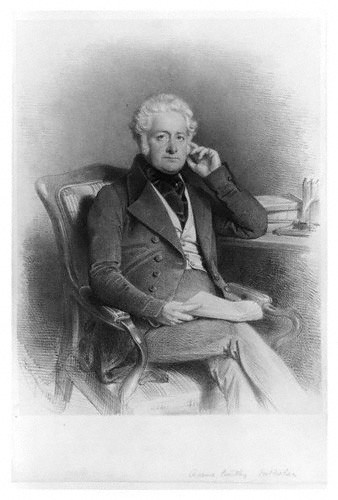
Richard Bentley was a 19th-century English publisher born into a publishing family. He started a firm with his brother in 1819. Ten years later, he went into partnership with the…
Richard Bentley (24 October 1794 – 10 September 1871) was a 19th-century English publisher born into a publishing family. He started a firm with his brother in 1819.
Richard Bentley was a 19th-century English publisher born into a publishing family. He started a firm with his brother in 1819. Ten years later, he went into partnership with the publisher Henry Colburn. Although the business was often successful, publishing the famous "Standard Novels" series, they ended their partnership in acrimony three years later. Bentley continued alone profitably in the 1830s and early 1840s, establishing the well-known periodical Bentley's Miscellany. However, the periodical went into decline after its editor, Charles Dickens, left. Bentley's business started to falte
Read more about this topic
Richard Bentley (24 October 1794 – 10 September 1871) was a 19th-century English publisher born into a publishing family. He started a firm with his brother in 1819. Ten years later, he went into partnership with the publisher Henry Colburn. Although the business was often successful, publishing the famous "Standard Novels" series, they ended their partnership in acrimony three years later. Bentley continued alone profitably in the 1830s and early 1840s, establishing the well-known periodical Bentley's Miscellany. However, the periodical went into decline after its editor, Charles Dickens, left. Bentley's business started to falter after 1843 and he sold many of his copyrights. Only 15 years later did it begin to recover.
Early life
Bentley came from a publishing family that stretched back three generations. His father, Edward Bentley, and his uncle, John Nichols, published the General Evening Post, and Nichols also published the Gentleman's Magazine. Richard Bentley was born in Fetter Lane, Fleet St, in London in 1794. He attended St Paul's School. Richard and his brother, Samuel (1785–1868), both trained in publishing and in 1819 established their own firm in Dorset Street. (The Library of Congress identifies publisher name "S. and R. Bentley", variant "S. & R. Bentley", LCCN: nr2002-014818. That is the first of four Bentley publisher names formally identified. See the footer.) The Bentley firm, according to the Dictionary of National Biography entry on Bentley, "became arguably the finest printers in London". They were the first to prominently feature wood-engraved illustrations.
In 1823, Bentley married Charlotte Botten (1800–1871), daughter of Thomas Botten by his wife, Kezia Francis. They had nine children, one of whom, their eldest surviving son, George Bentley (1828–1895), joined his father in the printing business.
"Henry Colburn and Richard Bentley"
On 3 June 1829, Bentley signed a partnership agreement with Henry Colburn. Colburn was in financial trouble and owed the Bentleys money. Rather than see him default, the two firms agreed to merge, with the agreement favouring Colburn. Over the course of a trial three-year period, Bentley was obliged to invest £2,500, find new manuscripts to publish, and act as bookkeeper. He would, in return, receive two-fifths of the profits. Colburn, on the other hand, provided three-fifths of the capital and received three-fifths of the profits. The two would make publishing decisions together. If the partnership failed before three years had passed, Bentley would be obliged to buy out Colburn for £10,000, with Colburn agreeing to publish only what he had published before the agreement. The new firm, Henry Colburn and Richard Bentley, which lasted a little over three years, was located at 8 New Burlington Street.
We label verified structured information, user opinions, and AI-discovered relationships separately.
The firm was generally successful, primarily because they "catered to public taste". They fed the market for silver fork novels, including Benjamin Disraeli's The Young Duke (1831) and works by Catherine Gore. Furthermore, almost all their novels were three-deckers, the length preferred by circulating libraries. Another element behind their success was their advertising, on which they spent £27,000 in the three years of the firm's existence.
Not all of their ventures were successful, however. Among the notable failures were three series aimed at the increasing mass audiences: the National Library of General Knowledge, the Juvenile Library, and the Library of Modern Travels and Discoveries. Almost half the 55,750 copies of the National Library had to be sold as remainders, at a loss of almost five shillings per volume. The Juvenile Library lost the firm £900 and only three volumes were published. The Travels and Discoveries series was never published. The firm also rejected the manuscript of Sartor Resartus, by the then unknown Thomas Carlyle.
Standard Novels series
In February 1831 the firm also began publishing one-volume versions of novels that had previously been available only in three-decker form. They published novels whose copyright they owned and bought up the copyright to other novels. Colburn and Bentley's "Standard Novels series" became "a landmark in nineteenth-century publishing". Because each volume was only six shillings instead of a guinea and a half (i.e. 31s 6d), novels were suddenly available to a much wider audience than previously. Furthermore, the firm owned the copyright to the novels, making the profits of the enterprise entirely theirs. James Fenimore Cooper's The Pilot was the first novel in the series. The two publishers solicited revisions from living authors, sometimes forcing them to shorten their works so that they would fit into a single volume. Colburn and Bentley published the first 19 volumes together. The series would eventually be published over 24 years and include 126 volumes. These included "the first inexpensive reprints of Jane Austen's fiction" and many American titles. The series was extraordinarily successful. In its first year, it made the firm £1,160.
End of partnership
By 1831, the partnership between Bentley and Colburn was fraying. The cost of buying copyrights was mounting and the firm was in financial chaos. By early 1832, Bentley and Colburn were no longer speaking to each other and their dispute had to be mediated by lawyers and clerks. On 1 September 1832, Bentley and Colburn signed a settlement in which Bentley agreed to buy the firm for £1,500, keep the office on New Burlington Street, and rename the business "Richard Bentley". He paid Colburn £5,580 for materials and copyrights owned by the firm, including the Standard Novels series. Colburn agreed to a series of restrictions on his publications, an agreement which he violated almost immediately. The partnership was officially dissolved with effect from 31 August 1832.
"Richard Bentley"
Bentley and Colburn became bitter rivals in the years that followed the dissolution of their partnership, publishing similar series and trying to undersell each other. In 1833, Bentley was appointed Publisher in Ordinary to the king, but it brought him no b