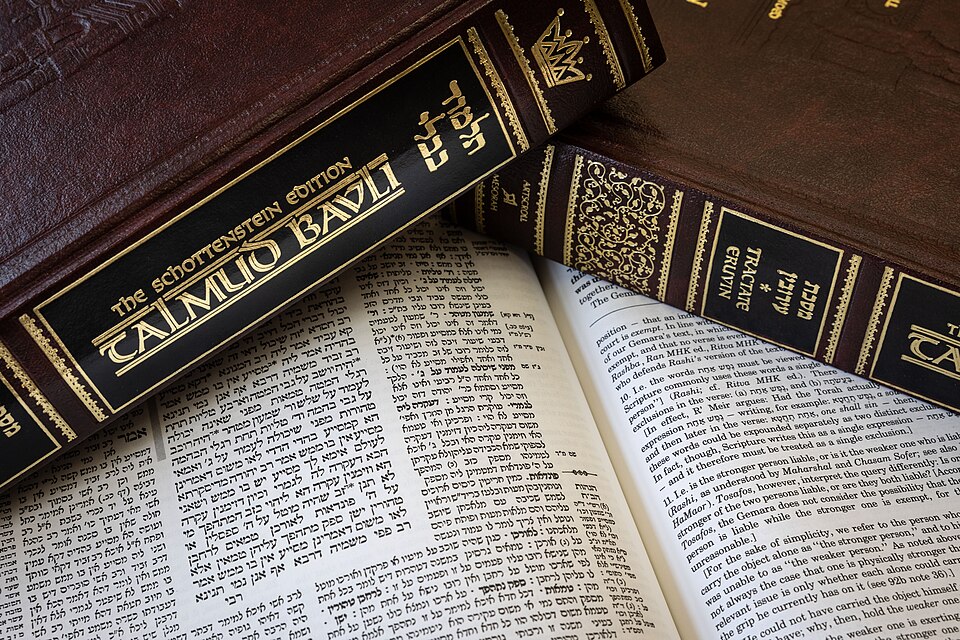
The Talmud is a central text of Rabbinic Judaism, and a primary source of Jewish law and Jewish theology. It consists of the part of the Oral Torah compiled in the Mishnah and its…
The Talmud (; Hebrew: תַּלְמוּד, romanized: Talmūḏ, 'study' or 'learning') is a central text of Rabbinic Judaism, and a primary source of Jewish law (הֲלָכָה, Halakha) and Jewish theology. It consists of the part of the Oral Torah compiled in the Mishnah and its commentaries, the Gemara.
The Talmud is a central text of Rabbinic Judaism, and a primary source of Jewish law and Jewish theology. It consists of the part of the Oral Torah compiled in the Mishnah and its commentaries, the Gemara. It records the teachings, opinions and disagreements of thousands of rabbis and Torah scholars on a variety of subjects, including Halakha, Jewish ethics, philosophy, customs, history, and folklore among other topics. Until the Haskalah in the 18th and 19th centuries, the Talmud was the centerpiece of Jewish culture in nearly all communities and foundational to "all Jewish thought and aspira
Read more about this topic
The Talmud (; Hebrew: תַּלְמוּד, romanized: Talmūḏ, 'study' or 'learning') is a central text of Rabbinic Judaism, and a primary source of Jewish law (הֲלָכָה, Halakha) and Jewish theology. It consists of the part of the Oral Torah compiled in the Mishnah and its commentaries, the Gemara. It records the teachings, opinions and disagreements of thousands of rabbis and Torah scholars (collectively referred to as Chazal) on a variety of subjects, including Halakha, Jewish ethics, philosophy, customs, history, and folklore among other topics. Until the Haskalah in the 18th and 19th centuries, the Talmud was the centerpiece of Jewish culture in nearly all communities and foundational to "all Jewish thought and aspirations", serving also as "the guide for the daily life" of Jews.
Talmud is used interchangeably with Gemara. The text is made up of 63 tractates, each covering one subject area. The Talmud is written in a combination of Aramaic and Hebrew. Talmudic tradition emerged and was compiled between the destruction of the Second Temple in 70 CE and the Arab conquest in the early seventh century. Traditionally, it is thought that the Talmud itself was compiled by Rav Ashi and Ravina II around 500 CE, although it is more likely that this happened in the middle of the sixth century.
The word Talmud commonly refers to the Babylonian Talmud (Talmud Bavli), not the earlier Jerusalem Talmud (Talmud Yerushalmi). The Babylonian Talmud is the more extensive of the two and is considered the more authoritative.
In Rabbinic Judaism, the Talmud is second in authority only to the Hebrew Bible (Tanakh), the first five books of which form the Torah along with the texts in Nevi'im (Prophets) and Ketuvim (Writings).
Etymology
Talmud translates as "instruction, learning", from the Semitic root lmd, meaning "teach, study".
We label verified structured information, user opinions, and AI-discovered relationships separately.
The two Talmuds
In antiquity, the two major centres of Jewish scholarship were the Talmudic academies in Syria Palaestina and Babylonia. A Talmud was compiled in each of these regional centres. The earlier of the two compilations took place in Galilee, either in the late fourth or early fifth century, and it came to be known as the Jerusalem Talmud (Jewish Palestinian Aramaic: תַּלְמוּד יְרוּשַׁלְמִי, romanized: Talmud Yerushalmi). Later, and likely some time in the sixth century, the Babylonian Talmud was compiled (Jewish Babylonian Aramaic: תַּלְמוּד בַּבְלִי, romanized: Talmud Bavli). The latter Talmud is usually what is meant when the word "Talmud" is used without qualification. Traditions of the Jerusalem Talmud and its sages had a significant influence on the milieu out of which the Babylonian Talmud arose.
Jerusalem Talmud
The Jerusalem Talmud is known by several other names, including the Palestinian Talmud (which is more accurate, given that it was not compiled in Jerusalem), and the Talmud of the Land of Israel (Talmuda de-Eretz Yisrael or Talmud Eretz Yisrael). The Jerusalem Talmud was a written codification of oral tradition that had been circulating for centuries, representing a compilation of the Palestinian rabbis' teachings about and textual analyses of the Mishnah (especially those concerning agricultural laws) found across regional centres of the Land of Israel in the Galilee (principally those of Tiberias, Sepphoris, and Caesarea). It is written largely in Jewish Palestinian Aramaic, a Western Aramaic language that differs from Jewish Babylonian Aramaic, its Babylonian counterpart. The compilation was likely made between the late fourth to the first half of the fifth century.
Despite its incomplete state, the Jerusalem Talmud remains an indispensable source for the study of the development of Halakha in the Holy Land. It was also an important primary source for the study of the Babylonian Talmud by the Kairouan school of Chananel ben Chushiel and Nissim ben Jacob, with the result being that opinions ultimately based on the Jerusalem Talmud found their way into the Tosafot and the Mishneh Torah by Maimonides. Ethical maxims in the Jerusalem Talmud are scattered and interspersed throughout the legal discussions of the several treatises, many of which differ from those in the Babylonian Talmud.
Babylonian Talmud
The Babylonian Talmud (Talmud Bavli) consists of documents compiled over the period of late antiquity (3rd to 6th centuries). During this period, the most important of the Mesopotamian Jewish centres of learning included the Talmudic academies in Babylonia, such as Nehardea, Nisibis (now Nusaybin), Mahoza (al-Mada'in, south of modern Baghdad), Pumbedita (near present-day al Anbar Governorate), and the Sura Academy, which was probably located about 60 km (37 mi) south of Baghdad.
The Babylonian Talmud is the culmination of centuries of analysis and dialectic of the Mishnah and Hebrew Bible in the Talmudic academies in Babylonia. According to tradition, the foundations of this process of analysis were laid by Abba Arika (175–247), a disciple of Judah ha-Nasi. Tradition ascribes the compilation of the Babylonian Talmud in its present form to two Babylonian sages, Rav Ashi and Ravina II. Rav Ashi was the president of the Sura Academy from 375 to 427. At this time, he began compiling the Talmud, a written project passed on and completed by Ravina II, the final Amoraic expounder of the Oral Torah. Traditionally, the latest year for the compilation of the Talmud is typically placed at 475, the year Ravina II died. However, even among those who hold traditional views, a final redaction is still thought to have been made by the Savoraim (Jewish Babylonian Aramaic: סָבוֹרָאִים, lit. 'Reasoners') in the sixth century.
Comparison
Unlike the Western Aramaic dialect of the Jerusalem Talmud, the Babylonian Talmud uses a Babylonian Aramaic dialect. The Jerusalem is also more fragmentary (and difficult to read) due to an incomplete redaction process. Discussions in the Babylonian Talmud are more discursive, rambling, and rely more heavily on anecdote and argumentation by syllogism and inductive reasoning; those in the Jerusalem Talmud are more factual and apply