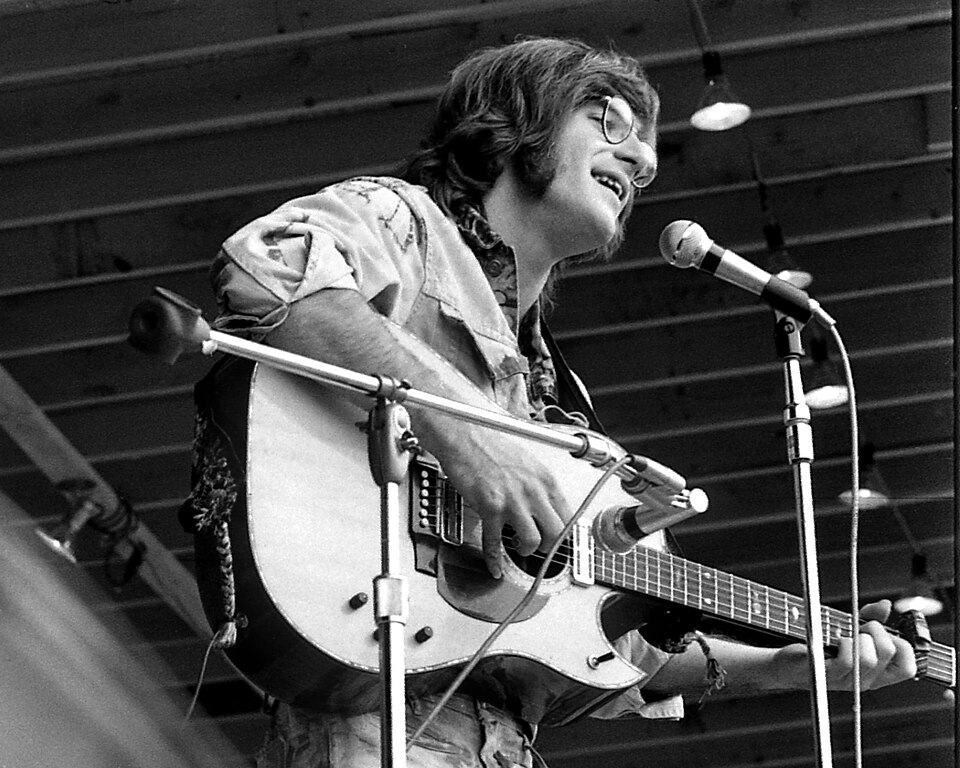
John Benson Sebastian is an American singer, songwriter and musician who founded the rock band the Lovin' Spoonful in 1964 with Zal Yanovsky. During his time in the Lovin' Spoonfu…
John Benson Sebastian (born March 17, 1944) is an American singer, songwriter and musician who founded the rock band the Lovin' Spoonful in 1964 with Zal Yanovsky. During his time in the Lovin' Spoonful, Sebastian wrote and sang some of the band's biggest hits such as "Do You Believe in Magic", “Summer in the City”, "Did You Ever Have to Make Up Your Mind", and "Daydream".
John Benson Sebastian is an American singer, songwriter and musician who founded the rock band the Lovin' Spoonful in 1964 with Zal Yanovsky. During his time in the Lovin' Spoonful, Sebastian wrote and sang some of the band's biggest hits such as "Do You Believe in Magic", “Summer in the City”, "Did You Ever Have to Make Up Your Mind", and "Daydream". Sebastian left the Spoonful after the 1968 album Everything Playing to focus on a solo career, releasing John B. Sebastian in 1970.
Read more about this topic
John Benson Sebastian (born March 17, 1944) is an American singer, songwriter and musician who founded the rock band the Lovin' Spoonful in 1964 with Zal Yanovsky. During his time in the Lovin' Spoonful, Sebastian wrote and sang some of the band's biggest hits such as "Do You Believe in Magic", “Summer in the City”, "Did You Ever Have to Make Up Your Mind", and "Daydream". Sebastian left the Spoonful after the 1968 album Everything Playing to focus on a solo career, releasing John B. Sebastian in 1970.
He made an impromptu appearance at the Woodstock festival in 1969 and scored a U.S. No. 1 hit in 1976 with "Welcome Back", which was used as the theme song on the sitcom Welcome Back, Kotter.
Sebastian was inducted into the Rock and Roll Hall of Fame in 2000 as a member of the Lovin' Spoonful.
Early life
Sebastian was born in New York City and grew up in Little Italy and Greenwich Village. His father, John Sebastian (né John Sebastian Pugliese), was a noted classical harmonica player, and his mother, Jane (born Mary Jane Bishir), was a radio script writer. His godmother was the actress Vivian Vance, who was a close friend of his mother. His godfather and first babysitter was children's book illustrator Garth Williams, a friend of his father. Eleanor Roosevelt was a neighbor who lived across the hall.
Sebastian grew up surrounded by music and musicians, including Burl Ives and Woody Guthrie, and hearing such players as Lead Belly and Mississippi John Hurt in his own neighborhood. He graduated from Blair Academy, a private boarding school in Blairstown, New Jersey, in 1962. He next attended New York University for just over a year, but dropped out as he became more interested in musical pursuits.
We label verified structured information, user opinions, and AI-discovered relationships separately.
In the early 1960s, Sebastian developed an interest in blues music and in playing harmonica in a blues style, rather than the classical style of his father. Through his father's connections, he met and was influenced by blues musicians Sonny Terry and Lightnin' Hopkins (for whom Sebastian served as "unofficial tour guide and valet" when Hopkins was in New York City). Sebastian became part of the folk and blues scene that was developing in Greenwich Village, which in part later gave rise to folk rock.
In addition to harmonica, Sebastian played guitar and occasionally autoharp. One of Sebastian's first recording gigs was playing guitar and harmonica for Billy Faier's 1964 album The Beast of Billy Faier. He also played on Fred Neil's album Bleecker & MacDougal and Tom Rush's self-titled album in 1965. He played in the Even Dozen Jug Band and in the Mugwumps, which split to form the Lovin' Spoonful and the Mamas & the Papas. Bob Dylan invited him to play bass on his Bringing It All Back Home sessions (though Sebastian's parts, from the first day of the recording session, did not appear on the album) and to join Dylan's new electric touring band, but Sebastian declined in order to concentrate on his own project, the Lovin' Spoonful.
The Lovin' Spoonful
Sebastian was joined by Zal Yanovsky, Steve Boone, and Joe Butler in the Spoonful, which was named after "The Coffee Blues," a Mississippi John Hurt song. The Lovin' Spoonful, which blended folk-rock and pop with elements of blues, country, and jug band music, became part of the American response to the British Invasion, and was noted for such hits as "Do You Believe in Magic", "Jug Band Music", "You Didn't Have to Be So Nice", "Daydream", "Did You Ever Have to Make Up Your Mind?", "Summer in the City", "Rain on the Roof", "Nashville Cats", "Darling Be Home Soon", and "Six O'Clock".
The band, however, began to implode after a 1966 marijuana bust in San Francisco involving Boone and Yanovsky, a Canadian citizen. Facing deportation, they revealed the name of their dealer to police, which caused a fan backlash and added to the internal tension already created by the diverging interests of the band members. Neither Sebastian nor Butler were involved in the matter, both being away from San Francisco at the time. Yanovsky subsequently left the band and was replaced by Jerry Yester, after which the band's musical style veered away from its previous eclectic blend and became more pop-oriented.
Sebastian would reunite with the band in 1980 and appear in the film One-Trick Pony. He would later be inducted into the Rock and Roll Hall of Fame in 2000, this was the last time Sebastian would play with the original line up.
In 2020 Sebastian reunited with Lovin Spoonful members Joe Butler and Steve Boone.
Broadway musical composer
One of Sebastian's first projects after leaving the Spoonful was composing the music and lyrics for a play with music, Jimmy Shine, written by Murray Schisgal. It opened on Broadway in December 1968, with Dustin Hoffman in the title role, and ran until April 1969, for a total of over 150 performances. In the late 1970s and early 1980s, Sebastian wrote a stage musical adaptation of E.B. White's Charlotte's Web in consultation with his godfather Garth Williams, who illustrated White's original book. The proposed musical included 20 songs, some of which Sebastian performed in concert, but the musical was never produced.
Woodstock appearance
In August 1969, Sebastian made an unscheduled appearance at Woodstock. He traveled to the festival as a spectator, but was asked to appear when the organizers suddenly needed an acoustic performer after a rain break because they couldn't set up amps on stage for Santana until the water was swept off. Sources that have tried to reconstruct the Woodstock running order differ on the exact time and position of Sebastian's unplanned set, with some stating that he played on Saturday, August 16, immediately after Country Joe McDonald; others saying that on that Saturday, Santana followed McDonald and Sebastian appeared after Santana; and still others, including McDonald, recalling that Sebastian actually played on Friday, August 15, at some point after Richie Havens opened the festival.
Sebastian's Woodstock set consisted of three songs from his recorded but not yet released John B. Sebastian album