The Tragedy of Tragedies, also known as The Tragedy of Tragedies; or, The Life and Death of Tom Thumb the Great, is a play by Henry Fielding. It is an expanded and reworked versio…
The Tragedy of Tragedies, also known as The Tragedy of Tragedies; or, The Life and Death of Tom Thumb the Great, is a play by Henry Fielding. It is an expanded and reworked version of one of his earlier plays, Tom Thumb, and tells the story of a character who is small in stature and status, yet is granted the hand of a princess in marriage; the infuriated queen and another member of the court sub…
The Tragedy of Tragedies, also known as The Tragedy of Tragedies; or, The Life and Death of Tom Thumb the Great, is a play by Henry Fielding. It is an expanded and reworked version of one of his earlier plays, Tom Thumb, and tells the story of a character who is small in stature and status, yet is granted the hand of a princess in marriage; the infuriated queen and another member of the court subsequently attempt to destroy the marriage.
In adapting his earlier work Fielding incorporated significant plot changes; he also made the play more focused, and unified the type of satire by narrowing its critique of the abuses of language. Additionally, in a reaction to the view that Tom Thumb was a burlesque, Fielding replaced some of the humour in favour of biting satire. The play was first performed at the Haymarket Theatre on 24 March 1731, with the companion piece The Letter Writers. Critics enjoyed the play, but pointed out that it was originally designed as a companion piece to The Author's Farce.
Background
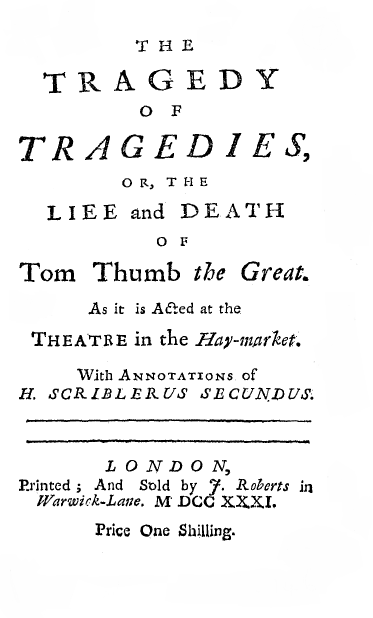
The Tragedy of Tragedies was an expanded and rewritten version of Tom Thumb. Fielding altered the play because although audiences enjoyed the play they did not notice the satire directed at the problems of contemporary theatre; the rewrite was intended to make the satire more obvious. The play was first performed on 24 March 1731 at the Haymarket Theatre in London, with the companion piece The Letter Writers. Its printed edition was "edited" and "commented" on by Fielding's pseudonym H. Scriblerus Secundus, who pretends not to be the original author. It contains a frontispiece by Hogarth, which serves as the earliest proof of a relationship between Fielding and Hogarth.
The printed edition was available on opening night and the notes included with the printed edition served as a way to explain the play. It was printed by James Roberts alongside of an edition of The Letter-Writers. The printed version of The Tragedy of Tragedies created two versions of the play, one that was acted and another that was to be read, and both contained humour catered to each. Fielding believed modern tragedies to be superior to the Classic Greek tragedies because the Classics could only invoke pity and fear in the audience, while modern tragedies were able to leave the audience laughing at the ridiculous situations onstage. Fielding referred to these modern works as "laughing tragedies" and claimed that the only difference between his work and the modern tragedies was that his work was intentional in its laughter. Fielding's play was later adapted into The Opera of Operas; or Tom Thumb the Great by playwrights Eliza Haywood and William Hatchett. It ran 13 nights at the Little Theatre starting 31 May 1733 and was discontinued because of the hot weather. It was later continued and had many shows during the seasons following.
The Tragedy of Tragedies turned out to be one of Fielding's most enduring plays, with interesting later revivals. The novelist Frances Burney played Huncamunca in private productions of 1777, there was a private production done by the family of Jane Austen at Steventon in 1788, and professor William Kurtz Wimsatt Jr. played the giantess Glumdalca at a Yale University production in 1953.
Cast
Cast according to the original printed billing:
King Arthur – "A passionate sort of King, Husband to Queen Dollallolla, of whom he stands a little in Fear; Father to Huncamunca, of whom he is very fond; and in Love with Glumdalca", played by Mr. Mullart
Tom Thumb the Great – "A little Hero with a great Soul, something violent in his Temper, which is a little abated by his Love for Huncamunca", played by Young Verhuyck
Ghost of Gaffar Thumb – "A whimsical sort of Ghost", played by Mr. Lacy
Lord Grizzle – "Extremely zealous for the Liberty of the Subject, very cholerick in his Temper, and in Love with Huncaumunca", played by Mr. Jones
Merlin – "A Conjurer, and in some sort Father to Tom Thumb", played by Mr. Hallam
Noodle and Doodle – "Courtiers in Place, and consequently of that Part that is uppermost", Mr. Reynolds and Mr. Wathan
Foodle – "A Courtier that is out of Place, and consequently of that Part that is undermost", played by Mr. Ayres
Bailiff and Follower – "Of the Party of the Plaintiff", played by Mr. Peterson and Mr. Hicks
Parson – "Of the Side of the Church", played by Mr. Watson
Queen Dollallolla – "Wife to King Arthur, and Mother to Huncaumunca, a Woman entirely faultless, saving that she is little given to Drink; a little too much a Virago towards her Husband, and in Love with Tom Thumb", played by Mrs. Mullart
The Princess Huncamunca – "Daughter to their Majesties King Arthur and Queen Dollallolla, of a very sweet, gentle, and amorous Disposition, equally in Love with Lord Grizzle and Tom Thumb, and desirous to be married to them both", played by Mrs. Jones
Glumdalca – "of the Giants, a Captive Queen, belov'd by the King, but in Love with Tom Thumb", played by Mrs. Dove
Cleora and Mustacha – "Maids of Honour, in Love with Noodle. Doodle." unlisted
Other characters include Courtiers, Guards, Rebels, Drums, Trumpets, Thunder and Lightning
Plot
There is little difference between the general plot outline of Tom Thumb and The Tragedy of Tragedies, but Fielding does make significant changes. He completely removed a scene in which two doctors discuss Tom Thumb's death, and in doing so unified the type of satire that he was working on. He narrowed his critique to abuses of language produced only by individuals subconsciously, and not by frauds like the doctors. As for the rest of the play, Fielding expanded scenes, added characters, and turned the work into a three-act play. Merlin is added to the plot to prophesize Tom's end. In addition, Grizzle becomes Tom's rival for Huncamunca's heart, and a giantess named Glumdalca is added as a second love interest for both King Arthur and Tom. As the play progresses, Tom is not killed by Grizzle, but instead defeats him. However, Tom is killed by a giant, murderous cow offstag