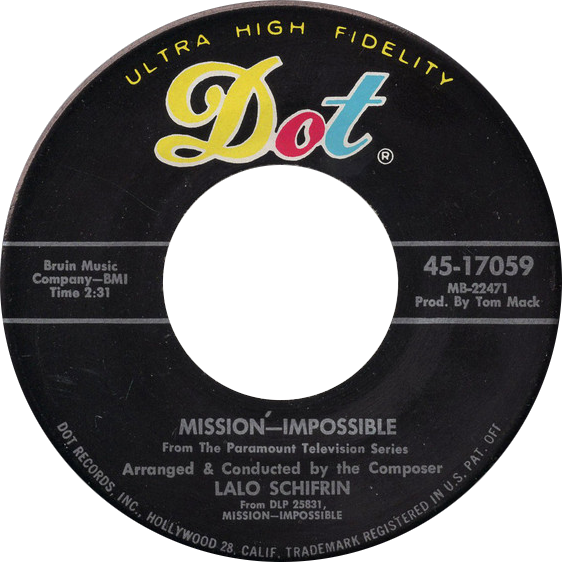
"Theme from Mission: Impossible" is the theme tune of the American espionage TV series Mission: Impossible (1966–1973). The theme was written and composed by Argentine composer La…
"Theme from Mission: Impossible" is the theme tune of the American espionage TV series Mission: Impossible (1966–1973). The theme was written and composed by Argentine composer Lalo Schifrin and has since gone on to appear in several other works of the Mission: Impossible franchise, including the 1988 TV series, the film series, and the video game series.
"Theme from Mission: Impossible" is the theme tune of the American espionage TV series Mission: Impossible (1966–1973). The theme was written and composed by Argentine composer Lalo Schifrin and has since gone on to appear in several other works of the Mission: Impossible franchise, including the 1988 TV series, the film series, and the video game series.
Overview
The theme is written in quintuple meter (with a 54 time signature), which composer Lalo Schifrin jokingly explained as being for mutant people with five legs.
The Morse code for M.I. is two dashes followed by two dots ▄▄▄ ▄▄▄ ▄ ▄ ; if a dot is one beat and a dash is one-and-a-half beats, then this gives a bar of five beats, exactly matching the theme's underlying rhythm. It has been suggested that Schifrin consciously used the Morse code as a starting point for his composition, but this cannot be verified. He did write that he used Morse code as a method for obtaining an unusual rhythmic pattern for his theme to the film The Concorde... Airport '79.
Schifrin's working title for the song was "Burning Fuse". He compared his writing process to writing a letter: "When you write a letter, you don't have to think what grammar or what syntaxes you're going to use, you just write a letter. And that's the way it came." He estimated that he wrote the main theme in 90 seconds and completed the full arrangement in three minutes.
The actor Martin Landau, who played the character Rollin Hand in the show, attended the recording session for the theme song. "Lalo raised his wand to the musicians and I heard 'dun dun, da da, dun dun, da da' for the first time, and it was deafening", Landau recalled. "Lalo interrupted the band and said, 'no, no, it should be like this.' They resumed and before we could say anything, they had recorded it. I was stunned. It was so perfect. I came out humming that tune."
Reception
The original single release, on Dot Records, peaked at number 41 on the US Billboard Hot 100 and 19 on the magazine's Adult Contemporary chart in 1967. Also in that year, two years before Leonard Nimoy began playing the role of Paris in Mission Impossible, the theme appeared on the album Leonard Nimoy Presents Mr. Spock's Music from Outer Space. (Nimoy did not perform on the song.)
Awards
The theme won as the Best Instrumental Theme at the 10th Grammy Awards held on February 29, 1968. Schifrin also won the Grammy for Best Original Score Written for a Motion Picture or a Television Show. In 2017, Schifrin's 1967 recording of the Theme from Mission: Impossible was inducted into the Grammy Hall of Fame.
Schifrin's version, as performed with the London Philharmonic Orchestra, received a nomination for the Grammy Award for Best Pop Instrumental Performance for the 39th Grammy Awards held in 1997. The Clayton and Mullen version (see below) was also nominated for the same award in the same edition.
In 1996, the theme was remade by U2 members Adam Clayton and Larry Mullen Jr. for the soundtrack to the film. The duo recorded two versions of the song, the main theme and another subtitled "Mission Accomplished". The main theme was used during the end credits. Unlike the original, the majority of this version is in common time, with the exception of the intro. The single was released on 3 June 1996 by Mother Records. The accompanying music video was directed by English singer, songwriter, musician and music video director Kevin Godley.
Critical reception
Larry Flick from Billboard magazine wrote that Clayton and Mullen "cover the film's instantly recognizable theme, effectively funking it up for the '90s with a shuffling jeep beat". He complimented Lalo Schifrin's melody as "suspenseful and compelling as ever" and added, "It'll give fans of the TV show a fun jolt while entertaining a whole new generation." Dave Sholin from the Gavin Report commented, "Those not familiar with this piece of music A) are under five years of age, B) have been living with Theodore Kaczynski for the past 25 years, or C) are not aware of television. This interpretation by half of U2 will be heard by millions of moviegoers expected to see what's been anticipated as the film of the summer. Try cranking this up and driving around the hills of San Francisco! Very cool."
Richard Smith from Melody Maker noted that the Mission Impossible theme "has been weirded and danced up with lots of (not desperately imaginative) This tape will self destruct-type samples laid over the top." A reviewer from Music Week gave it a score of four out of five, adding that the song "should be massive". Music Week editor Alan Jones stated, "They have successfully updated it while retaining its more memorable motifs and drafted in mixers including Junior Vasquez, Guru and Goldie to give it a variety of dancefloor flavourings." Jordan Paramor from Smash Hits gave the single three out of five.
Chart performance
The instrumental became a worldwide hit. In the United States, it peaked at number seven on the Billboard Hot 100 and received a gold certification, selling 500,000 copies there. It additionally peaked at number one in Finland, Hungary and Iceland, number two in Australia and Ireland, and number seven in the United Kingdom.
Other cover versions and renditions
Jazz organist Jimmy Smith recorded a cover version for his 1968 album Livin' It Up.
Composer and arranger Alan Copeland in 1968 issued the single, "Mission: Impossible Theme / Norwegian Wood", interpolating "Theme from Mission: Impossible" and the Beatles song "Norwegian Wood". It peaked at number 120 on the Billboard Bubbling Under chart and won a Grammy Award for Best Contemporary Pop Performance by a Chorus.
The recording might be termed a proto-mashup. In her 2014 essay, "When Pop Stars Collide: Mashups As Musical Destiny," Assistant Professor of Music Theory Christina Boone of Indiana State University states that this "was probably the earliest example of pop songs being heard at the same time, overlaid on top of one another," while also noting that it cannot literally be