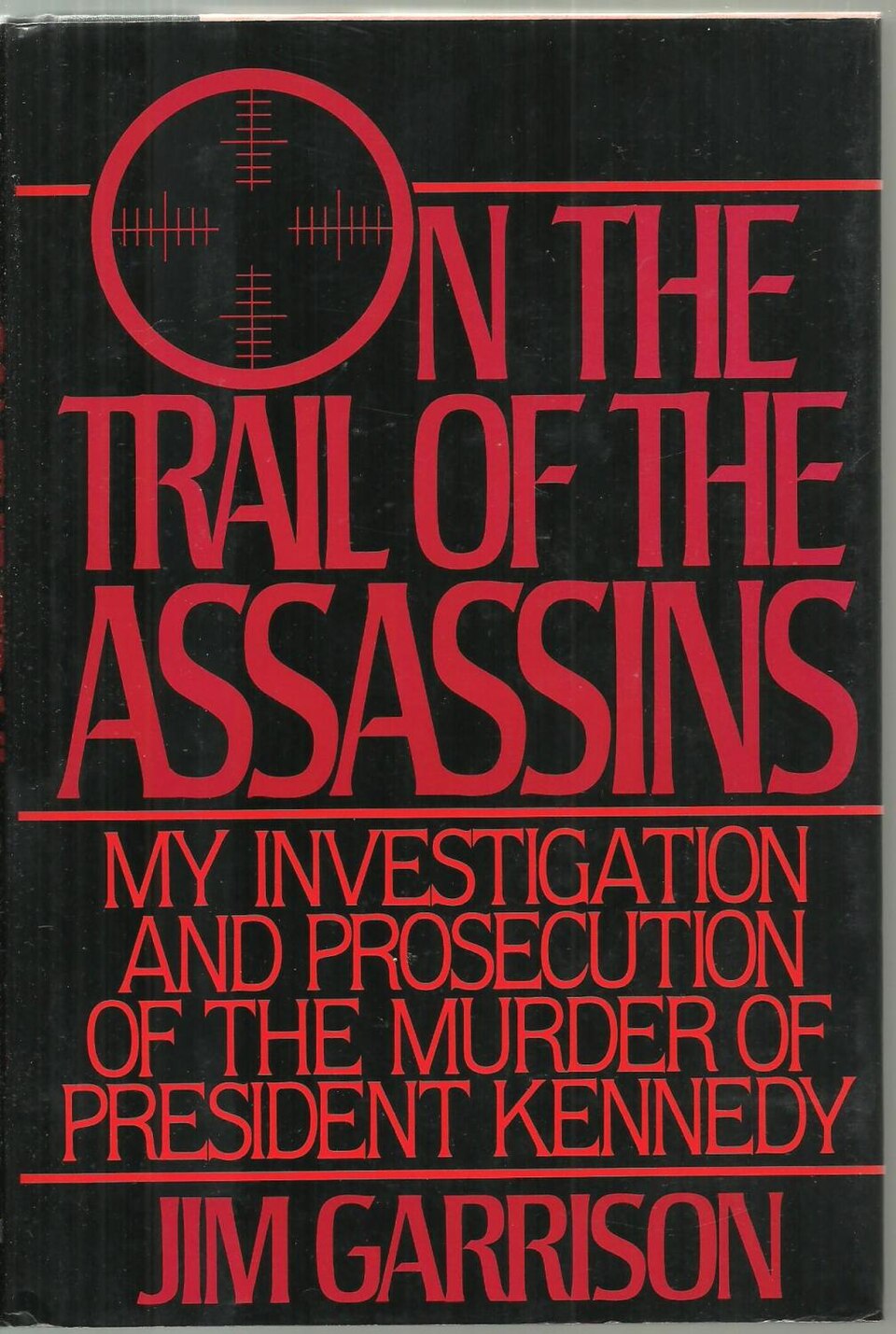
On the Trail of the Assassins is a 1988 book by former New Orleans District Attorney (DA) Jim Garrison. Written a few years before his death, he looks back on his office's investi…
On the Trail of the Assassins is a 1988 book by former New Orleans District Attorney (DA) Jim Garrison. Written a few years before his death, he looks back on his office's investigation of the November 1963 assassination of John F.
On the Trail of the Assassins is a 1988 book by former New Orleans District Attorney (DA) Jim Garrison. Written a few years before his death, he looks back on his office's investigation of the November 1963 assassination of John F. Kennedy in Dallas. Garrison became involved in the case because the accused assassin, Lee Harvey Oswald, had spent the summer of 1963 in New Orleans. In the book, Garrison charts his own transformation from accepting the official account of what occurred in Dallas, to believing that members of the U.S. intelligence community "were responsible for the assassination and had carried it out in order to stop President Kennedy's efforts to break with Cold War foreign policy."
The book details how his DA office assembled what they felt was compelling evidence of a plot to kill JFK, and were preparing in early 1967 to bring charges against two alleged co-conspirators based in New Orleans: David Ferrie and Clay Shaw. When Ferrie died suddenly before he could be indicted, Garrison narrowed his prosecution to Shaw. Garrison goes on to describe what he regards as systematic government obstruction, including placement of undercover agents on his DA team, to sabotage his case. In what would be the only criminal trial for John Kennedy's murder, Shaw was acquitted in March 1969.
Upon its publication in late 1988, On the Trail of the Assassins sold moderately well. It then received a huge sales boost in 1991 when Oliver Stone's film JFK credited Garrison's book as one of its primary sources.
Background
On the Trail of the Assassins is a retelling of the investigation and unsuccessful prosecution of Clay Shaw. But Garrison also weaved in personal recollections, which turned the book into a memoir as well as an attack on the Warren Commission's lone-gunman theory. He asserts in the Introduction that unlike authors of the hundreds of other JFK assassination books, he was not just a critic "analyzing the dry evidence" of the case; he was "a participant, a prosecutor and an investigator."
In an early manuscript draft, Garrison told the story from a third-person point of view. His editor Zachary Sklar (who is thanked at the start of the Acknowledgements) urged Garrison to recast the book in the first person to make it more of a memoir. Garrison eventually agreed to the change and, as James DiEugenio observes, "I think most people today would say that was a good choice." To emphasize the autobiographical dimensions of the story, the subtitle of the first edition was: "My Investigation and Prosecution of the Murder of President Kennedy". In a later edition, the subtitle was reworded as "One Man's Quest to Solve the Murder of President Kennedy".
Garrison had to write portions of the book from memory because he was unable to access many of his office records, including grand jury transcripts (his successor as New Orleans DA, Harry Connick Sr., had ordered all of Garrison's DA records to be burned). As a consequence, there are inaccuracies in Trail, according to Garrison biographer Joan Mellen. For example, she says it was not U.S. Senator Russell Long who first prompted Garrison to question the Warren Report; it was Congressman Hale Boggs (D-LA), a member of the Warren Commission, who privately expressed misgivings to Garrison in March 1964.
Mellen notes that before selecting "On the Trail of the Assassins", Garrison contemplated other titles: The Execution; The War Machine; A Game of Kings; Coup D'Etat; and A Farewell to Justice. He was using the latter title when he shopped the book around in the mid-1980s. A Farewell to Justice was rejected by twenty publishers prior to its acceptance by Sheridan Square Press.
Garrison dedicates the book to members of his DA staff in the 1960s—Frank Klein, Andrew Sciambra, James Alcock, Louis Ivon, D'Alton Williams, Alvin Oser, and Numa Bertel—who he says "never stopped fighting to bring out the truth. They just ran out of time."
Description
The book opens on Friday, November 22, 1963, when Garrison heard the shocking news from Dallas. After news bulletins reported that Oswald lived in New Orleans in mid-1963, Garrison convened an emergency Sunday meeting with staff members. He asked them to check all possible associates of Oswald. They soon learned that the accused assassin was seen around town that summer with David Ferrie, a colorful local character known as an expert pilot and avid anti-communist. An assistant DA also heard that on November 22, Ferrie embarked on a lengthy driving trip to Texas, through a heavy thunderstorm, supposedly to go ice skating. On Monday, Garrison brought Ferrie in for questioning, listened to a confusing rationale for the ice skating trip, and then ordered his investigators to take Ferrie to the police station, to be booked and held in jail for FBI questioning.
Garrison says he initially had no reason to doubt the "Oswald-did-it" narrative being explained to the American public by the media, FBI, and Warren Commission. He was himself an ex-FBI agent with deep respect for the Bureau. He traces his "awakening" to a chance conversation with Louisiana's Sen. Russell Long in autumn of 1966. The subject of JFK's assassination arose, and Long said, "Those fellows on the Warren Commission were dead wrong. There's no way in the world that one man could have shot up Jack Kennedy that way." That conversation prompted Garrison to want to educate himself about the case. He read the 26 volumes of Warren Commission Hearings and Exhibits, and found what he believed were numerous contradictions, "promising leads that were never followed up", and conclusions that did not comport with the evidence. He opted to launch his own investigation.
He began by going to 544 Camp Street, which Oswald stamped on leaflets he distributed for the pro-Castro Fair Play for Cuba Committee (FPCC). Oswald had made the New Orleans TV news in August 1963 when he was arrested for fighting with anti-Castro Cubans who objected to his passing out FPCC leaflets. Garrison noticed that a