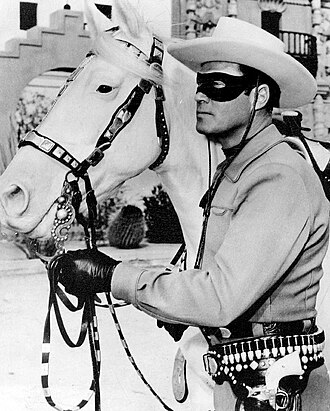
George W. Trendle retained the title of producer, although he recognized that his experience in radio was not adequate for producing the television series. For this, he hired veteran MGM film producer Jack Chertok. Chertok served as the producer for the first 182 episodes.
The first 78 episodes were produced and broadcast for 78 consecutive weeks without any breaks or reruns. Then the entire 78 episodes were shown again before any new episodes were produced. All were shot in Kanab, Utah and California. Much of the series was filmed on the former Iverson Movie Ranch in Chatsworth, California, including the opening sequence to each episode, in which the cry of "Hi-yo Silver" is heard before the Lone Ranger and Silver gallop to a distinctive rock and Silver rears up on his hind legs. The rock seen next to Silver is known as Lone Ranger Rock and remains in place today near the site of the Iverson movie ranch.
When it came time to produce another batch of 52 episodes, there is speculation of a wage dispute with Clayton Moore (although he stated in his autobiography I Was That Masked Man that he never really knew exactly why he was dismissed), and John Hart was hired to play the role of the Lone Ranger. Once again, the 52 new episodes were aired in sequence followed by 52 weeks rerunning them. Despite expectations that the mask would make the switch workable, Hart was not accepted in the role, and his episodes were not seen again until the 1980s.
At the end of the fifth year of the television series, Trendle sold the Lone Ranger rights to Jack Wrather, who bought them on August 3, 1954. Wrather immediately rehired Clayton Moore to play the Lone Ranger, and another 52 episodes were produced. Once again, they were broadcast as a full year of new episodes followed by a full year of reruns.
The final season saw a number of changes, including an episode count of 39, which had become the industry standard. Wrather invested money from his own pocket to film in color, although ABC telecast only in black and white. Wrather also went outdoors for action footage. Otherwise, the series was mostly filmed on a studio sound stage. Another big change, not readily detectable by the viewers, was replacing with producer Sherman A. Harris. By this time, Chertok had established his own television production company and was busy producing other programs.