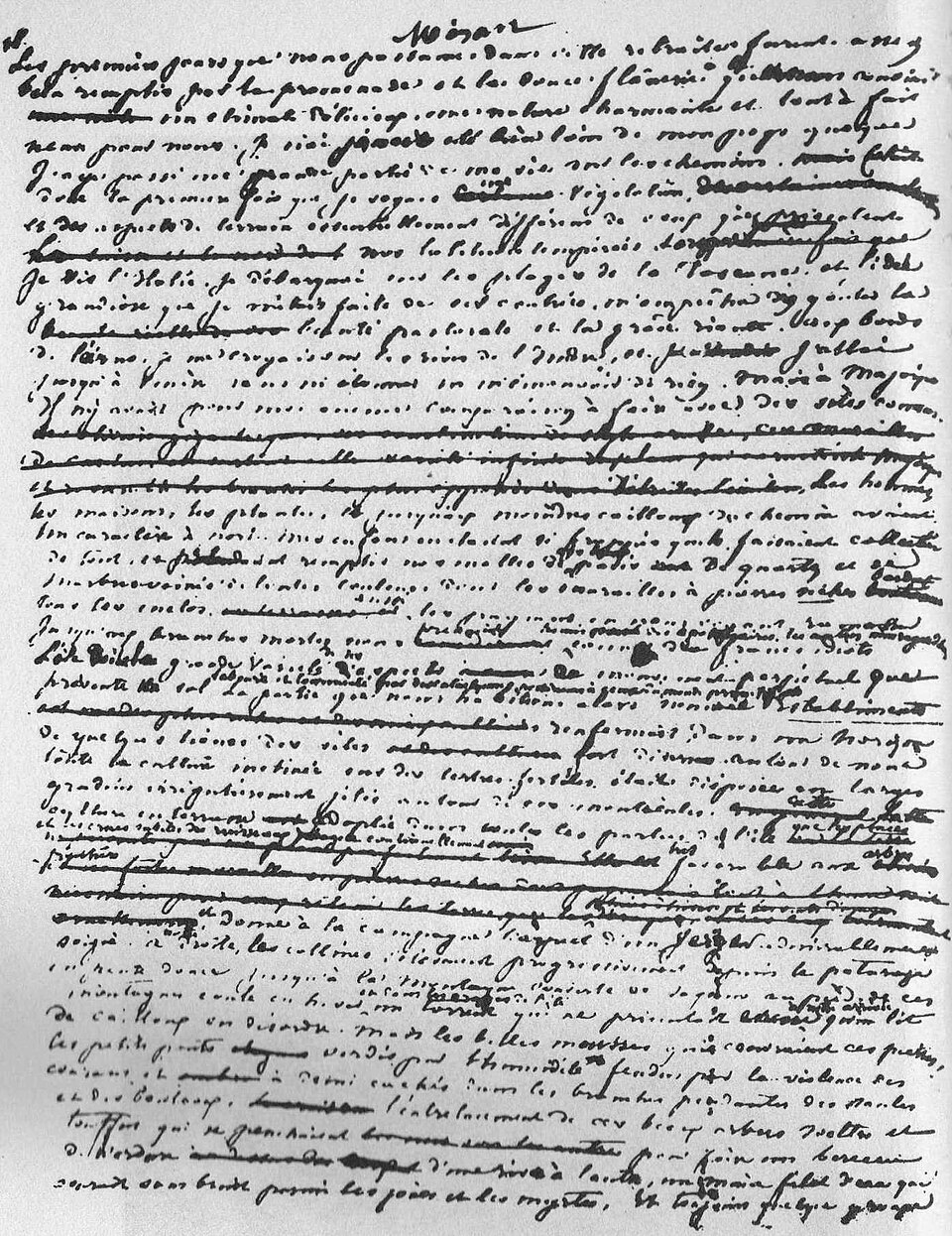
A Winter in Majorca is an autobiographical travelogue written by George Sand, at the time in a relationship with Frédéric Chopin. Although published in 1842, it appeared for the f…
A Winter in Majorca (whose original title in French is Un hiver à Majorque) is an autobiographical travelogue written by George Sand, at the time in a relationship with Frédéric Chopin. Although published in 1842, it appeared for the first time in 1841 in the Revue des deux Mondes.
A Winter in Majorca is an autobiographical travelogue written by George Sand, at the time in a relationship with Frédéric Chopin. Although published in 1842, it appeared for the first time in 1841 in the Revue des deux Mondes.
Read more about this topic
A Winter in Majorca (whose original title in French is Un hiver à Majorque) is an autobiographical travelogue written by George Sand, at the time in a relationship with Frédéric Chopin. Although published in 1842, it appeared for the first time in 1841 in the Revue des deux Mondes.
In it, Sand relates the details of her trip and stay with Chopin on the island of Majorca, due to the illness of the pianist. Sand, Chopin, and Sand's two children stayed in the Valldemossa Charterhouse for a few months, from the end of 1838 until February 1839, during which time they hoped that Chopin's tuberculosis would improve. However, the winter was hard and his health did not improve and so they soon returned to Barcelona and eventually to Marseille and then Paris.
Sand stretches the genre of autobiographical travelogue toward a more literary work, relating the experience of men and women, the experience of nature, and the experience of oneself during her encounter with the island of Majorca. Clearly irritated by the material conditions of this voyage, Sand expresses her clear intolerance towards the islanders, as many commentators, such as the writer Llorenç Villalonga, would later point out.
Travelogue as literary genre
At the time of writing Un hiver à Majorque, the genre of the travelogue was in full development. The first works of George Sand, Voyage en Auvergne and the unfinished Voyage en Espagne, were already travelogues. She had written Lettres d'un voyageur a few years before, a work which she nodded to in the preface of Un hiver by describing it as a "Letter from an ex-traveler to a settled friend".
The travelogue is a flexible genre, and Un hiver is also the analysis of a political situation. Since 1835 George Sand had been looking for a political system capable of improving human life. She is interested in the person and ideas of Michel de Bourges, the socialist theories of Pierre Leroux and those of Claude-Henri de Rouvroy de Saint-Simon, among others. Saint-Simon's work described the importance of the economy, a recurring theme in Un hiver. Sand's humanitarian ideal is developed clumsily in Un hiver, but will be further developed in her later novel Consuelo. In 1833, the Spanish reign of Isabella II began, characterized by political tensions, a strong military power, and no major economic difficulties. Liberal progressivism gradually established itself under the direction of Espartero. When George Sand arrived in Majorca, the writer's lessons praising free enterprise were a little excessive, but in line with her concern for social justice, efficiency and the fair distribution of wealth. She wrote, "[t]he Majorcans are not yet ripe enough for a revolution". These reflections were her inspiration, however, and her dialogue in an "Inquisition convent" conveys a more open understanding of the island's realities and perspectives.
As a literary work Un hiver relates the experience of the men and women she met on the island, the experience of nature and the experience of herself. As a conduit for the experience of the inhabitants the novel is a failure: steeped in the ideas of the French Revolution and the Enlightenment, George Sand did not understand the Majorcans. She shows arrogance and disdain for their traditions as well as for their daily life. Sand relates that the experience of nature gave her a strong creative energy, which Chopin apparently also experienced. However, she would write Un hiver later, after her return to France, piqued by the publication of a Majorca travelogue written by Jean-Joseph Bonaventure Laurens. When relating her experience of herself, Sand blurred or erased everything concerning her life with Chopin; departing from the autobiographical genre. Rather, she relates her inner experience, consisting of solitude in a sublime landscape. She addresses the nature of religious experience, drawing on the ideas of Manuel Marliani. She reflects on the demands of household chores, describing all the logistics and all the effort they require.
Intolerance and revenge
Sand espoused freedom and progress, values she represented for her admirers and supporters.
However, in this work Sand delivers a full-throated attack on the Majorcans. Her mood reflected in part the hostile attitude of the natives towards a foreign and free woman. But she does not hesitate to refer to the Majorcans as monkeys:
Nous avions surnommé Majorque l’île des Singes, parce que, nous voyant environnés de ces bêtes sournoises, pillardes et pourtant innocentes, nous nous étions habitués à nous préserver d’elles sans plus de rancune et de dépit que n’en causent aux Indiens les jockos et les orangs espiègles et fuyards.
We had nicknamed Majorca the Island of Monkeys, because, seeing ourselves surrounded by these sly, plundering and yet innocent beasts, we had become accustomed to protecting ourselves from them without any more rancor and spite than the mischievous and fugitive jockos and orangs cause the Indians.
Sand tells the reader that they initially wanted to write a story, but ultimately delivered "personal impressions". Sand's haughty attitude towards the Spanish is constant:
quand nous fuyons le foyer d’action pour chercher l’oubli et le repos chez quelque peuple à la marche plus lente et à l’esprit moins ardent que nous, [...]
When we flee from the center of action to seek oblivion and rest among some people whose march is slower and whose spirit is less ardent than ours, [...]
Sand constantly reproaches them for their religious feelings, and expresses antisemitism:
le juif est inexorable, mais patient. Il fait des concessions, il affecte une grande tolérance, il donne du temps, car il poursuit son but avec un génie diabolique: dès qu’il a mis sa griffe sur une propriété, il faut que pièce à pièce elle vienne toute à lui, et son intérêt est de se rendre nécessaire jusqu’à ce que la dette ait atteint la valeur du capital. Dans vingt ans il n’y aura plus de seigneurie à Majorque. Les juifs pourront s’y constituer à l’état de puissance, comme ils ont fa