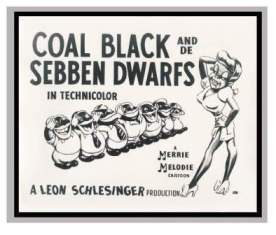
Coal Black and de Sebben Dwarfs is a 1943 Merrie Melodies animated cartoon directed by Bob Clampett. The short was released on January 16, 1943.
The film is an all-black parody of the Brothers Grimm fairy tale Snow White, known to audiences at the time from the popular 1937 Walt Disney animated feature Snow White and the Seven Dwarfs. The stylistic portrayal of the characters is an example of "darky" iconography, which was widely accepted in American society at the time. As such, it is one of the most controversial cartoons in the classic Warner Brothers library, being one of the Censored Eleven. The cartoon has been rarely seen on television since it was pulled from circulation in 1968 and has never been officially released on home video.
History
In this version of the story, all of the characters are black, and speak all of their dialogue in rhyme. The story is set during World War II in the United States, and the original tale's fairy tale wholesomeness is replaced in this film by a hot jazz mentality and sexual overtones. Several scenes unique to Disney's film version of Snow White, such as the wishing-well sequence, the forest full of staring eyes, and the awakening kiss, are directly parodied in this film. The film was intended to have been named So White and de Sebben Dwarfs, which producer Leon Schlesinger thought was too close to the original film's actual title, and had changed to Coal Black and de Sebben Dwarfs.
Clampett intended Coal Black as both a parody of Snow White and a dedication to the all-black jazz musical films popular in the early 1940s (like Cabin in the Sky and Stormy Weather). In fact, the idea to produce Coal Black came to Clampett after he saw Duke Ellington's 1941 musical revue Jump for Joy, and Ellington and the cast suggested Clampett make a black musical cartoon. The Clampett unit made a couple of field trips to Club Alabam, a black club in the Los Angeles area, to gain a feel for the music and the dancing, and Clampett cast popular radio actors as the voices of his three main characters. The main character, So White, is voiced by Vivian Dandridge, sister of actress Dorothy Dandridge. Darrel Payne voices the Wicked Queen. Leo Watson is the voice of "Prince Chawmin'". The other characters, including the Sebben Dwarfs, are voiced by veteran Warner Bros. voice artist Mel Blanc.
Originally, Clampett wanted an all-black band to score the cartoon, the same way Max and Dave Fleischer had Cab Calloway and His Orchestra score the Betty Boop cartoons Minnie the Moocher, The Old Man of the Mountain, and their own version of Snow White. However, Schlesinger refused, and the black band Clampett had hired, Eddie Beals and His Orchestra, only recorded the music for the final kiss sequence. The rest of the film was scored, as was standard for Warner Bros. cartoons, by Carl W. Stalling.
Plot
Coal Black opens in front of a fireplace with a red-tinted silhouette of a large woman holding a young child in her lap. The little black girl asks her "mammy" to tell her the story of "So White an' de Sebben Dwarfs". "Mammy" begins:
Well, once there was a mean ol' queen. And she lived in a gorgeous castle. And was that ole' gal rich! She was just as rich as she was mean! She had everythang!
The rich, Wicked Queen then appears, depicted as a "food hoarder", with a large repository of items that were on ration during World War II: rubber, sugar, gin ("Eli Whitney's Cotton Gin" brand) and more. After stuffing her face with candies (from a box marked "Chattanooga Chew-Chews"), she asks her magic mirror to "send her a prince 'bout six feet tall", but when Prince Chawmin' arrives in his flashy car, he declares "that mean ol' queen sho' is a fright / but her gal So White is dyn-a-mite!" Finding So White hard at work doing the laundry, the prince takes her hand and the two swing out into a wild jitterbug. The queen sees this, calls, and hires "Murder, Incorporated" to "black-out So White". She eats the phone in frustration, as the assassins immediately arrive in a panel truck that advertises, "We rub out anybody for $1.00; Midgets: 1/2-price; Japs: free".
The assassins kidnap the girl, but after several unseen "favors" which make the would-be assassins very happy, slowly set her free in the woods unharmed. Just before they drive off, the assassins are seen covered with So White's lipstick all over their heads, an innuendo as to exactly how she earned her freedom. Wandering through the woods by herself, So White discovers a dwarf who hoots like an owl. In fright, she immediately lights up a lighter and reveals one of the dwarfs holding a rifle. He asked, "Who goes there, Friend or Foe?" She then runs the answer into the Sebben Dwarfs, seven diminutive army men in uniform who marched and sing "We're in the Army Now", with two dwarfs singing "it takes us cats ... to catch them rats" at the end, and So White declares in a 1940s swing-style singing voice, "I'm wacky over khaki now!" They immediately recruit her as their squad cook, and she spends her days "fryin' up eggs an' pork chops too" (to the tune of "Five O'Clock Whistle") for the hungry soldiers, as a sign which hangs from her outdoor antique stove reads, "Keep 'em frying", as a sendup of the World War II slogan, "Keep 'Em Flying".
Meanwhile, the queen has learned that So White is still alive, and pumps an apple full of poison (turning the red apple into a green apple) to give it to the girl and kill her. Four worms escape the apple as the queen injects it with poison, one carrying a sign that says "Refoogees", and one other thinks it smells like Limburger. The queen disguises herself as an old peddler woman as she arrives at the Sebben Dwarfs' camp, reveals a Jimmy Durante reference, and gives So White the poisoned apple (who immediately forced her to eat it). She gobbled the entire apple down. One of the seven dwarfs (modeled on the "Dopey" dwarf in Disney's film) sees her lying on the ground and alerts the others that the queen has caused So White t