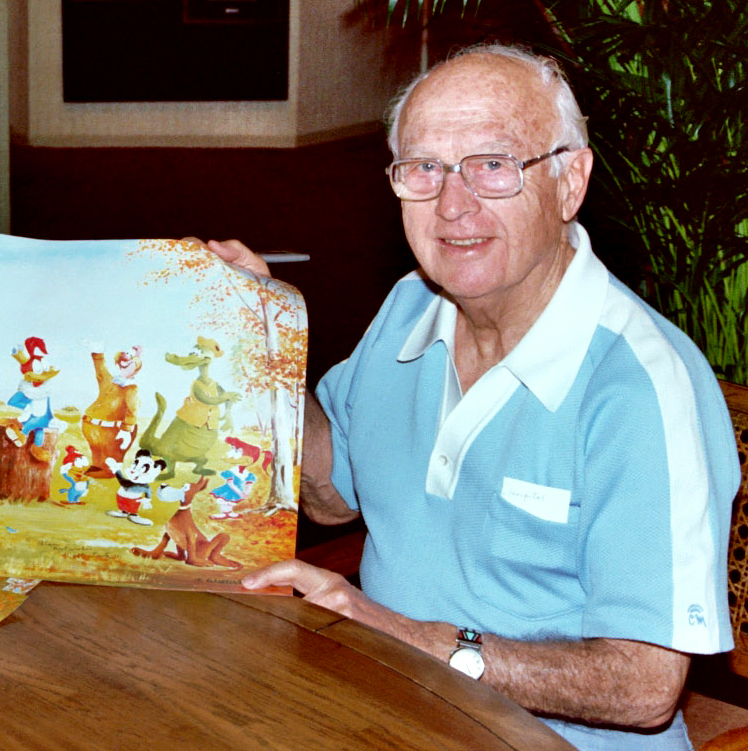
Walter Lantz began his career at the art department of William Randolph Hearst's New York American during the 1910s, having his start in the cartoon industry at Hearst's International Film Service, which in 1918 transferred its entire staff to Bray Productions. By the mid-1920s, Lantz was directing (and acting in) the studio's top cartoon, Dinky Doodle, also becoming a producer as Bray attempted to compete with Hal Roach and Mack Sennett by making live-action comedies. Bray Productions closed shop in 1928, and Lantz moved to Hollywood, trying to start a studio while trying to make a living in a succession of odd jobs, including driving Universal Pictures owner Carl Laemmle's limousine. The chauffeur job also landed Lantz a job at Winkler Pictures, which, under producer Charles Mintz, produced the Oswald the Lucky Rabbit cartoons for Universal Pictures. Lantz became one of the Oswald series' directors alongside Hugh Harman and Rudolf Ising, after series creators Walt Disney and Ub Iwerks left the company.
The popularity of the Oswald series began to fall because of a decline in quality, alongside a series of heated confrontations between Mintz and Harman & Ising, and then between Laemmle and Harman & Ising, which led Laemmle to fire Mintz and terminate the Winkler contract in early 1929. Laemmle was now looking for someone to run a new in-house animation studio for Universal, and Walter Lantz won the job in a poker game with Laemmle. He reunited with his Bray colleague and former Winkler director Bill Nolan, who led the newly founded studio with him. The first "Oswald" cartoon produced by Lantz at the new Universal Cartoon Studios was Race Riot, released on September 2, 1929. The first animators for the studio included Winkler veterans Rollin Hamilton, Tom Palmer and "rubber-hose" pioneer Bill Nolan. Bert Fiske scored the first cartoons, having done this for the few Winkler sound "Oswalds". Additions to the staff included Pinto Colvig and Tex Avery.
The earliest Lantz cartoons from 1929 were built around set plots and stories, in the tradition of the earlier Disney and Winkler shorts. The conversion of Oswald cartoons into musicals was a different matter, but by mid-1930, Lantz and his staff achieved this goal. In the process however, Oswald's personality became less consistent. It could and did change drastically to fit a particular gag. Lantz's musical directors changed as well. To replace David Broekman, Lantz brought in James Dietrich, a member of the Paul Whiteman Orchestra, making the jazz-era sound of the 1920s a quintessential element in the early Lantz cartoons. He remained as the permanent studio musical director until 1937. Lantz and Nolan worked in a character called "Fanny the Mule" for a 13-cartoon series announced by Laemmle in early 1930, but these cartoons were never produced.