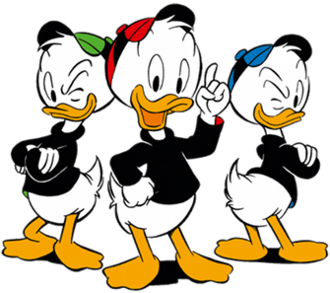
Huey, Dewey, and Louie Duck are triplet cartoon characters created by storyboard artist and screenwriter Carl Barks for The Walt Disney Company from an idea proposed by cartoonist…
Huey, Dewey, and Louie Duck are triplet cartoon characters created by storyboard artist and screenwriter Carl Barks for The Walt Disney Company from an idea proposed by cartoonist Al Taliaferro. They are the nephews of Donald Duck and the grand-nephews of Scrooge McDuck.
Huey, Dewey, and Louie Duck are triplet cartoon characters created by storyboard artist and screenwriter Carl Barks for The Walt Disney Company from an idea proposed by cartoonist Al Taliaferro. They are the nephews of Donald Duck and the grand-nephews of Scrooge McDuck. Like their maternal uncles, the brothers are domestic anthropomorphic white ducks with yellow-orange bills and feet. The boys are sometimes distinguished by the color of their shirts and baseball caps (with Huey wearing red clothing, Dewey wearing blue clothing, and Louie wearing green clothing). They appeared in many Donald Duck animated shorts, as well as in the television show DuckTales and its reboot, but the comics remain their primary medium.
While the boys were originally created as troublemakers to provoke Donald's famous easily triggered temper, in later appearances, beginning especially in the comic books stories by Carl Barks, they are shown growing to be heroes in their own right and valuable assets to him and Uncle Scrooge on their adventures. All three of the triplets are members of a fictional scouting organization called the Junior Woodchucks.
Origins
Al Taliaferro, the artist for the Silly Symphony comic strip, proposed the idea for the film Donald's Nephews, so that the studio would have duck counterparts to Morty and Ferdie Fieldmouse, the nephews of Mickey Mouse. The Walt Disney Productions Story Dept. on February 5, 1937, sent Taliaferro a memo recognizing him as the source of the idea for the planned short.
The memo indicated, “we have decided to actually put a story crew to work on Donald’s Nephews.” With the short already in production more than eight months before the boys' Silly Symphonies comic strip debut (on October 17, 1937), the animation studio's model sheet and storyline would have been Taliaferro and writer Ted Osborne's frame of reference for the comic strip. Because the strip was an adaptation of the animated shorts, it could utilize ideas from films still in production (DuckTales reversed this, being a TV adaptation of the comics). Similarly, Barks' Junior Woodchuck prototype, Good Scouts, was released three months after identical scouting uniforms were introduced by Taliaferro and Bob Karp in the comic strip.
The nephews being triplets who finished each other's sentences was developed by Carl Barks, the screenwriter of Donald's Nephews, for whom Happy Hooligan, a comic strip that featured such triplets, was a childhood influence. This characteristic appeared for the first time at the end of the film, as the boys parted with Donald. In the comic strip, it was first implemented a week after the film's release.
The nephews' names were devised by Disney gag man Dana Coty, who took them from Huey Long, Thomas Dewey, and Louis Schmitt, a Disney Studio animator. In translation, the nephews' names often follow the repetition (parachesis) of their names in English, for example: Tupu, Hupu and Lupu (Finnish) and Hyzio, Dyzio and Zyzio (Polish).
Character background
Huey, Dewey, and Louie are the sons of Donald's sister Della Duck; in Donald's Nephews, their mother is instead named Dumbella. In the original theatrical shorts, they were originally sent to visit Donald for only one day; in the comics, the three were sent to stay with Donald on a temporary basis, until their father came back from the hospital (the boys ended up sending him there after an attempted practical joke of putting firecrackers under his chair). In both the comics and animated shorts, the boys' parents were never heard from or mentioned again after these instances, with the boys ending up permanently living with Donald. All four of them live in the fictional city of Duckburg, in the fictional state of Calisota.
In the theatrical shorts, Huey, Dewey, and Louie often behave in a rambunctious and mischievous manner, and they sometimes commit retaliation or revenge on Donald. In the early Barks comics, the ducklings were still wild and unruly, but their character improved considerably due to their membership in the Junior Woodchucks and the good influence of Grandma Duck. As the boys mature, they prefer to assist Donald and Scrooge in the adventure at hand. They occasionally interact with Daisy Duck’s nieces, April, May, and June.
Colors of Huey, Dewey, and Louie's outfits
In early comic books and shorts, the caps of Huey, Dewey, and Louie were colored randomly, depending on the whim of the colorist. On a few occasions until 1945 and most cartoons shortly afterward, all three nephews wore identical outfits (most commonly red).
It was not until the 1980s when it became established that Huey is dressed in pink then in 1982 changed to red, Dewey in black then in 1982 changed to blue, and Louie in brown then in 1982 changed to green. Disney's archivist Dave Smith, in "Disney A to Z", said, "Note that the brightest hue of the three is red (Huey), the color of water, dew, is blue (Dewey), and that leaves Louie, and leaves are green (Louie)."
A few random combinations appear in early Disney merchandise and books, such as orange and yellow. Another combination that shows up from time to time is Huey in blue, Dewey in green, and Louie in red. In-story, this inconsistency is explained away as a result of the ducklings borrowing each other's clothes. The trio have often been depicted wearing indistinguishable black shirts (or the same dark color).
The Don Rosa story An Eye for Detail (1997) was based around Donald spending so much time trying to tell his three nephews apart that he developed a heightened sense of sight.
Voices
Clarence Nash, Donald's voice actor, voiced the nephews in the cartoon shorts, making their voices just as duck-like (and thereby difficult to understand) as Donald's. Huey, Dewey, and Louie were all voiced by Russi Taylor in DuckTales. In Quack Pack, they were voiced by Jeannie Elias, Pamela Segall, and Elizabeth Daily, respectively. Tony Anselmo voiced the characters in Donald Duck, The Star-Struck (1986), Down and Out with Donald Duck (1987), Mickey Mouse Works, House of Mouse, and the Have a