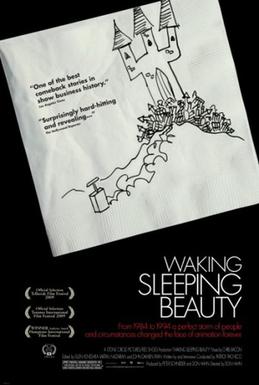
The documentary is narrated by animator and film producer Don Hahn, with numerous audio interviews from company animators and executives.
The documentary begins in the early 1980s, when The Walt Disney Company was led by Walt Disney's son-in-law Ron W. Miller. Many new animators had joined the company after graduating from CalArts, but they were hired in a time when animation was considered a dying art. Roy E. Disney, Walt's nephew and son of Disney co-founder Roy O. Disney, resigned from the company during a corporate takeover attempt by Saul Steinberg, which led to Miller's ousting. Roy returned to the company as vice-chairman of the board of directors, and chairman of the animation department. Roy installed Michael Eisner and Frank Wells, respectively, as the company's new CEO and President.
Eisner hired Jeffrey Katzenberg as head of the film division, but he proved to be a controversial figure, moving the animation department to an off-site location in Glendale, California. Roy hired Peter Schneider to be President of Walt Disney Feature Animation, who helped modernize the animation process. Losing at the domestic U.S. box office to many films released by Don Bluth, a former studio animator who left on his 42nd birthday in 1979 to found his namesake company, Disney began producing new animated features to be released at a pace of one per year. The company also began releasing its classic films in the new home video videocassette formats. A gong show in the company led to the green-lighting of numerous film projects. The production of Who Framed Roger Rabbit, though expensive for Disney, proved to be a huge financial success, along with Oliver & Company.
The Disney Renaissance, which lasted from 1989 to 1999, began with The Little Mermaid. The soundtrack was composed and written by Howard Ashman and Alan Menken, who also composed the music for Beauty and the Beast; Menken later composed the music for Aladdin. Ashman's involvement in The Little Mermaid and Beauty and the Beast aided in both being box office successes; winning two Academy Awards each, for Best Original Song and Best Original Score. However, Ashman died on March 14, 1991, and never saw a chance to see the completed film. The Rescuers Down Under utilized the new CAPS system, which blended traditional and computer animation together, but the film was a financial disappointment.