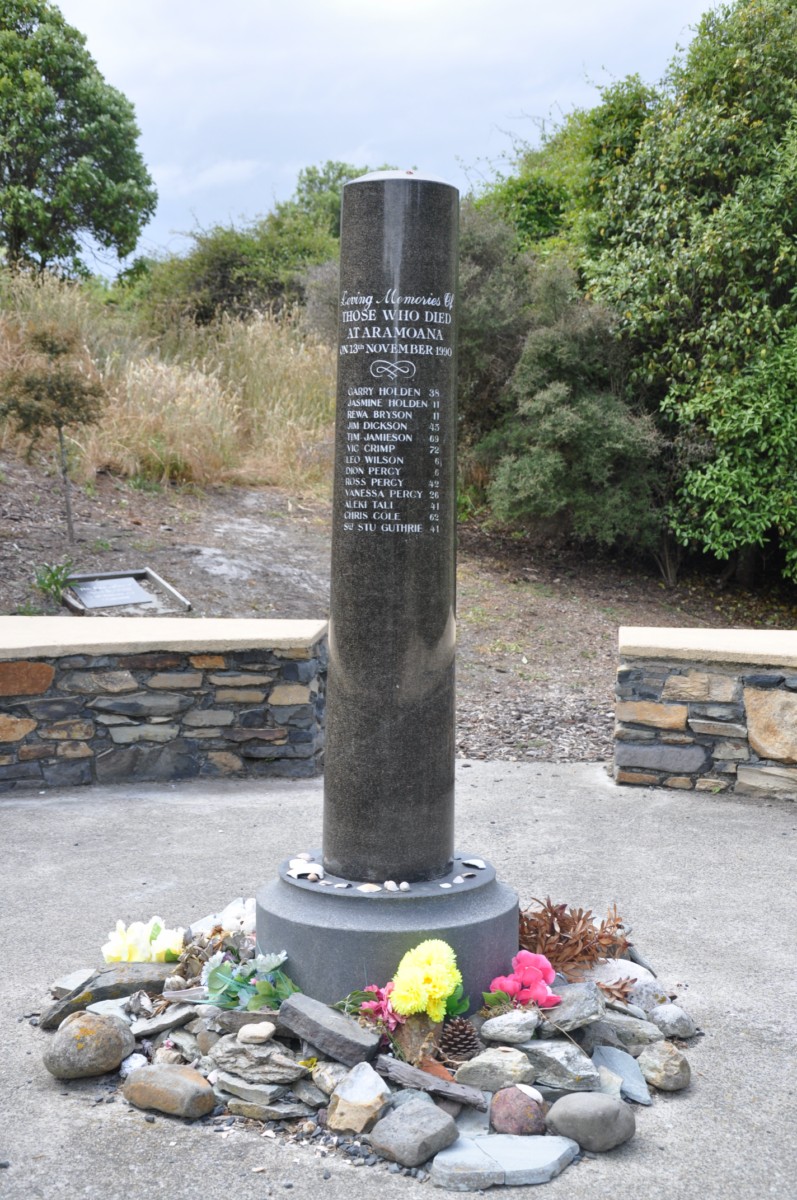
The Aramoana massacre was a mass shooting that occurred on 13 November 1990 in the small seaside township of Aramoana, northeast of Dunedin, New Zealand. Resident David Gray kille…
The Aramoana massacre was a mass shooting that occurred on 13 November 1990 in the small seaside township of Aramoana, northeast of Dunedin, New Zealand. Resident David Gray killed 13 people, including local police Sergeant Stewart Guthrie, one of the first responders to the reports of a shooting, after a verbal dispute between Gray and his next-door neighbour.
The Aramoana massacre was a mass shooting that occurred on 13 November 1990 in the small seaside township of Aramoana, northeast of Dunedin, New Zealand. Resident David Gray killed 13 people, including local police Sergeant Stewart Guthrie, one of the first responders to the reports of a shooting, after a verbal dispute between Gray and his next-door neighbour. After a careful house-to-house search the next day, police officers led by the Anti-Terrorist Squad (now known as the Special Tactics Group) located Gray, and shot and injured him as he came out of a house firing from the hip. He died in an ambulance while being transported to hospital.
At the time, the incident was the deadliest mass shooting in New Zealand's history; it was surpassed 28 years later by the Christchurch mosque shootings. After the shootings, sweeping changes were made to New Zealand's firearms legislation in 1992, including 10-year photographic licences and tight restrictions on military style semi-automatic firearms.
Initial incident
The massacre began on 13 November at 7:30 p.m. when Gray confronted neighbour Garry Holden about one of Holden's daughters wandering onto his property. After the confrontation, Gray went into his house, retrieved a Norinco 84S semi-automatic rifle, walked outside and shot Holden multiple times in his chest, before walking over to him and shooting him fatally through the head.
Nearby were three young girls: Holden's two daughters, Chiquita and Jasmine, and his girlfriend Julie Ann Bryson's daughter, Rewa. The girls ran into Holden's house to hide as Gray walked onto Holden's property. He quickly found Chiquita and shot her in the chest and arm with a Squires and Bingham Model 16 .22-calibre semi-automatic sporting rifle, with one of the bullets lodging in her abdomen. Shortly after shooting her, Gray found the other two girls and killed them.
Chiquita, who managed to escape by running out of the back door, fled past her father's body to Bryson's nearby house, while Gray set the Holden house on fire. Bryson, realising that Rewa and Jasmine were still in the Holden house, drove her van there with Chiquita in an attempt to save the girls. Gray shot at the van as it passed the house, which was by then ablaze.
Gray started shooting indiscriminately, targeting a utility vehicle full of locals who had seen the Holden house burning and stopped to help. He first shot Vanessa Percy several times in the back as she ran down the street in terror; she died a few hours later at the scene. He then turned towards three children. He killed the two boys, Leo Wilson and Dion Percy. The boys' sister, Stacey, was critically injured by a bullet to her abdomen, but survived. Ross Percy, the children's father, who had been driving them home after a day fishing when they saw the fire, was fatally shot in the head. Next, Aleki Tali was killed. Gray then entered the home of Tim Jamieson, killing him and another elderly local, former Green Island mayor Vic Crimp. The next victim was James Dickson, who was looking for his dog. Eva Helen Dickson, James' mother, and neighbour Chris Cole went into the road to see what the noise was. Gray shot at both of them, wounding Cole who was in a phone booth calling the police and forcing Dickson to dive for cover. Dickson, who had recently had a hip replacement and was unable to walk without assistance, pulled herself along on her stomach using her arms and feet in a ditch to get inside and called 111 (the emergency telephone number). She then crawled back to Cole to tell him help was coming. By this stage, it was getting dark and the dispatcher advised her to stay inside. Dickson later received the George Medal for bravery. Help arrived too late for Cole, who died in the hospital.
First responders
The first armed police officer to arrive was Sergeant Stewart Guthrie, officer in charge of Port Chalmers police station and an NCO in the Armed Offenders Squad (AOS). He came armed with a Smith & Wesson Model 10 police revolver (front-line police in New Zealand do not routinely carry firearms). Guthrie enlisted the help of Constable Russell Anderson, who had arrived a short time earlier with the fire service. He armed Anderson with a rifle belonging to a resident. With darkness approaching, the pair moved through the township to Gray's house, where Guthrie deployed the constable to cover the front while he moved to cover the more dangerous rear of the house. Detective Paul Alan Knox and two constables arrived, starting the first step of the "cordon, contain, appeal" standard police strategy for armed offenders.
Guthrie observed Gray and relayed his movements inside the house to the police communications centre. After some time he lost sight of the gunman, and advised the detective to warn everyone to be alert. Anderson spotted Gray coming out the front of his property and issued a challenge, at which the gunman retreated quickly, passing through the rear of his property. Taking cover in the sand dunes of a neighbouring crib, Guthrie encountered Gray coming out of the darkness. Yelling at the gunman to surrender, he fired a warning shot. Gray shouted, "Don't shoot!", leading Guthrie to believe he was surrendering. However, Gray suddenly fired several times, one shot striking Guthrie in the head, killing him instantly.
Minutes later the Dunedin branch of the AOS began to arrive and sealed off the township with a roadblock about 250 metres along the only road out of Aramoana, securing it with an armoured car. AOS units from Christchurch, Timaru, and Invercargill were called in for support. The situation was considered dangerous as Gray had a scoped rifle, making him potentially accurate at long range. By this point, the police had ordered that Gray was to be shot on sight – without a warning shot.
Anti-Terrorist Squad
Commissioner of Police John Jamieson authorised the Anti-Terrorist Squad (ATS) (now known as the Special Tactics Group (STG)), the specialist counter terrorist unit, to travel to Dunedin and locate Gray; group members were in