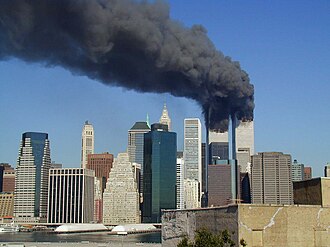
Terrorism, in its broadest sense, is the use of violence against non-combatants to achieve political or ideological aims. The term is used in this regard primarily to refer to int…
Terrorism, in its broadest sense, is the use of violence against non-combatants to achieve political or ideological aims. The term is used in this regard primarily to refer to intentional violence during peacetime or in the context of war against non-combatants.
Terrorism, in its broadest sense, is the use of violence against non-combatants to achieve political or ideological aims. The term is used in this regard primarily to refer to intentional violence during peacetime or in the context of war against non-combatants. There are several different definitions of terrorism, without universal agreement on the precise meaning of the term. Different definitions of terrorism emphasize its randomness, the aims are to generally instill fear and to seek a broader impact, beyond the immediate effect on the victims that suffered the attack.
Modern terrorism, evolving from earlier iterations, employs various tactics to pursue political goals, often leveraging fear as a strategic tool to influence decision makers. By targeting densely populated public areas such as transportation hubs, airports, shopping centers, tourist attractions, and nightlife venues, terrorists aim to instil widespread insecurity, prompting policy changes through psychological manipulation and undermining confidence in security measures.
The terms "terrorist" and "terrorism" originated during the French Revolution of the late 18th century, but became widely used internationally and gained worldwide attention in the 1970s during the Troubles in Northern Ireland, the Basque conflict and the Israeli–Palestinian conflict. The increased use of suicide attacks from the 1980s onwards was typified by the September 11 attacks in the United States in 2001. The Global Terrorism Database, maintained by the University of Maryland, College Park, has recorded more than 61,000 incidents of non-state terrorism, resulting in at least 140,000 deaths between 2000 and 2014.
Various organizations and countries have used terrorism to achieve their objectives. These include left-wing and right-wing political organizations, nationalist groups, religious groups, revolutionaries, and ruling governments. In recent decades, hybrid terrorist organizations have emerged, incorporating both military and political arms. State terrorism, with its institutionalized instrumentation of terror tactics through massacres, genocides, forced disappearances, carpet bombings and torture, is a deadlier form of terrorism than non-state terrorism.
Etymology
The term "terrorism" itself was originally used to describe the actions of the Jacobin Club during the "Reign of Terror" in the French Revolution. "Terror is nothing other than justice, prompt, severe, inflexible", said Jacobin leader Maximilien Robespierre. In 1795, Edmund Burke denounced the Jacobins for letting "thousands of those hell-hounds called Terrorists ... loose on the people" of France. John Calvin's rule over Geneva in the 16th century has also been described as a reign of terror.
The terms "terrorism" and "terrorist" gained renewed currency in the 1970s as a result of the Palestine Liberation Organization (PLO), the Irish Republican Army (IRA), Basque Homeland and Liberty (Euskadi Ta Askatasuna, ETA), and the operations of groups such as the Red Army Faction. Leila Khaled was described as a terrorist in a 1970 issue of Life magazine. A number of books on terrorism were published in the 1970s. The topic came further to the fore after the 1983 Beirut barracks bombings and again after the 2001 September 11 attacks and the 2002 Bali bombings.
Definition
No definition of terrorism has gained universal agreement. Challenges emerge due to the politicised and emotionally charged nature of the term, the double standards used in applying it, and disagreement over the nature of terrorist acts and limits of the right to self-determination. Harvard law professor Richard Baxter, a leading expert on the law of war, was a skeptic: "We have cause to regret that a legal concept of 'terrorism' was ever inflicted upon us. The term is imprecise; it is ambiguous; and above all, it serves no operative legal purpose."
Different legal systems and government agencies employ diverse definitions of terrorism, with governments showing hesitation in establishing a universally accepted, legally binding definition. The international community has been slow to formulate a universally agreed, legally binding definition of this crime, and has been unable to conclude a Comprehensive Convention on International Terrorism that incorporates a single, all-encompassing, legally binding, criminal law definition of terrorism. These difficulties arise from the fact that the term "terrorism" is politically and emotionally charged. The international community has instead adopted a series of sectoral conventions, which do not have terrorism as a single cohesive criminal offense of terrorism. Rather, sectoral conventions criminalizes various types of criminal activities involved in the commission of terrorism (for example homicide). Terrorism can be seen as a high-impact subset of violent extremism.
Counterterrorism analyst Bruce Hoffman has noted that it is not only individual agencies within the same governmental apparatus that cannot agree on a single definition of terrorism; experts and other long-established scholars in the field are equally incapable of reaching a consensus. In 1992, terrorism studies scholar Alex P. Schmid proposed a simple definition to the United Nations Commission on Crime Prevention and Criminal Justice (CCPCJ) as "peacetime equivalents of war crimes", but it was not accepted. In 2006, it was estimated that there were over 109 different definitions of terrorism.
Pre-modern terrorism
Early published studies like Paul Wilkinson considered terrorism a product of 19th-century revolutionary politics. Technological developments like the pistol and dynamite made possible the relentless onslaught of successful attacks and assassinations that shook the 19th-century. For the most part, scholars considered terrorism a modern phenomenon until David C. Rapoport published his seminal article Fear and Trembling: Terrorism in Three Religious Traditions in 1984.
Rapoport proposed three case studies to demonstrate "ancient lineage" of religious t