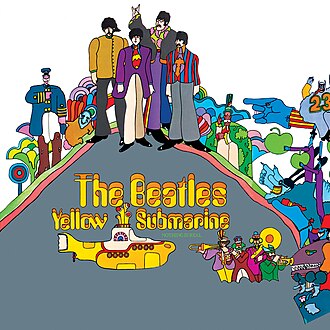
Yellow Submarine is the tenth studio album by the English rock band the Beatles, released in January 1969. It is the soundtrack to the animated film of the same name, which premie…
Yellow Submarine is the tenth studio album by the English rock band the Beatles, released in January 1969. It is the soundtrack to the animated film of the same name, which premiered in London in July 1968.
Yellow Submarine is the tenth studio album by the English rock band the Beatles, released in January 1969. It is the soundtrack to the animated film of the same name, which premiered in London in July 1968. The album contains six songs by the Beatles, including four new songs and the previously released "Yellow Submarine" and "All You Need Is Love". The remainder of the album is a re-recording of selections from the film's orchestral soundtrack by the band's producer, George Martin.
The project was regarded as a contractual obligation by the Beatles, who were asked to supply four new songs for the film. Some were written and recorded specifically for the soundtrack, while others were unreleased tracks from other projects. The album was recorded before – and issued two months after – the band's self-titled double LP (also known as the "White Album") and was not viewed by the band as a significant release. An EP containing only the new songs had been considered, and was mastered, but left unreleased. The original mono mixes were later included in the 2009 compilation Mono Masters.
Yellow Submarine reached the top 5 in the UK and the US. It has since been afforded a mixed reception from music critics, some of whom consider that it falls short of the high standard generally associated with the Beatles' work. Another version of the album, Yellow Submarine Songtrack, was issued on the film's 30th anniversary. It dispenses with the George Martin orchestral works, and includes the six Beatles songs from the original album, along with an additional nine songs heard in the film, all newly remixed.
Background and recording
The album arose from contractual obligations as part of the Beatles' three-picture deal with United Artists. With the band having disliked their previous film Help!, it was agreed that an animated film Yellow Submarine would fulfil their obligation as it reduced their involvement, though they reluctantly agreed to record four new songs for the film. Having recently completed their album Sgt. Pepper's Lonely Hearts Club Band in April 1967, the group showed minimal enthusiasm for the project. Along with the music for their Magical Mystery Tour TV film, the Yellow Submarine soundtrack was part of a period that author Ian MacDonald later described as the band's "regime of continuous low-intensity recording ... it had a workaday quality about it – an intrinsic lack of tension which was bound to colour the resulting material."
Soundtrack songs
Only one side of the album contains songs performed by the Beatles; of the six, two of them were previously released. "Yellow Submarine" had been issued in August 1966 as a single, topping the UK chart for four weeks, and had also been released on the album Revolver. Following the Beatles' performance of the song on the Our World international television broadcast, "All You Need Is Love" had been issued as a single as well, in July 1967, and had also been included on the Capitol Records LP release of Magical Mystery Tour in November 1967. A stereo mix was made of this song on 29 October 1968 for release on this album.
Of the unreleased tracks, the first to be recorded was George Harrison's "Only a Northern Song", taped in February 1967 but rejected for inclusion on Sgt. Pepper. The group performed overdubs on this basic track in April, immediately after completing the stereo mixes for that album. Among the sounds added during what Beatles historian Mark Lewisohn describes as "a curious session", were trumpet, glockenspiel and spoken voices. Harrison's lyrics reflect his displeasure at being merely a contracted songwriter to the Beatles' publishing company, Northern Songs.
"All Together Now" was recorded in a single session on 12 May 1967, specifically for the film project. The title came from a phrase Paul McCartney had heard as a child, to encourage everyone to sing music hall songs. He later described the song as "a throwaway".
The band recorded Harrison's "It's All Too Much" in late May 1967 at De Lane Lea Studios in central London. Inspired by its author's experimentation with the drug LSD, and originally running to over eight minutes in length, the song reflects the Summer of Love philosophy of 1967 and makes extensive use of guitar feedback. As with the later recorded "All You Need Is Love", the track includes musical and lyrical quotations from other works – in this case, a trumpet passage from Jeremiah Clarke's "Prince of Denmark's March" and a lyric from the Merseys' 1966 hit "Sorrow".
John Lennon's "Hey Bulldog" was recorded on 11 February 1968 and evolved from an initial intent to shoot a promotional film for the single "Lady Madonna". Like "All Together Now", it was specifically recorded with the film soundtrack in mind. The track's ending contained a jam session after the point where a fade-out was intended in the final mix, which was kept in the finished version. Lennon later described the song as "a good-sounding record that means nothing".
George Martin orchestral works
Side 2 consists of re-recordings of the symphonic film score composed by the Beatles' producer, George Martin, specifically for the album. The recording took place with a 41-piece orchestra over two three-hour sessions on 22 and 23 October 1968 in Abbey Road, and was edited down to the length on the LP on 22 November.
In some of his compositions, Martin referenced his past work with the Beatles; for example, "Sea of Time" includes what MacDonald terms "an affectionate quotation" from the Indian-styled "Within You Without You", from Sgt. Pepper, and "Yellow Submarine in Pepperland" reprises the film's title track. In "Sea of Monsters", Martin included the beginning of Bach's Air on the G String, while in other selections he parodies works by Stravinsky. MacDonald also detects the influence of Mozart and Webern among the "classical allusions" in Martin's score.
Release
The film received its worldwide premiere in London in July 1968, by which time the Beatles were busy working on their self-titled double album, commonly called "the White Album". After viewing the fin