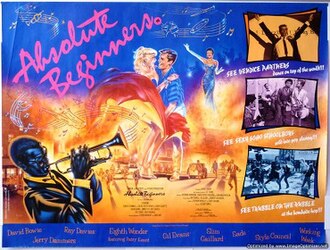
Absolute Beginners is a 1986 British musical film adapted from Colin MacInnes' book about life in late 1950s London, directed by Julien Temple. The film stars Eddie O' Connell, Pa…
Absolute Beginners is a 1986 British musical film adapted from Colin MacInnes' book about life in late 1950s London, directed by Julien Temple. The film stars Eddie O' Connell, Patsy Kensit, James Fox, Edward Tudor-Pole, Anita Morris, and David Bowie, with featured appearances by Sade Adu, Ray Davies, and Steven Berkoff.
Absolute Beginners is a 1986 British musical film adapted from Colin MacInnes' book about life in late 1950s London, directed by Julien Temple. The film stars Eddie O' Connell, Patsy Kensit, James Fox, Edward Tudor-Pole, Anita Morris, and David Bowie, with featured appearances by Sade Adu, Ray Davies, and Steven Berkoff. It was screened out of competition at the 1986 Cannes Film Festival. It received coverage in the British media but was panned by critics and became a box office failure, although modern reviews have been more favourable. Bowie's theme song was very popular in the UK, spending nine weeks on the charts and peaking at number two. The commercial failure of Absolute Beginners and two other films is blamed for the collapse of British film studio Goldcrest Films and for Virgin Films withdrawing from production.
Plot
Taking place in 1958, popular culture in London is transforming from 1950s jazz to a new generation on the verge of the rock and roll 1960s. Young photographer Colin is in love with aspiring fashion designer Suzette. Colin aims to be an artist with integrity. Suzette's boss, famous designer Henley of Mayfair, takes advantage of her forward-thinking designs to boost his own image.
Colin lives in the poor, ethnically diverse neighbourhood of Notting Hill. To make money, he gets a job with music producer Harry Charms, taking photos of new teen idol Baby Boom. Despite Colin getting commercial photography work, Suzette breaks up with him. She explains that she wants a successful and luxurious life, and won't settle for less ("Having It All"). Colin is initially despondent, but believes she'll eventually come back to him.
Colin learns that Suzette will be at a party hosted by gossip columnist Dido Lament, and so he attends. He learns Suzette plans to marry the middle-aged, homosexual Henley for her career ("Selling Out"). Colin also meets advertising mogul Vendice Partners at the party.
Meanwhile, the Teddy Boy subculture is increasingly hostile towards Black residents in London, spurred by the recent rise in immigration. The White Defence League, led by the Fanatic, preaches fascist politics and is vehemently against the increasing ethnic diversity of London. Colin despises this racist ideology.
Partners brings Colin to his advertising agency, where he shows off plans for the White Housing Development. Partners offers Colin a position as an advertisement photographer. While hesitant at first, Colin takes the job in the hopes that money may help him win back Suzette ("That's Motivation").
Henley and Suzette marry, but she is deeply unhappy. Colin, Dido, and Charms go on the TV show Searchlight. Dido gropes Colin, prompting him to have an outbust and rail against the elder generation trying to exploit teenagers. Later, at a jazz club, Colin is commended for his honesty on television. However, he's upset when he sees a newspaper headline about Suzette's wedding ("Killer Blow").
Racial violence intensifies in the area. Colin's Black friend, Mr. Cool, informs him that the racists are becoming more organized and dangerous. Colin discovers that the new White Housing Development is a scheme between Partners and Henley to "redevelop" the "West 11." Colin sends incriminating photos to Dido in an attempt to reveal the plan, but she's in cahoots with Partners and is no help.
Colin witnesses the 1958 Notting Hill race riots ("Riot City"). His pleas for peace are ignored. The police eventually arrive and stop the violence. Colin finds Suzette and they flee a fire set by the WDL. Mr. Cool has a fight with Flikker and wins. There is celebratory dancing in the street as rain puts out the fires. Colin and Suzette go back to his flat and have sex. He throws her wedding ring out the window.
Production
The novel was admired by Don MacPherson, a magazine editor who was friends with Julien Temple, then best known for directing music videos. MacPherson, Temple and Temple's business partner Michael Hamlyn agreed to try to turn Absolute Beginners into a film. MacPherson wrote the first draft, but this was not well received. Richard Burridge wrote a draft which was more positively received. The movie was going to be made at Virgin Films. Goldcrest Films also became involved as did Steve Woolley's Palace Flms.
According to a history of Palace Pictures "The main reason for Palace's commitment to Temple's film... was the tremendous depth of Powell's and Woolley's shared ambition. Here was a film that was clearly going to be a huge event, and Palace's partners were equally determined to be at the forefront of such a national spectacle. To say 'No' to Absolute Beginners was unthinkable."
Temple later admitted "MacInnes's book has a very flawed narrative to my mind, and is very hard to adapt. It lacks drive in terms of plot, and largely concerns the central characters views on the world, about jazz, pop stars, television, advertising and so on."
Palace covered development costs. Under the arrangement between Palace and Goldcrest, the latter would provide 60% of the budget if Palace could find the other 40%. Palace raised this from Orion Pictures in the US. Eventually $2.5 million of the film's budget came from Orion and £2.5 million from Goldcrest. Goldcrest guaranteed any cost overruns
Christopher Wicking was hired to do a version of the script which he said "had some sort of propulsion from one scene to the next". He says the script helped raise American finance but then Julien Temple disregarded a lot of Wicking's ideas. Wicking also says the filmmakers could never decide if the musical numbers should advance the story or illustrate something about the characters at the time.
Terry Johnson did a rewrite of the script. According to Sandy Lieberson of Goldcrest the script "was never nailed down, and it kept being edited and not edited during the whole run-up to production and during the production itself."
Eddie O'Connell and Patsy Kensit were relative unknowns when cast for the film and, according to Julien Temple in