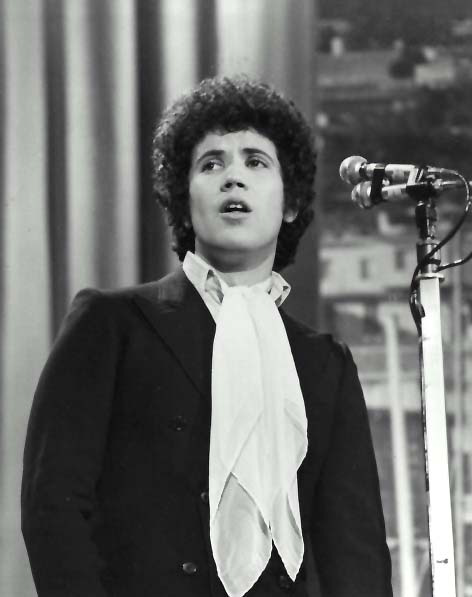
In 1969, Battisti took part in the Festival of Sanremo, with the song "Un'avventura", and his popularity began to increase. His first hit was "Acqua azzurra, acqua chiara", which won the Festivalbar. The same year, Ricordi issued Battisti's self-titled debut album. During this successful year he met Grazia Letizia Veronese, whom he later married and lived with until his death.
Forming a highly successful duo with lyricist Mogol, Battisti continued to issue solo albums on a regular basis throughout the 1970s. In almost every case they reached the highest places in the Italian charts and are regarded as classics of Italian pop music ("musica leggera"). He also became a popular presence on television.
In 1970 Battisti won Festivalbar for the second time in a row, with the song "Fiori rosa, fiori di pesco", and he and Mogol started to collaborate with vocalist Mina, who sang some of their most-acclaimed songs. In December, Ricordi issued Battisti's second LP, Emozioni, a compilation of previously released singles. Battisti was really angry about this, as he had composed a concept album called Amore e non-amore, but his label chose to release the compilation rather than the album, which was considered to be too experimental and advanced for the Italian audience.
Amore e non-amore was eventually released in July 1971, but to preserve their creative freedom, Battisti and Mogol moved over to Numero Uno, one of Italy's first independent record labels, founded by them in 1969. In the same year English band Love Affair recorded the song "Wake Me I Am Dreaming", a cover of "Mi ritorni in mente".
The new label released Umanamente uomo: il sogno (1972) followed by the even more successful Il mio canto libero (1972). The latter topped the Italian charts for 8 weeks: one of its songs – "Io vorrei, non vorrei, ma se vuoi" – was later recorded by Mick Ronson with lyrics translated by David Bowie, as "Music Is Lethal" (on the album Slaughter on 10th Avenue). The song "Il mio canto libero" has remained one of the most popular songs among Italians. Another successful album was Il nostro caro angelo (1973).
U.S. magazine Billboard nominated Battisti "Italian Personality of the Year" in 1972, defining him "singer, composer, music publisher of international fame, has elevated Italian audience's taste and strengthened the market".