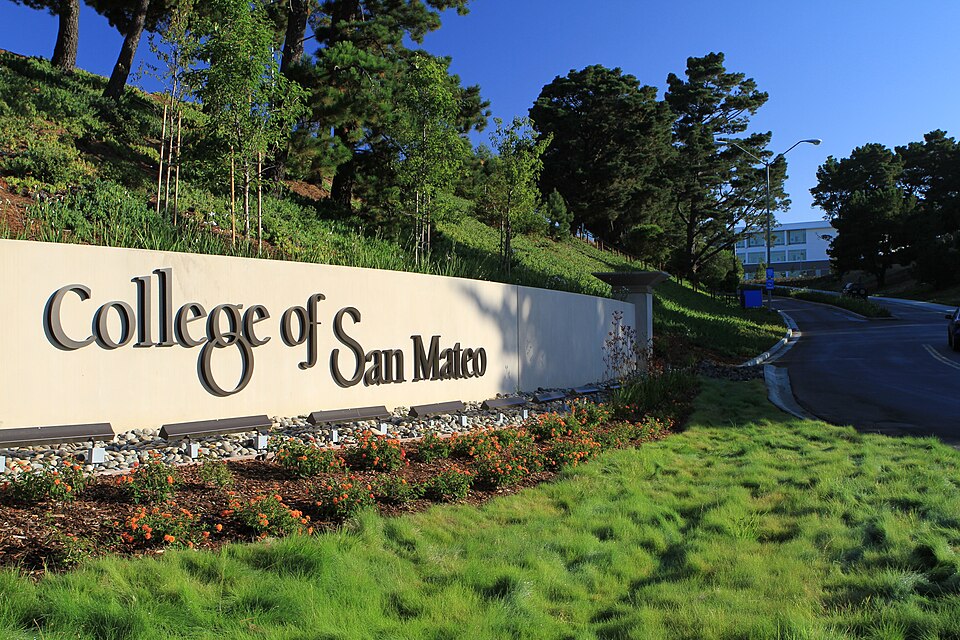
College of San Mateo (CSM) is a public community college in San Mateo, California. It is part of the San Mateo County Community College District. College of San Mateo is located a…
College of San Mateo (CSM) is a public community college in San Mateo, California. It is part of the San Mateo County Community College District. College of San Mateo is located at the northern corridor of Silicon Valley and situated on a 153-acre site in the San Mateo hills. The college currently serves approximately 15,000 day, evening and weekend students. The college offers 69 A.A./A.S. degree majors and 81 certificate programs.
History
William L. Glascock, the principal of San Mateo High School, first proposed a junior college for San Mateo in the early 1920s as an alternative to the traditional four-year college. Tuition at four-year institutions cost up to US$1,000 (equivalent to $19,000 in 2025) per year at the time; at the junior college, students could instead live at home while earning credit equivalent to the freshman and sophomore years of a four-year school. The college was initially founded as the San Mateo Junior College (SMJC) after being approved by voters on March 31, 1922. The first classes started on August 22 of that year in a building shared with San Mateo High School. The first registered student was Marjorie Brace, who could not attend Stanford because of the high cost of tuition. She joined an initial class of 30 students, which would grow to 48 by the end of the academic year. The typical target for students graduating from the junior college was either Berkeley or Stanford; although the junior college was "in a valley between two mountains of conceit—Stanford and the University of California" as described by early faculty, the curriculum at San Mateo was designed to allow graduating students to continue studies at the larger four-year institutions.
The school colors of blue and white were chosen, according to anecdotes from early graduates, either from the colors of those two targets (white from Stanford, blue from Berkeley), or because those were the leftover ribbon colors from a student tasked with decorating a dance. The origins of the bulldog mascot are similarly murky: either all other animals had already been chosen by other colleges, or a local kennel which specialized in raising English bulldogs offered to have one of their animals, Rival Goldstone, appear at sporting events.
Second year students would haze incoming freshmen in one of the earliest traditions at SMJC, which required first year male students to carry decorated wooden paddles. Sophomore students would stop first-years so they could "frequently and strenuously [apply the paddle] for any of a dozen real or imagined infractions." Hazing culminated in an all-day event held semi-annually called The Brawl, which was filmed by Fox Movietone News on February 19, 1928. Incoming dean Charles S. Morris ended physical hazing in 1931.
Dean Morris had a fatal heart attack in 1952, and students and faculty members began proposing a name change for SMJC. Proposed names included San Mateo College, San Mateo City College, and Peninsula College, but the name was finally changed to College of San Mateo on April 14, 1954, in part because the initials (CSM) would also honor the memory of Dean Morris.
Enrollment
Enrollment at SMJC grew rapidly from the initial class of 30 in 1922: 137 students enrolled in 1923, and the freshman class alone was 102 in 1924. SMJC reached enrollments of 430 students (250 freshmen) in 1926 and 480 students in 1927, when classes moved back to the Baldwin campus. It was the only junior college on the Peninsula until 1935 and attracted commuter students from San Francisco (who used San Francisco and San Mateo Electric Railway and/or Peninsula Commute trains), San Jose, and the East Bay. By 1935, enrollment had reached 1,500, but fell back to 1,000 when San Francisco Junior College opened that fall.
The first classes for workers to develop additional skills were offered in 1932, when a vocational class in aeronautics started. An Adult Program was introduced in 1936 for evening classes at the Baldwin campus, and 500 students signed up by the end of the first week. By 1943, 5,073 were enrolled in evening classes. During World War II, enrollment dropped as many potential students were serving in the military instead; SMJC shifted to teaching servicemen and radar courses. Unused land at Delaware was planted with crops as a victory garden. The college set up a Community Canning Center in June 1944 and had produced 108,000 cans by the end of the year. Enrollment rebounded after the war; although there were only 35 graduates in 1945, there were 1,800 students enrolled in 1946 and 2,400 in 1947, with 307 graduating in 1949. 5,621 attended classes on September 30, 1963, the first day of classes at the new College Heights campus.
As initially founded, SMJC served students matriculating from the San Mateo Union High School District; Jefferson Union and Half Moon Bay were added in 1937; Sequoia Union and South San Francisco followed in the 1960s; and the college served all San Mateo County residents by 1976, when the La Honda-Pescadero Unified School District joined.
San Mateo Community College District
By then, two more campuses had opened in what had become the San Mateo County Community College District alongside the College of San Mateo: Cañada College (1968, Redwood City) and Skyline College (1969, San Bruno). Julio Bortolazzo is credited with the expansion of what had become the College of San Mateo into the three-college District. In 1956, he formed a 27-member Citizens Committee to study potential sites for a new campus for CSM. The final report filed by the Committee concluded that San Mateo County needed more than one community college.
County voters overwhelmingly approved a $5.9 million bond issue in 1957 based on Committee recommendations, which provided funds to purchase the present-day College Heights campus for CSM as well as the site for Skyline College. In 1962, the parcel for Cañada College was purchased. Voters approved another bond of $12.8 million in March 1964, which provided funds to construct Cañada College (opened 1968) and Skyli