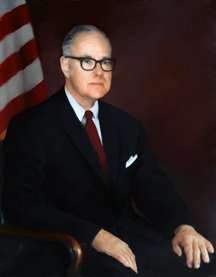
Richard Mervin Bissell Jr. was an American Central Intelligence Agency officer responsible for major projects such as the U-2 spy plane and the Bay of Pigs Invasion. The journalis…
Richard Mervin Bissell Jr. (September 18, 1909 – February 7, 1994) was an American Central Intelligence Agency officer responsible for major projects such as the U-2 spy plane and the Bay of Pigs Invasion.
Richard Mervin Bissell Jr. was an American Central Intelligence Agency officer responsible for major projects such as the U-2 spy plane and the Bay of Pigs Invasion. The journalist Annie Jacobsen said he was referred to by many as "the mayor of Area 51" due to his close involvement in turning that Nevada salt flat into a top-secret U-2 testing facility.
Read more about this topic
Richard Mervin Bissell Jr. (September 18, 1909 – February 7, 1994) was an American Central Intelligence Agency officer responsible for major projects such as the U-2 spy plane and the Bay of Pigs Invasion. The journalist Annie Jacobsen said he was referred to by many as "the mayor of Area 51" due to his close involvement in turning that Nevada salt flat into a top-secret U-2 testing facility.
Early years
Bissell Jr. came from a well-to-do family; his father, Richard Bissell, was president of Hartford Fire Insurance. Bissell Jr. was born in the Mark Twain House in Hartford, Connecticut, and went to Groton School in Groton, Massachusetts. Two of his fellow pupils were Joseph Alsop and Tracy Barnes. He studied history at Yale University and graduated in 1932. He attended the London School of Economics until 1933 before returning to Yale for postgraduate studies in economics. He worked as a consultant to Fortune magazine for two years starting in 1937. He obtained his Ph.D. in economics from Yale in 1939. He remained there as an assistant professor until 1941. The following year, he joined the U.S. Department of Commerce as Chief Economic Analyst of the Bureau of Foreign and Domestic Commerce.
Marshall Plan
In July 1947, Bissell was recruited by W. Averell Harriman to run a committee to lobby for an economic recovery plan for Europe. In 1948, he was appointed assistant deputy administrator of the Economic Cooperation Administration (ECA) (better known as the Marshall Plan) in Germany and eventually became the ECA's deputy director and acting director. He worked with the Office of Policy Coordination (OPC) in diverting counterpart funds of the ECA to OPC operations in Europe.
Georgetown Set
Bissell and his wife Ann moved to Washington, D.C., where they associated with a group of journalists, politicians, and government officials who were later termed "the Georgetown Set". Originally formed in 1945–1948 by a cadre of Office of Strategic Services (OSS) veterans of WWII—Frank Wisner, Stewart Alsop, Thomas Braden, Philip Graham, David K. E. Bruce and Walt Rostow—the politically influential Georgetown Set drew its membership from the Georgetown neighborhood within the upper northwest section of the capital. The group would grow to include George Kennan, Dean Acheson, William Averell Harriman, Desmond FitzGerald, Joseph Alsop, Tracy Barnes, Ben Bradlee, John F. Kennedy, Clark Clifford, Charles "Chip" Bohlen, James Angleton, Felix Frankfurter, James "Scotty" Reston, Allen Dulles and Paul Nitze.
CIA career
While Bissell was working for the Ford Foundation, Frank Wisner persuaded him to join the Central Intelligence Agency (CIA). This would begin the most eventful years of Bissell's life.
U-2 'spy plane'
In 1954, he was placed in charge of developing and operating the Lockheed U-2 "spy plane". He and Herbert Miller, another CIA officer, chose Area 51 as the site for the U-2 test facility, and Bissell supervised the facility and its build-up until he resigned from the CIA nearly a decade later. The U-2 spy plane was a great success and within two years Bissell was able to say that 90% of all hard intelligence about the Soviet Union coming into the CIA was "funneled through the lens of the U-2's aerial cameras".
The U-2 photographs debunked the allegations of a "bomber gap"—the belief that the Soviets had amassed a numerical advantage over the U.S. in strategic bomber aircraft which could reach the other country—and convinced President Dwight D. Eisenhower that Nikita Khrushchev was lying about the number of bombers and missiles being built by the Soviet Union. However, because of the shroud of secrecy erected by the CIA around the U-2 spy plane as its source of information, the "bomber gap" hysteria in some American circles was not easily put to rest.
In 1956, after the Soviets protested the first U-2 overflights, Bissell initiated Project RAINBOW to develop radar camouflage for the aircraft. When this was unsuccessful, he launched Project Gusto to design a follow-on aircraft. Gusto evolved into Project Oxcart, under which the CIA developed and operated the Lockheed A-12.
Vision for the CIA
In 1957, Bissell delivered an address at the CIA entitled "The Stimulation of Innovation". He called for funding the research and development of groundbreaking new technologies for intelligence gathering and surveillance. He acknowledged that such surveillance may entail "gray activities" by the CIA, such as surveillance that the agency might not have the legal right to undertake. But he said the dubious legal status of such activities should not preclude the CIA from pursuing them. He also advocated that the CIA implement covert political actions in target countries.
CIA Deputy Director for Plans
After Frank Wisner suffered a mental breakdown in September 1958, Bissell replaced him as the CIA's Deputy Director for Plans. Bissell assumed the office on 1 January 1959. He was meanwhile also playing a key role as CIA Program Manager in the development of the Corona program.
Leading the CIA's Directorate of Plans (DDP) put Bissell in a vital position. The DDP branch of the CIA was responsible for covert operations, such as the prior overthrow of Mohammad Mosaddegh and Jacobo Árbenz. When Bissell took office, the main DDP target was Fidel Castro.
In March 1960, a top-secret policy paper, titled "A Program of Covert Action Against the Castro Regime" (code-named JMARC), was drafted "to bring about the replacement of the Castro regime with one more ... acceptable to the U.S. in such a manner as to avoid any appearance of U.S. intervention." The courses of action outlined in the paper were based on Operation PBSuccess, which had worked to great effect in Guatemala in 1954. In fact, Bissell assembled the same team as the one used in Guatemala: Tracy Barnes, David Atlee Phillips, Jacob Esterline, William "Rip" Robertson, E. Howard Hunt and Gerry Droller (aka "Frank Bender"). Added to the team were Lieutenant Colonel Jack Hawkins, Desmond FitzGerald, William Harvey and Ted Shackley.
The covert action plan to overthrow Castro was presented to Preside