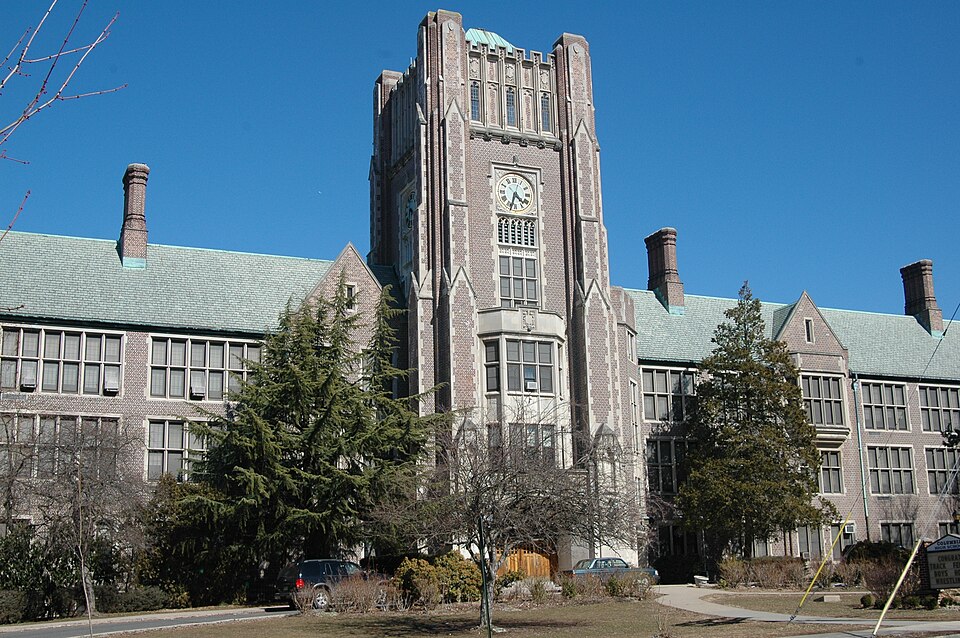
Columbia High School is a four-year comprehensive regional public high school in Maplewood, in Essex County, in the U.S. state of New Jersey. It serves students in ninth through t…
Columbia High School is a four-year comprehensive regional public high school in Maplewood, in Essex County, in the U.S. state of New Jersey. It serves students in ninth through twelfth grades, as the lone secondary school of the South Orange-Maplewood School District, which includes Maplewood and neighboring South Orange. The school has been accredited by the Middle States Association of Colleges and Schools Commissions on Elementary and Secondary Schools since 1928; its accreditation expires in July 2026.
The school is known for its connection to the invention of ultimate frisbee in 1968.
As of the 2024–25 school year, the school had an enrollment of 1,985 students and 139.5 classroom teachers (on an FTE basis), for a student–teacher ratio of 14.2:1. There were 317 students (16.0% of enrollment) eligible for free lunch and 45 (2.3% of students) eligible for reduced-cost lunch.
Beginnings
Since the days of the Revolution, a one-room stone schoolhouse had stood on a grassy area known as the Common, located close to the present intersection of South Orange Avenue and Academy Street in South Orange. In 1814, this building blocked the construction of a new toll highway from Newark to Morristown. The 73 "Proprietors and Associates" of the school met on August 3 of that year and resolved to erect a new school building near the site of the old one, naming seven trustees to thereafter oversee the education of local children. The resolution reflected "the desire of the meeting that the said school should in the future have the name of Columbian School of South Orange."
The new schoolhouse was a two-story wood structure, topped by a thin steeple and a lofty weather vane. It was completed before the fall term of 1815. The trustees decided "That the price of tuition in this school be fixed at $1.75 per quarter for spelling, reading and writing; for Arithmetic in addition to the above branches the sum of $0.25 cts and for Grammar or Geography the further sum of twenty-five cents." The cost of firewood was to be "divided equally among the scholars." On May 10, 1816, the trustees adopted a seal for the school in the form of "a spread eagle standing on a globe with the word Excelsior underneath in Roman Capitals."
In the early years, students at the Columbia School were not separated according to grade. All were subject to the same rules, among them the following adopted by the trustees on May 2, 1827:
"Every scholar must be made to name every silent letter in his spelling when he spells a word with one in and mention every figure which is placed over a letter and be taught to know their uses and for every mistake or omission in such letter or figure shall be considered the same as spelling a word wrong and subject to the same usage.
"Every scholar that spells a word wrong or omits a silent letter or figure shall step in the rear of the class and there stand until the class shall have spelled through, then those that have spelled right are to move up in a solid body and those who are in the rear to move down and take their places at the foot."
For decades, the school was supported by tuition payments. But gradually the State began to assume a share of the financial responsibility. In 1820, a law authorized townships to levy a tax to pay the tuition of poor students. By 1828, townships had the power to tax for general school purposes. The State itself began to contribute money in 1830, and in 1846 every township was required to raise as much money each year for schools as the State itself contributed. The last tuition assessment for residents occurred in 1861, and thereafter the Columbia School was entirely supported by public taxation.
Post-Civil War
After the Civil War, improvements on the railroad contributed to a decided growth of population in the old Township of South Orange. The general character of the citizenry underwent a significant change and residents known as "commuters" began to emerge in numbers. In 1867, a state law required that Columbia become a graded school. By 1877, the old two-story wooden building erected in 1815 was found to be woefully inadequate for the growing community. One resident complained that "in very cold weather, with stoves at red heat, it is impossible to raise the temperature in the room above 55 degrees, and in such a place are sown the seeds of suffering, disease and death."
The trustees responded in 1879 by resolving to erect a new brick building, of two stories, to accommodate between 220 and 240 pupils. The new structure was opened in 1880. The final cost of construction was $17,094.49. The building later became the northeast wing of the old South Orange Junior High School, demolished when the present middle school was built.
The separate existence of the high school began in 1885, when the trustees decided "that in order to increase the efficiency of the Columbia School a new class of a higher grade shall be formed at the commencement of the coming term to be taught by the Principal." Lower grades continued to be housed at Columbia. The trustees' minutes of May 31, 1888, reflect the principal's request "that a diploma be voted to Miss Etta A. Kilburn" and that, "on motion, a diploma was voted to Miss Kilburn, the first graduate of the high school.
20th century
The close of the 19th century and the beginning of the 20th brought significant changes in high school curriculum and school management. The Board of Education had by now replaced the old board of trustees. In 1890, "manual training" was offered in school. By 1891, sciences had been added to the course of study. A tradition of excellence was beginning to evolve, and in 1892 two Columbia graduates were admitted to Cornell University. Musical enrichment was added in 1894 with the hiring of a singing teacher from New York City. Early in the 1900s the value of athletics was recognized and encouraged at Columbia by the organization of boys' and girls' teams. The student council was formed in 1912, and The Columbian student newspaper followed in 191