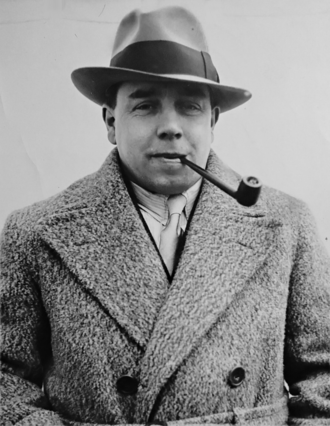
Priestley's first major success came with a novel, The Good Companions (1929), which earned him the James Tait Black Memorial Prize for fiction and made him a national figure. His next novel, Angel Pavement (1930), further established him as a successful novelist. However some critics were less than complimentary about his work and Priestley threatened legal action against Graham Greene for what he took to be a defamatory portrait of him in the novel Stamboul Train (1932).
In 1934, he published the travelogue English Journey, an account of what he saw and heard while travelling through the country in the depths of the Great Depression.
Priestley has been considered prejudiced against the Irish, as shown in English Journey: "A great many speeches have been made and books written on the subject of what England has done to Ireland... I should be interested to hear a speech and read a book or two on the subject of what Ireland has done to England... if we do have an Irish Republic as our neighbour, and it is found possible to return her exiled citizens, what a grand clearance there will be in all the western ports, from the Clyde to Cardiff, what a fine exit of ignorance and dirt and drunkenness and disease."
He moved into a new genre and became equally well known as a dramatist. Dangerous Corner (1932) was the first of many plays that would enthral West End theatre audiences. His best-known play is An Inspector Calls (1945). His plays are more varied in tone than the novels, several being influenced by J. W. Dunne's theory of time, which plays a part in the plots of Dangerous Corner (1932) and Time and the Conways.
In 1940, Priestley wrote an essay for Horizon magazine in which he criticised George Bernard Shaw for his support of Stalin: "Shaw presumes that his friend Stalin has everything under control. Well, Stalin may have made special arrangements to see that Shaw comes to no harm, but the rest of us in Western Europe do not feel quite so sure of our fate, especially those of us who do not share Shaw's curious admiration for dictators."
During the Second World War he was a regular broadcaster on the BBC. The Postscript, broadcast on Sunday night in 1940 and again in 1941, drew peak audiences of 16 million; only Churchill was more popular with listeners. Graham Greene wrote that Priestley "became in the months after Dunkirk a leader second only in importance to Mr Churchill. And he gave us what our other leaders have always failed to give us—an ideology." But his talks were cancelled. It was thought that this was the effect of complaints from Churchill that they were too left-wing; however in 2015 Priestley's son said in a talk on the latest book being published about his father's life that it was in fact Churchill's Cabinet that brought about the cancellation by supplying negative reports on the broadcasts to Churchill.