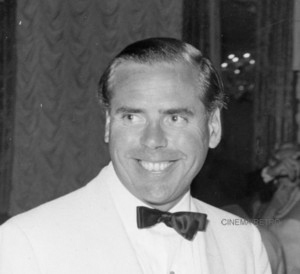
McClory started a career at Shepperton Studios in Middlesex as a film boom operator and location manager, where he worked on The Cockleshell Heroes for Warwick Films. He was an assistant to John Huston on films including The African Queen (1951) and Moulin Rouge (1952). He was an assistant director on Huston's version of Moby-Dick (1956), and associate producer and second-unit director on Mike Todd's Around the World in 80 Days (also 1956).
McClory was romantically involved with Elizabeth Taylor. Although he and Taylor reportedly had plans to marry, she eventually left him for her future husband Mike Todd. Todd and McClory fell out over Taylor, yet they managed to complete the final cut of the film side by side. The trio would eventually reconcile, and they remained friends until Todd's untimely death in 1958.
In 1957, McClory led an expedition of 25 men in an attempt to drive around the world. He filmed a documentary of the adventure, One Road, as well as a series of ads for his sponsor Ford Motor Company. The team completed the journey in 104 days. He later wrote, produced and directed the 1957 film The Boy and the Bridge, with financial assistance from heiress Josephine Hartford Bryce (sister of Huntington Hartford) and her husband Ivor Bryce, a friend of Ian Fleming.
In 1958, Fleming approached McClory to produce the first Bond film. McClory rejected all of Fleming's books but felt that the character James Bond could be adapted for the screen. McClory, Bryce, Fleming and Jack Whittingham developed the character through a number of treatments and screenplays. McClory, Fleming and Bryce settled on a screenplay, Longitude 78 West (later renamed Thunderball), and went into pre-production. Fleming novelised the draft screenplay as his ninth novel, Thunderball, in 1961 and initially did not credit McClory or Whittingham. McClory and Whittingham engaged libel lawyer Peter Carter-Ruck and sued Fleming shortly after the 1961 publication of the Thunderball novel, claiming he based it upon the screenplay the trio had earlier written.
The trial opened in the High Court in London on 20 November 1963. After nine days, the case was settled out of court. Fleming paid McClory damages of £35,000 and McClory's court costs of £52,000, and future versions of the novel were credited as "based on a screen treatment by Kevin McClory, Jack Whittingham, and Ian Fleming" – in that order. Fleming conveyed to McClory the worldwide film rights to the novel and McClory retained certain screen rights to the novel's story, plot, and characters. Harry Saltzman's and Albert R. Broccoli's production company Eon Productions later made a deal with McClory for Thunderball to be made into a film in 1965, with McClory producing. Under the deal, Eon licensed McClory's rights for a period of ten years and in return they assigned to McClory any rights they had in the scripts and treatments. McClory made an uncredited cameo in the film. By then, Bond was a box-office success, and series producers Broccoli and Saltzman feared a rival McClory film beyond their control; they agreed to McClory's 's credit of a cinematic Thunderball, with them as executive producers.