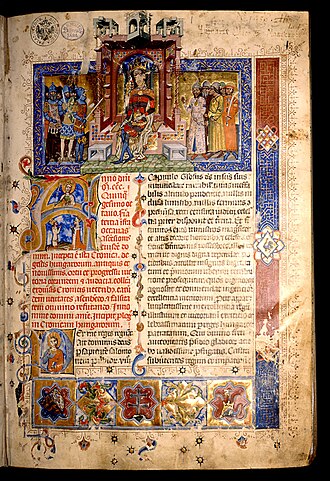
Scholars categorize the genre of chronicle into two subgroups: live chronicles, and dead chronicles. A dead chronicle is one where the author assembles a list of events up to the time of their writing, but does not record further events as they occur. A live chronicle is where one or more authors add to a chronicle in a regular fashion, recording contemporary events shortly after they occur. Because of the immediacy of the information, historians tend to value live chronicles, such as annals, over dead ones.
The term often refers to a book written by a chronicler in the Middle Ages describing historical events in a country, or the lives of a nobleman or a clergyman, although it is also applied to a record of public events. The earliest medieval chronicle to combine both retrospective (dead) and contemporary (live) entries, is the Chronicle of Ireland, which spans the years 431 to 911.
Chronicles are the predecessors of modern "time lines" rather than analytical histories. They represent accounts, in prose or verse, of local or distant events over a considerable period of time, both the lifetime of the individual chronicler and often those of several subsequent continuators. If the chronicles deal with events year by year, they are often called annals. Unlike the modern historian, most chroniclers tended to take their information as they found it, and made little attempt to separate fact from legend. The point of view of most chroniclers is highly localised, to the extent that many anonymous chroniclers can be sited in individual abbeys.