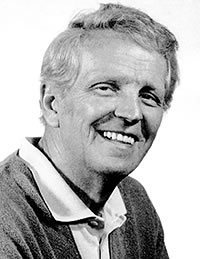
George Tuska was born in Hartford, Connecticut, the youngest of three children of Russian immigrants Harry and Anna Onisko Tuska, who had met in New York City. George's siblings Peter, the eldest, and Mary, the middle child, were born in New York City. Years later, Mary died while giving birth to her second child, who was stillborn. Harry, a foreman at a Hartford auto-tire company, died when George was 14. Anna then opened a restaurant in Paterson, New Jersey, where she had relatives, and later remarried. At 17, Tuska moved to New York City, rooming with his cousin Annie, and a year later began attending the National Academy of Design. His artistic influences included illustrators Harold von Schmidt, Dean Cornwell, and Thomas Lovell, and comic strip artists Lou Fine, Hal Foster, and Alex Raymond. At some early point, he took his first job in art, designing women's costume jewelry.
Tuska then began working for comic book packager Eisner & Iger, one of a handful of companies at the time that supplied comics on demand for publishers entering the new medium. His first known published comic-book work appeared in Fox Comics' Mystery Men Comics #1 and Wonderworld Comics #4, both cover-dated August 1939. Tuska in the mid-2000s recalled:
I went to art school at the same I was doing costume jewelry design. I put in an application with a professional agency in New York City. I told them I could do cartooning, drawing. A week later, I got a call from Eisner-Iger, asking me to submit some samples. ... [Eisner] said, 'That's pretty good, but we don't do that [cartoon] stuff'. He showed me a comic book and said, 'This is what we want'. ... I went home and made a page — a whole story in one page. When I brought it back, he bought it for $5. He said, 'We'd like to have you work for us'. That's how I got started. ... I gave up school. ... I made $10 per week.
At Eisner & Iger, Tuska said in 2001, "I worked alongside Bob Powell, Lou Fine, and Mike Sekowsky". His studio colleagues later grew to include artists Charles Sultan, John Celardo, and Nick Cardy, and writer Toni Blum.
Writer-artist and company co-founder Will Eisner recalled of the period, "It was a friendly shop, and I guess I was the same age as the youngest guys there. We all got along. The only ones who ever got into a hassle were George Tuska and Bob Powell. Powell was kind of a wiseguy and made remarks about other people in the shop. One day, George had enough of it, got up, and punched out Bob Powell". The otherwise mild-mannered Tuska, thinking comic books "would last two or three years — a fad", later left to seek non-comics work. After two weeks, however, he came across colleagues Sultan and Dave Glaser, on their way to meet with comics packager Harry "A" Chesler. Tuska, invited along, joined Chesler's studio, working there in 1939 and 1940, earning $22 a week, increased to $42 a week within six months. Alongside colleagues that included Sultan, Ruben Moreira, Mac Raboy, and Ralph Astarita, Tuska helped to supply content for such Fawcett Comics publications as Captain Marvel Adventures. Later, when Eisner-Iger client Fiction House formed its own bullpen to produce work on staff, Tuska left Chesler to join Cardy, Jim Mooney, Graham Ingels and other artists there.