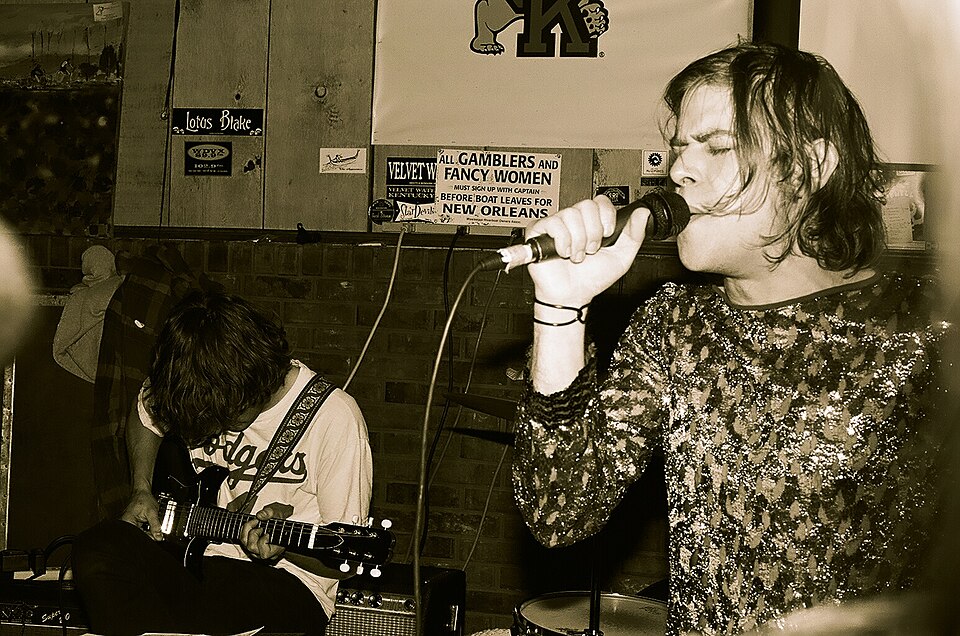
Hypnagogic pop is a loosely defined style of pop and psychedelic music that evokes cultural memory and nostalgia for the popular entertainment of the past. It emerged in the 2000s…
Hypnagogic pop (or simply h-pop) is a loosely defined style of pop and psychedelic music that evokes cultural memory and nostalgia for the popular entertainment of the past (principally the 1980s and early 1990s). It emerged in the 2000s through a wave of American Millennial home recording artists in the lo-fi and post-noise scene, who adopted retro aesthetics from their childhood, such as radio…
Hypnagogic pop is a loosely defined style of pop and psychedelic music that evokes cultural memory and nostalgia for the popular entertainment of the past. It emerged in the 2000s through a wave of American Millennial home recording artists in the lo-fi and post-noise scene, who adopted retro aesthetics from their childhood, such as radio and soft rock, new wave, video game music, synth-pop, R&B, film soundtracks, new-age and early Internet aesthetics. Recordings were typically marked by the use of outmoded analog equipment and DIY experimentation, while distributed on cassettes and CD-R's wit
Read more about this topic
Hypnagogic pop (or simply h-pop) is a loosely defined style of pop and psychedelic music that evokes cultural memory and nostalgia for the popular entertainment of the past (principally the 1980s and early 1990s). It emerged in the 2000s through a wave of American Millennial home recording artists in the lo-fi and post-noise scene, who adopted retro aesthetics from their childhood, such as radio and soft rock, new wave, video game music, synth-pop, R&B, film soundtracks, new-age and early Internet aesthetics. Recordings were typically marked by the use of outmoded analog equipment and DIY experimentation, while distributed on cassettes and CD-R's with circulation primarily based on the Internet through blog sites.
The genre's name was coined by journalist David Keenan in an August 2009 issue of The Wire to label the developing trend, the term was inspired by a comment made by musician James Ferraro about the notion that 1980s sounds had seeped into the unconscious of contemporary musicians while they were toddlers falling asleep. Keenan characterized the concept as "pop music refracted through the memory of a memory." It was used interchangeably with "chillwave" or "glo-fi" and gained critical attention through artists such as Ariel Pink and James Ferraro. The music has been variously described as a 21st-century update of psychedelia, a reappropriation of media-saturated capitalist culture, and an "American cousin" to British hauntology.
In response to Keenan's article, The Wire received a "slew of semi-hate mail" that derided hypnagogic pop as the "worst genre created by a journalist". Some of the tagged artists rejected the label or denied that such a unified style exists. During the 2010s, the style's "revisionist nostalgia" sublimated into various youth-oriented cultural zeitgeists. The scene influenced the rise of bedroom pop, while elements evolved into vaporwave, with which it is sometimes conflated.
Etymology
In August 2009, journalist David Keenan, who was known as a reporter of noise, freak folk, and drone music scenes, coined the term "hypnagogic pop" in issue 306 of British music magazine The Wire. His article was entitled Childhood's End. Keenan applied the label to a developing trend of 2000s lo-fi and post-noise music in which artists engaged with elements of cultural nostalgia, childhood memory, and outdated recording technology. Inspired by comments by James Ferraro and Spencer Clark of the Skaters, and while invoking a similar concept discussed by Russian esotericist P.D. Ouspensky, Keenan employed the term "hypnagogic" as referring to the psychological state "between waking and sleeping, liminal zones where mis-hearings and hallucinations feed into the formation of dreams." The term reportedly originated with a comment by James Ferraro about the notion that 1980s sounds had seeped into the unconscious of contemporary musicians while they were toddlers falling asleep and their parents played music in another room.
We label verified structured information, user opinions, and AI-discovered relationships separately.
Among the artists discussed in Keenan's article were Ariel Pink, Daniel Lopatin, the Skaters, the Savage Young Taterbug, Gary War, Zola Jesus, Ducktails, Emeralds, and Pocahaunted. According to Keenan, these artists drew on cultural sources subconsciously remembered from their 1980s and early 1990s adolescence while freeing them from their historical contexts and "hom[ing] in on the futuristic signifiers" of the period. He alternately summarized hypnagogic pop as "pop music refracted through the memory of a memory" and as "1980's-inspired psychedelia" that engages with capitalist detritus of the past in an attempt to "dream of the future." In a later article, Keenan identified Lopatin, Ferraro, Clark, and ex-Test Icicles member Sam Mehran as hypnagogic pop's "most adventurous proponents".
Characteristics
Hypnagogic pop is pop or psychedelic music that draws heavily from the popular music and culture of the 1980s – also ranging from the 1970s to the early 1990s. The genre reflects a preoccupation with outmoded analog technology and bombastic representations of synthetic elements from these epochs of pop culture, with its creators informed by collective memory as well as their personal histories. Per the imprecise nature of memory, the genre does not faithfully recreate the sounds and styles popular in those periods. In this way, hypnagogic pop distinguishes itself from revivalist movements. As authors Maël Guesdon and Philippe Le Guern write, the genre can be described as "revisionist nostalgia, not in the sense that 'everything used to be better' but because it rewrites collective memory with a view to being more faithful to an idea or a memory of the original than to the original itself."
Examples of specific sounds evoked by hypnagogic pop artists range from "ecstatically blurry and irradiated lo-fi pop" to "seventies cosmic-synth-rock" and "tripped-out, tribal exotica". Writing for Vice in 2011, Morgan Poyau described the genre as "making awkward bedfellows out of experimental music enthusiasts and weird progressive pop theorists." He described a typical manifestation of the style as featuring long tracks "saturated with echo, delay, smothered guitars and amputated synths." Critic Adam Trainer writes that, rather than a particular sound, the music was defined by a collection of artists who shared the same approaches and cultural experiences. He observed that their music drew from "the collective unconscious of late 1980s and early 1990s popular culture" while being "indebted stylistically to various traditions of experimentalism such as noise, drone, repetition, and improvisation."
Common reference points include various forms of 1980s music, including radio rock, new wave pop, MTV one-hit wonders, New Age music, synth-driven Hollywood blockbuster soundtracks, lounge music, easy-listening, corporate muzak, lite rock "schmaltz", video game music, and 1980s synth-pop and R&B. Recordings are often deliberately degraded, produced with analog equipment, and exhibit recording idiosyncras