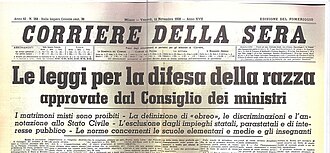
The first and most important of the Racial Laws (Leggi Razziali) was the Regio Decreto 17 Novembre 1938, Nr. 1728. It restricted the civil rights of Italian Jews, banned books written by Jewish authors, and excluded Jews from public offices and higher education. Additional laws stripped Jews of their assets, restricted travel, and finally, provided for their confinement in internal exile, as was done for political prisoners. In recognition of both their past and future contributions and for their service as subjects of the Italian Empire, Rome passed a decree in 1937 distinguishing the Eritreans and Ethiopians from other subjects of the newly-founded colonial empire. In the Kingdom of Italy, Eritreans and Ethiopians were to be addressed as "Africans" and not as natives, as was the case with the other African peoples subjected to the colonial rule of the Italian Empire.
The promulgation of the Racial Laws was preceded by a long press campaign and publication of the "Manifesto of Race" earlier in 1938, a purportedly-scientific report signed by scientists and supporters of the National Fascist Party (PNF); among the 180 signers of the "Manifesto of Race" were two medical doctors (S. Visco and N. Fende), an anthropologist (L. Cipriani), a zoologist (E. Zavattari), and a statistician (F. Savorgnan). The "Manifesto of Race", published in July 1938, declared the Italians to be descendants of the Aryan race. It targeted races that were seen as inferior (i.e. not of Aryan descent). In particular, Jews were banned from many professions. Under the Racial Laws, sexual relations and marriages between Italians, Jews, and Africans were forbidden. Jews were banned from positions in banking, government, and education, as well as having their properties confiscated.
The final decision about the Racial Laws was made during the meeting of the Gran Consiglio del Fascismo, which took place on the night between 6 and 7 of October 1938 in Rome, Palazzo Venezia. Not all Italian Fascists supported discrimination: while the pro-German, anti-Jewish Roberto Farinacci and Giovanni Preziosi strongly pushed for them, Italo Balbo strongly opposed the Racial Laws. Balbo, in particular, regarded antisemitism as having nothing to do with fascism and staunchly opposed the antisemitic laws. The Racial Laws prohibited Jews from most professional positions as well as prohibited sexual relations and marriages between Italians, Jews, and Africans. The press in Fascist Italy highly publicized the "Manifesto of Race", which included a mixture of biological racism and history; it declared that Italians belonged to the Aryan race, Jews were not Italians, and that it was necessary to distinguish between Europeans and non-Europeans.
While some scholars argue that this was an attempt by Mussolini to placate Adolf Hitler, who increasingly exerted influence over Mussolini in the late 1930s and is speculated to have pressured him to increase the racial discrimination and persecution of Jews in the Kingdom of Italy, others believe that it reflected sentiments long entrenched not just in Fascist political philosophy but also in the teachings of the post-Tridentine Catholic Church, which remained a powerful cultural force in Mussolini's Fascist regime, representing a uniquely Italian flavour of antisemitism in which Jews were seen as an obstacle to the Fascist transformation of Italian society due to being bound to what Mussolini saw as decadent liberal democracies.