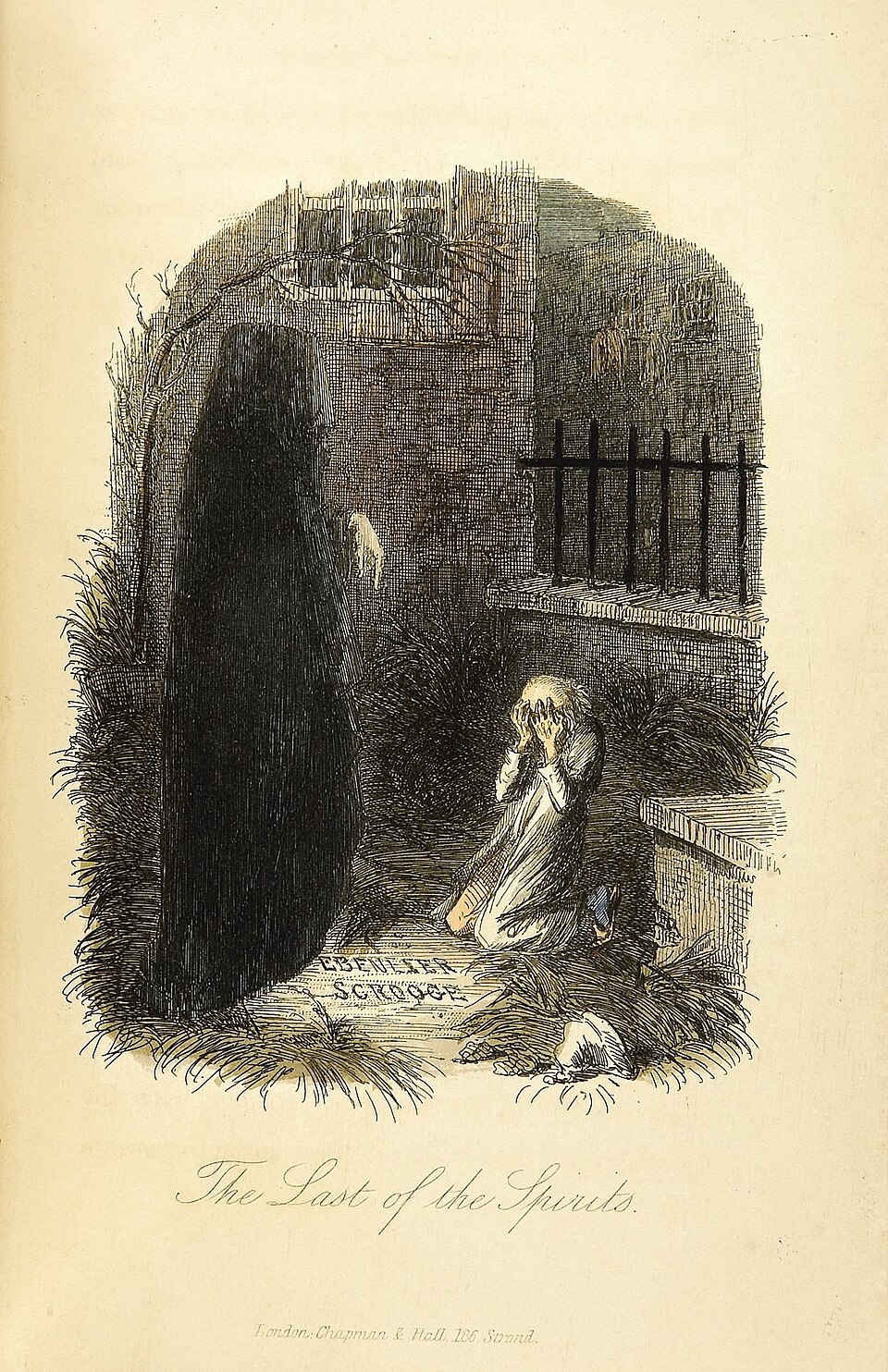
The Ghost of Christmas Yet to Come is a fictional character in Charles Dickens's 1843 novella A Christmas Carol. The Ghost is the last of the three spirits that appear to miser Eb…
The Ghost of Christmas Yet to Come is a fictional character in Charles Dickens's 1843 novella A Christmas Carol. The Ghost is the last of the three spirits that appear to miser Ebenezer Scrooge to offer him a chance of redemption, foretold by the ghost of his deceased business partner, Jacob Marley.
The Ghost of Christmas Yet to Come is a fictional character in Charles Dickens's 1843 novella A Christmas Carol. The Ghost is the last of the three spirits that appear to miser Ebenezer Scrooge to offer him a chance of redemption, foretold by the ghost of his deceased business partner, Jacob Marley.
Following the visit from Marley, Scrooge receives nocturnal visits from three Ghosts of Christmas, each representing a different period in Scrooge's life. The shrouded, ominous, and silent Ghost of Christmas Yet to Come is Scrooge's last visitor and shows him a vision of a Christmas Day soon after his death.
Background
By early 1843, Dickens had been affected by the treatment of the poor, and in particular the treatment of the children of the poor after witnessing children working in appalling conditions in a tin mine and following a visit to a ragged school. Indeed, Dickens experienced poverty as a boy when he was forced to work in a blacking factory after his father's imprisonment for debt. Originally intending to write a political pamphlet titled, An Appeal to the People of England, on behalf of the Poor Man's Child, he changed his mind and instead wrote A Christmas Carol which voiced his social concerns about poverty and injustice.
Dickens's friend and biographer John Forster said that Dickens had "a hankering after ghosts" while not having a belief in them himself. His journals Household Words and All the Year Round regularly featured ghost stories, with the novelist publishing an annual ghost story for some years after his first, A Christmas Carol, in 1843. In this novella, Dickens was innovative in making the existence of the supernatural a natural extension of the real world in which Scrooge and his contemporaries lived. Dickens making the Christmas Spirits a central feature of his story is a reflection of the early-Victorian interest in the paranormal.
Unlike the previous two Christmas Spirits, the Ghost of Christmas Yet to Come follows the tradition of Gothic literature, which Dickens had read as a teenager. Apart from A Christmas Carol, Dickens also incorporated the gloomy atmosphere and melodrama of Gothic literature into various of his other works, shifting them to a more modern period and an urban setting, for example in Oliver Twist (1837–1838), Bleak House (1854), Great Expectations (1860–1861) and the unfinished Edwin Drood (1870). As in A Christmas Carol, these novels juxtapose wealthy, ordered, and affluent civilisation with the disorder and barbarity of the poor in the same metropolis.
Significance to the story
Unlike the two previous Spirits who come at the stroke of one, the Ghost of Christmas Yet to Come makes its appearance on the last stroke of twelve, the Witching Hour. It is introduced as an ominous and silent figure: "...a solemn Phantom, draped and hooded, coming, like a mist along the ground, towards him... Scrooge feared the silent shape so much that his legs trembled beneath him, and he found that he could hardly stand when he prepared to follow it."
When it came near him, Scrooge bent down upon his knee; for in the very air through which this Spirit moved, it seemed to scatter gloom and mystery. It was shrouded in a deep black garment, which concealed its head, its face, its form, and left nothing of it visible, save one outstretched hand. But for this, it would have been difficult to detach its figure from the night and separate it from the darkness by which it was surrounded.
The Spirit in its "dusky shroud" is a personification of Death. While this may seem an odd choice to modern readers for a Christmas ghost, in the early Victorian era, people would remember their deceased loved ones at Christmastime, which was also a time for reflection at the end of the year. In his article "What Christmas Is, As We Grow Older", published in Household Words in 1851, Dickens wrote, "Of all days in the year, we will turn our faces to that City [of the Dead] upon Christmas Day, and from its silent hosts bring those we loved, among us." Dickens described a similar Christmas spectre in his story "A December Vision" (1850), which also has a slow and unwavering persistence and which also has a shaded face and ghostly eyes.
Like the future, the Ghost of Christmas Yet to Come is unknown, mysterious, and silent, and Scrooge fears his message most of all. The Spirit points when it wishes Scrooge to look at something or follow. The Victorians believed ghosts had the power to see the future, including people's deaths, and in the novella, the Ghost of Christmas Yet to Come reveals to Scrooge his death. The Spirit shows Scrooge that his future fate is not set in stone or written on his gravestone but can be changed – by changing his actions in the present. The ghost is described as being moved by Scrooge's case. When it first arrives, Scrooge is fearful of the ghost that the "spirit paused a moment, as observing his condition, and giving him time to recover." When Scrooge vows to change his ways upon seeing his unloved grave, the ghost's kind hand trembles.
During the 1840s, the threat of typhus and cholera was very real for everyone, high and low in London, and the Ghost of Christmas Yet to Come is a memento mori, a reminder of the inevitability of death, but also a reminder of the fear of death and dying – because with death comes a reckoning, leading either to eternal reward or to eternal punishment. The ghost of Jacob Marley in Stave I revealed to Scrooge which fate he can expect unless he changes his ways. The Spirit shows Scrooge how his death will bring indifference to others at best and joy at its worst; that those who build up treasures on earth will find that these same treasures have no worth after death. The only sorrow the Spirit can show in connection with the death of the unknown man is the death of Tiny Tim, the two deaths being linked in a way as yet unknown to Scrooge. Without becoming benevolent and charitable and without accepting redemption and salvation, Scrooge will suffer the same fate as Marley