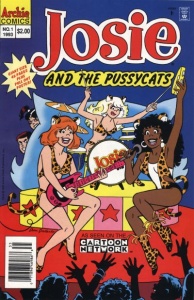
Josie and the Pussycats is a teen-humor comic book about a fictional rock band, created by Dan DeCarlo and published by Archie Comics. First published in 1963, with regular issues…
Josie and the Pussycats is a teen-humor comic book about a fictional rock band, created by Dan DeCarlo and published by Archie Comics. First published in 1963, with regular issues through 1982, additional one-shot issues followed on an irregular basis. A reboot of the comic for the New Riverdale imprint launched in September 2016.
Read more about this topic
Josie and the Pussycats (initially published as She's Josie and Josie) is a teen-humor comic book about a fictional rock band, created by Dan DeCarlo and published by Archie Comics. First published in 1963, with regular issues through 1982, additional one-shot issues followed on an irregular basis. A reboot of the comic for the New Riverdale imprint launched in September 2016.
Hanna–Barbera adapted the comic as a Saturday-morning animated TV series in 1970, paired with an eponymous pop album. The band was subsequently portrayed in a 2001 live-action film, with musical performances released on an eponymous soundtrack album. Josie and the Pussycats appear as part of the 2017 live-action television drama series Riverdale on The CW, with the character of Josie recurring in the Katy Keene spin-off series.
Publication history
Cartoonist Dan DeCarlo, who had spent most of the 1950s drawing teen and career-girl humor comics such as Millie the Model for Atlas Comics, that decade's forerunner of Marvel Comics, began freelancing for Archie Comics. In 1960, he and Atlas editor-in-chief Stan Lee co-created the short-lived syndicated comic strip Willie Lumpkin, about a suburban mail carrier, for the Chicago, Illinois-based Publishers Syndicate. Casting about for more comic-strip work, DeCarlo created the characters of Josie and her friends. Josie DeCarlo, the artist's wife and Josie's namesake, explained that "We went on a Caribbean cruise, and I had a [cat] costume for the cruise, and that's the way it started."
DeCarlo first tried to sell the character as a syndicated comic strip called Here's Josie, recalling in 2001:
When Publishers Syndicate in Chicago got interested in Willie Lumpkin ... I was also hustling my own strip and trying to get it published. Before we got to Publishers Syndicate, I went to United Features in New York with two strips — Barney's Beat and Josie. [United Feature] told me they liked them both, and they'd like to see more samples, because I didn't bring much. I brought maybe six dailies of Barney's Beat and six dailies of Josie. That posed a problem for me. I knew I couldn't handle both strips and still keep up with the comic book work, because a syndicated bit was very risky. So, I decided to shelve Josie, and concentrated on Willie Lumpkin. Once publishers got interested in it, it was a year in developing, and it was launched, I think, in 1960. But Willie Lumpkin didn't last long—it only last [sic] a little better than a year, maybe a year and a half. I quickly submitted the Josie strip back to Publishers and Harold Anderson, and he sent it back and said, 'It's not what we're looking for, Dan, but keep up the good work,' or words of that kind. Then is when I decided to take it to Archie to see if they could do it as a comic book. I showed it to Richard Goldwater, and he showed it to his father, and a day or two later I got the OK to do it as a comic book.
Josie was introduced in a solo series, She's Josie. The first issue was cover-dated February 1963. The series featured levelheaded, sweet-natured redhead Josie, her ditzy blonde bombshell friend Melody, and the brainy, cynical, bespectacled brunette Pepper. These early years also featured the characters of Josie's beatnik boyfriend Albert; Pepper's strong but not-too-bright boyfriend Socrates ("Sock" for short); Albert's rival Alexander Cabot III, who chased after both Josie and Melody; and Alex's obnoxious twin sister Alexandra Cabot. None of the mainstream Archie characters appeared with Josie until the ninth issue of her own title. Josie and her friends occasionally appeared in "crossover" issues with the main Archie characters. She's Josie displayed a new Josie-only logo beginning with issue #14 (August, 1965), was officially renamed Josie with issue #17 (December, 1965), and again renamed, to Josie and the Pussycats, with issue #45 (December, 1969). The series finished its run under this title with issue #106 (October, 1982). Josie and her gang also made irregular appearances in Pep Comics and Laugh Comics during the 1960s.
In 1969, Archie Comics made several changes to the Josie comic:
In Josie #42 (August 1969), Josie met a heavily built blond folk singer named Alan M. who, over time, became Josie's on-again, off-again boyfriend (much to the chagrin of Alexandra, who was also immediately smitten with Alan M. and never missed an opportunity to try and steal him away).
In Josie #43 (September 1969), Alexandra discovered that her cat Sebastian was actually a reincarnation of an ancestor of the Cabot family, who was executed for consorting with witches. Whenever Alexandra held Sebastian in her arms, she could cast magic spells. Alexandra generally used her powers to compete with Josie for Alan M., but the spells she cast usually backfired in some way. Moreover, her spells ended whenever someone nearby snapped their fingers (which happened often). Alexandra and Sebastian's witchy powers were not used in Hanna-Barbera's TV show, and they were soon discontinued in the comic as well.
In Josie and the Pussycats #45 (December 1969), the first issue to bear that new title, Josie and Melody decided to start a band called the Pussycats. Alexandra was asked to be their bassist, but she insisted that the group's name be to "Alexandra's Cool Time Cats"; so, instead, Valerie Smith, a new girl in school, was recruited to play bass. The Pussycats made their leopard print band uniforms (complete with cat-ear headbands and long tails) and performed at their first gig, a school dance, as a seething Alexandra tried unsuccessfully to use her witchcraft for revenge.
The reimagining of the comic resulted in three casualties: Albert, Sock, and Pepper, who were phased out altogether. From 1970 on, most of the stories in the comic book revolved around the Pussycats traveling around the country and the world to perform gigs, with Alan M., Alex, and Alexandra (and sometimes Sebastian) in tow. When the girls were not performing, they dealt with the various trial