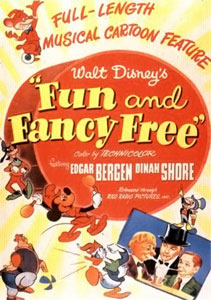
Fun and Fancy Free, formerly known as Fun & Fancy Free, is a 1947 American animated musical fantasy anthology film produced by Walt Disney and Ben Sharpsteen and released on Septe…
Fun and Fancy Free, formerly known as Fun & Fancy Free, is a 1947 American animated musical fantasy anthology film produced by Walt Disney and Ben Sharpsteen and released on September 27, 1947, by RKO Radio Pictures. The film is a compilation of two stories: Bongo, narrated by Dinah Shore and loosely based on the short story "Little Bear Bongo" by Sinclair Lewis; and Mickey and the Beanstalk, nar…
Fun and Fancy Free, formerly known as Fun & Fancy Free, is a 1947 American animated musical fantasy anthology film produced by Walt Disney and Ben Sharpsteen and released on September 27, 1947, by RKO Radio Pictures. The film is a compilation of two stories: Bongo, narrated by Dinah Shore and loosely based on the short story "Little Bear Bongo" by Sinclair Lewis; and Mickey and the Beanstalk, narrated by Edgar Bergen and based on the "Jack and the Beanstalk" fairy tale. Though the film is primarily animated, it also uses live-action segments starring Bergen to join its two stories.
Plot
Jiminy Cricket appears inside a large house, exploring and singing "I'm a Happy-Go-Lucky Fellow" until he comes across a doll, a teddy bear, and a record player. Among the records, he finds one titled Bongo, a musical romance story narrated by Dinah Shore. While he doesn't know the narrator, he still decides to play it.
Bongo
The story follows Bongo, a circus bear who longs for freedom. Though celebrated in the circus ring, he is mistreated offstage. While traveling by circus train, he acts on his instincts and escapes into the wild. Initially optimistic about his new life, Bongo quickly realizes the harsh realities of the North American wilderness.
The next morning, Bongo meets a female bear named Lulubelle, and the two fall in love. However, a burly rogue bear named Lumpjaw misinterprets Lulubelle's playful slap as affection and claims her for himself. Bongo later learns that slapping is the bears' way of showing love and returns to challenge Lumpjaw. After a fierce fight ending in a plunge down a waterfall, Lumpjaw is swept away, and Bongo and Lulubelle are happily united.
After the story ends, Jiminy notices an invitation to a birthday party for Luana Patten at the house across the street. He hops over and quietly joins the festivities, where Charlie McCarthy, Mortimer Snerd, and Edgar Bergen entertain Luana. Edgar decides to tell a story.
Mickey and the Beanstalk
In a parody of Jack and the Beanstalk, the kingdom of Happy Valley, sustained by a singing golden harp, falls into despair when the harp is stolen. The story focuses on three poor farmers — Mickey, Donald, and Goofy — are down to a single loaf of bread and one bean. Driven mad by hunger, Donald nearly kills their pet cow, prompting Mickey to trade the cow for "magic beans". Enraged and thinking that Mickey had been defrauded, Donald throws the beans and they fall into a hole in the floor. Overnight, the beans, which turn out to be truly magical after all, sprout into a gigantic beanstalk that lifts their house to the sky.
The next morning, the trio find themselves in a giant land above the clouds. They sneak into a castle where they discover a table of food. While the friends feast, they find the golden harp, who reveals that she was kidnapped by Willie the Giant. Willie appears, showing off his powers of flight, invisibility, and shapeshifting. When Mickey sneezes inside Willie's sandwich, he is caught. Pretending to be a fortune-teller, Mickey tries to trick Willie into becoming a fly but fails when Willie transforms into a bunny instead. He catches Mickey, Donald, and Goofy, locking them in the harp's chest in retaliation while taking the harp out. Mickey manages to escape and the harp sings Willie to sleep. As he tries to get the key for the chest, Mickey accidentally falls into a box of snuff and sneezes, almost waking the giant. The giant sneezes and falls asleep as Mickey climbs up the shelf and frees Donald and Goofy.
The trio flees with the harp, but Willie awakens and chases them down the beanstalk. Mickey stalls Willie long enough for Donald and Goofy to cut the beanstalk, causing Willie to fall to his presumed death.
Back at Edgar Bergen's home, he concludes the tale by explaining that the return of the harp restored happiness to Happy Valley. Mortimer mourns Willie's fate, but just as Edgar reassures him that Willie is fictional, the giant appears in Hollywood, having survived the fall, and inquires about the whereabouts of Mickey. Upon seeing Willie, Edgar faints from shock while Mortimer tells Willie goodnight. The film ends with Jiminy Cricket leaving the house as Willie continues his search.
Cast
Edgar Bergen – himself, Charlie McCarthy, and Mortimer Snerd
During the 1940s, Mickey and the Beanstalk and Bongo were originally going to be developed as two separate feature films.
In the late 1930s, Mickey's popularity fell behind Donald Duck, Goofy, Pluto, Max Fleischer's Popeye and Warner Bros.' Porky Pig. To boost his popularity, Disney and his artists created cartoons such as "Brave Little Tailor" and "The Sorcerer's Apprentice", the latter of which was later included in Fantasia (1940). In early 1940, during production on Fantasia, animators Bill Cottrell and T. Hee had pitched the idea of a feature film based on Jack and the Beanstalk starring Mickey Mouse as Jack and with Donald Duck and Goofy as supporting characters. When they pitched it to Disney, he "burst out laughing with tears rolling down his cheeks with joy", as Cottrell and Hee later recalled. Disney enjoyed the pitch so much he invited other employees to listen to it. However, he said that, as much as he enjoyed the pitch of the film, the film itself would never go into production, because, as Disney claimed, they "murdered [his] characters". However, Cottrell and Hee were able to talk Disney into giving it the green-light and story development as The Legend of Happy Valley, which began production on May 2, 1940.
The story was handed to Frank Tashlin after developmental hurdles, who finished the story treatment in a more efficient manner and ahead of schedule, much to Disney's pleasure. In an interview with hist