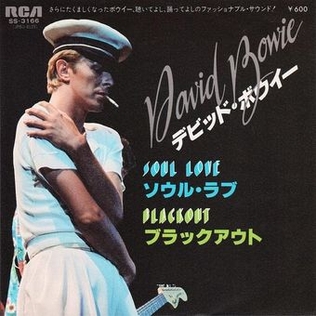
David Bowie recorded "Soul Love" on 12 November 1971 at Trident Studios in London. Co-produced by Bowie and Ken Scott, the lineup consisted of Bowie's backing band known as the Spiders from Mars – comprising guitarist Mick Ronson, bassist Trevor Bolder and drummer Mick Woodmansey.
Biographer Nicholas Pegg notes that the song acknowledges Bowie's formative years, calling the riff reminiscent of "Stand by Me" by Ben E. King. Like most songs on the album, the song was not initially written with the Ziggy concept. After being rewritten to fit the narrative, "Soul Love" pertains to numerous characters dealing with love before the impending disaster that will destroy Earth as described in the album opener "Five Years". Author Marc Spitz notes that the track has a sense of "pre-apocalypse frustration" to it. Whereas "Soul Love" features a hand-clap rhythm, both it and "Five Years" share similar drum rhythms and vocal progressions, leading biographer Chris O'Leary to believe that the two tracks were written around the same time. He also states that both tracks act as a "prelude" to the true introduction of the Ziggy Stardust character on "Moonage Daydream". Author Peter Doggett writes that Bowie's voice sounds reminiscent of his 1977 album Low: dull, jaded, depressed and "sapped" of vitality. Other than the rare exception of "Lady Grinning Soul" from Aladdin Sane (1973), Bowie rarely used the word "soul" in his vocabulary, mainly due to his belief that the soul is vulnerable to "unwelcome claimants", as well as soulfulness being a common theme in rock music.
Doggett notes that following the "panoramic vision" of "Five Years", "Soul Love" offers a more "optimistic" landscape, with bongos and acoustic guitar indicating "mellow fruitfulness." The characters include a mother grieving at her son's grave, the son's love of the ideal for which he died (which parallels Mary grieving at Jesus's tomb), a pair of young lovers believing in "new words", and the love of "God on high". However, according to Pegg, the lyrics have a "nihilistic undercurrent" and a "cynical re-reading" of love that contrasts sharply with Bowie's previous songs: "he rails against 'idiot love' which 'descends on those defenseless' and bleakly concludes that 'love is not loving'." Also present are themes that reflect Bowie's disdain for institutions and causes, such as the dead son that "gave his life to save the slogan", which reprises the theme of futility previously found in his 1969 song "Cygnet Committee", and prefigures "Tony went to fight in Belfast" later found in the song "Star". The lyrics also feature a priest that previously appeared in "Five Years", here "tastes the word" amid "the blindness that surrounds him", recollecting the "bullshit faith" of Bowie's 1971 song "Quicksand", which clears the way for a secularised "church of man, love" (or "church of man-love") found in "Moonage Daydream".