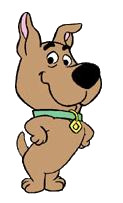
Scrappy-Doo is a fictional character in the Scooby-Doo franchise. A Great Dane puppy and the nephew of the titular character, he was created by Hanna-Barbera Productions in 1979 a…
Scrappy-Doo is a fictional character in the Scooby-Doo franchise. A Great Dane puppy and the nephew of the titular character, he was created by Hanna-Barbera Productions in 1979 and appeared in various incarnations of the franchise.
Scrappy-Doo is a fictional character in the Scooby-Doo franchise. A Great Dane puppy and the nephew of the titular character, he was created by Hanna-Barbera Productions in 1979 and appeared in various incarnations of the franchise. Lennie Weinrib provided his voice for one season in 1979, and from 1980 on it was performed by Don Messick (who also voiced Scooby). In the first live-action theatrical film, video games and commercials, he was voiced by Scott Innes (with some additional performance by Rowan Atkinson).
He was created in order to save the series' ratings, which by 1979 had begun to sink to the point of cancellation threats from ABC, who considered choosing between Scooby-Doo and an unnamed pilot from Ruby-Spears Enterprises which Mark Evanier had also written.
Precursors
Though Scrappy officially debuted in the fall of 1979, there may have been hints of his existence in 1969, as he "...bore a resemblance to Spears's and Ruby's initial idea for a feisty little dog", which was one of the early ideas for the Scooby-Doo character himself, along with the "big cowardly dog" ultimately chosen.
After hearing Joe Barbera's description of the character, writer Mark Evanier was significantly reminded of Henery Hawk from the Looney Tunes franchise and incorporated what he knew of said character into the script.
Development
Scrappy's creation officially began in 1978, when Scooby-Doo's ratings were sinking to the point of cancellation threats from ABC.
Duane Poole, a story editor for the first series in which Scrappy appeared, recalled it as a lively time, with many new ideas and some new blood being hired with the desperation to revive Scooby-Doo, which had been a cash-cow in its glory days.
Mel Blanc was the first choice to voice Scrappy, given his connection to Henery Hawk, but he demanded more money to voice the part. Frank Welker, the voice of Fred Jones, auditioned to voice Scrappy as a dual role during the character's development (one of several voice actors considered for the role) and coined the catchphrase "Scrappy Dappy Doo" & "Puppy Power" during his audition. He would later change this to "Monkey Muscle" for the similar Donkey Kong Jr. character he would voice for TV's Saturday Supercade. The next choice was Messick, who was seen as giving the best audition, but still deemed "the wrong voice". Afterwards, other well-known cartoon voice artists were considered or suggested: Daws Butler, Paul Winchell, Marilyn Schreffler, Howard Morris, Dick Beals and Marshall Efron. Ultimately, Lennie Weinrib was chosen.
Live-action Scooby-Doo movie (2002)
Scrappy was first included in an early draft of what would become Scooby-Doo (2002) in around March 2000—though he did not physically appear, was only mentioned offhand by Shaggy and Scooby and was heavily implied to have been put to sleep for undisclosed reasons. James Gunn first acknowledged his involvement in April 2000. Other original ideas for the villain included the Old Man Smithers, the villain from the film's prologue. Concept art for Scrappy turning into a monster was drawn in 2001. According to the DVD commentary, choosing the villain of the film was a problematic part of the production, as the makers did not feel comfortable simply giving the role to an "anonymous monster" and that the ending was in "bits and pieces" and the "confinements forced them to be creative". "There is a Scrappy because he exists in the cartoon, so we have to acknowledge him", Gunn stated in an interview shortly before the film's release.
Ultimately, in the final film, Scrappy is revealed to be its main antagonist and had been plotting to take revenge on Mystery Inc. for abandoning him prior to the film's events. Despite previously stating that he felt that "kids didn't care", Gunn later admitted with some dismay that younger viewers had reacted poorly to the development, admitting he had not understood how popular Scrappy was with younger viewers. "I still think it was funny that Scrappy was the villain", he explained in an interview with Cinefantastique, "but there are kids out there who were really upset."
Performers
Lennie Weinrib (1979–1980; Scooby-Doo and Scrappy-Doo)
Don Messick (1980–1988; Scooby-Doo and Scrappy-Doo, The New Scooby and Scrappy-Doo Show, Strong Kids, Safe Kids, The 13 Ghosts of Scooby-Doo, Scooby-Doo Meets the Boo Brothers, Scooby-Doo and the Ghoul School, Scooby-Doo and the Reluctant Werewolf)
Scott Innes (1999–present; The Scooby-Doo Project, Harvey Birdman, Attorney at Law, Scooby-Doo, video games, commercials, toys, various merchandise)
J.P. Manoux (2002; Scrappy Rex in the live-action film)
James Arnold Taylor (2007; Drawn Together)
Dan Milano (2007; Robot Chicken)
Tom Kenny (2019; Wacky Races)
Jason Mantzoukas (2024; Velma)
C. H. Greenblatt (2025; Jellystone!)
Reception
Scrappy was initially seen as a "good idea" by Saturday Morning Review. Viewership seemed to react positively to Scrappy, as Scooby's ratings went up with Scrappy's arrival. The character continued to be a success for the next decade. Story editor Duane Poole noted that "Scrappy solved a lot of story problems. Before you had to get Shaggy and Scooby into dangerous situations—and there was no real easy way to get them there—with Scrappy, he, uh, picked them up and carried them there. He just charged in. He was just such the antithesis of what Scooby and Shaggy were. The dynamic was great fun to play."
Joe Ruby and Ken Spears seemed to have a less-than-positive view of the character. The co-founder of Ruby-Spears enterprises said, "Everyone was upset", though was unclear about whether this concerned business reasons (they had started their own company two years earlier) or personal creative reasons (considering that if Scooby had been canceled, then the last slot would have hit their show instead), starting when, in 1979, it appeared that a pilot of theirs would be renewed over Scooby's. Mark Evanier, who wrote said pilot, was hired impromptu to write Scrappy-Doo into a new pilot to renew interest in Scooby. As a result, Scooby was renewed over t