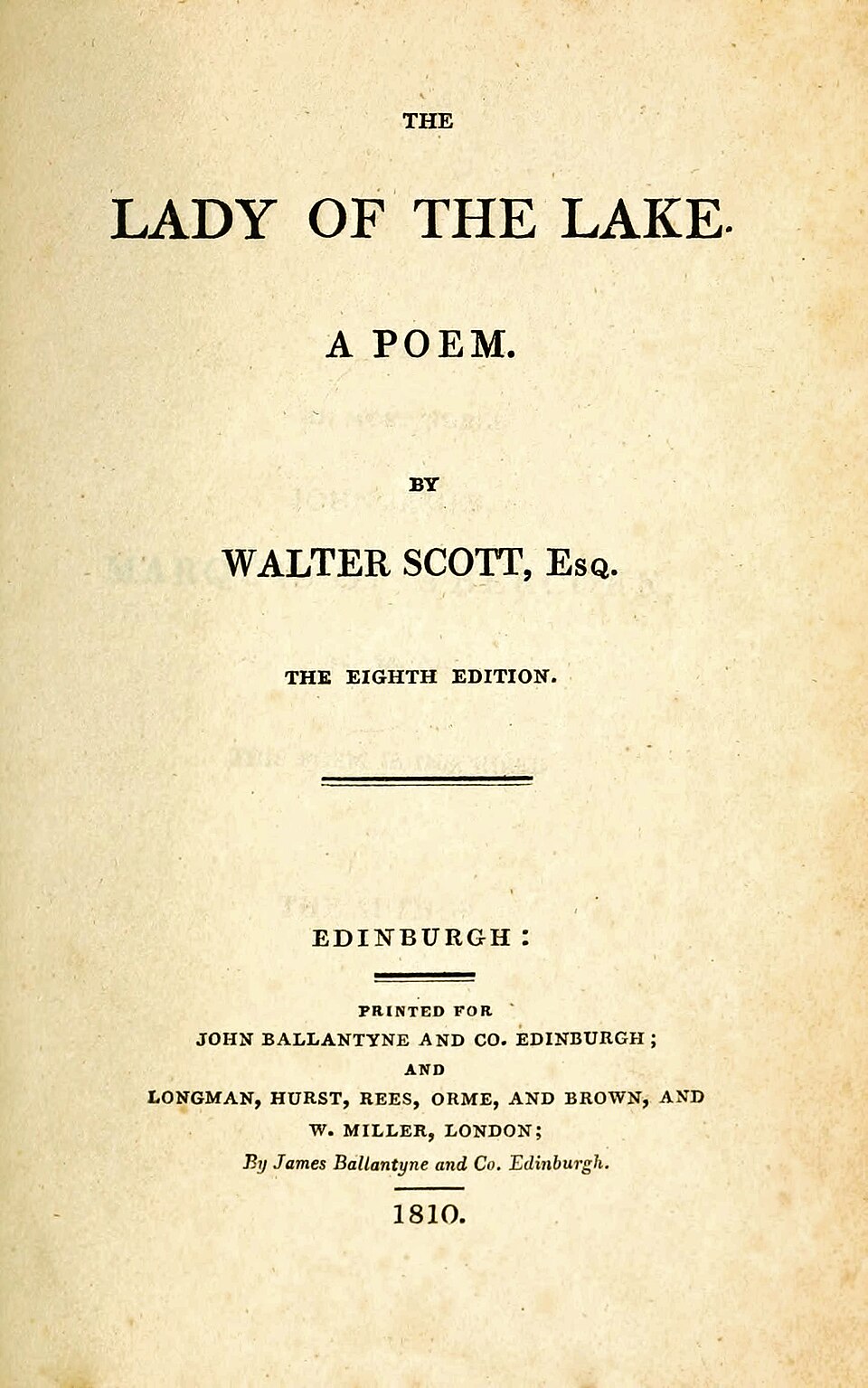
The Lady of the Lake is a narrative poem by Walter Scott, first published in 1810. Set in the Trossachs region of Scotland, it is composed of six cantos, each of which concerns th…
The Lady of the Lake is a narrative poem by Walter Scott, first published in 1810. Set in the Trossachs region of Scotland, it is composed of six cantos, each of which concerns the action of a single day.
The Lady of the Lake is a narrative poem by Walter Scott, first published in 1810. Set in the Trossachs region of Scotland, it is composed of six cantos, each of which concerns the action of a single day. There are voluminous antiquarian notes. The poem has three main plots: the contest among three men, Roderick Dhu, James Fitz-James, and Malcolm Graeme, to win the love of Ellen Douglas; the feud and reconciliation of King James V of Scotland and James Douglas; and a war between the Lowland Scots (led by James V) and the Highland clans (led by Roderick Dhu of Clan Alpine). The poem was tremendously influential in the nineteenth century, and inspired the Highland Revival.
Background
The first hint of The Lady of the Lake occurs in a letter from Scott to Lady Abercorn dated 9 June 1806, in which he says he has "a grand work in contemplation … a Highland romance of Love Magic and War founded upon the manners of our mountaineers". He saw it as doing for the Highlands what The Lay of the Last Minstrel had done for the Borders.
But in January 1807 he had decided to postpone the Highland work in favour of Marmion since "it would require a journey of some length into the country not only to refresh my faded or inaccurate recollection of the scenery; But also to pick up some of the traditions still floating in the memory of the inhabitants". The poem was eventually begun during a visit to the southern Highlands at the end of August and beginning of September 1809, but in the early stages it seems not to have been composed in a straightforward manner, Scott writing to his Highland correspondent Mrs Clephane on 27 October of the same year: 'I have been amusing myself with trying to scratch out a Douglas tale but this is only for your own ear and family as I have not formed any serious intention of combining or systematizing the parts I have written'. But the poem now had its name, The Lady of the Lake.
Scott announced good progress in November and December. There was some interruption from legal business, but the first two cantos were in print by 14 March, and the next two by 14 April with the fifth in the press and the sixth within sight of completion.
Editions
The first edition of The Lady of the Lake was published on 8 May 1810 in Edinburgh by John Ballantyne and Co. and in London on 16 May by Longman, Hurst, Rees, and Orme, and William Miller. The price was two guineas (£2 2s or £2.10), and 2000 copies were printed. Several more editions followed in the same year, and on 20 February Scott informed John Leyden that 'no less than 25,000 copies have disappeared in eight months and the demand is so far from being abated, that another edition of 3,000 is now at press'.
A critical edition of The Lady of the Lake is due to appear as Volume 3 of The Edinburgh Edition of Walter Scott's Poetry.
Characters
James V of Scotland travelling incognito as James Fitz-James, the Knight of Snowdoun
Ellen Douglas, daughter of James Douglas
James Douglas, once the Earl of Morton, the mentor of the youthful King James, now exiled as an enemy
Allan-Bane, a bard
Roderick Dhu, the chief of Clan Alpine, outlawed after committing a cold-blooded homicide at the Scottish court
Lady Margaret, the mother of Roderick Dhu
Malcolm Graeme, a young highland chief and former courtier of King James, loved by Ellen
Brian the Hermit, a pagan prophet in the druid tradition
Duncan, a leading member of Clan Alpine who has just died
Angus, the son of Duncan
Norman, a bridegroom and member of Clan Alpine
Mary, Norman's bride
Blanche of Devan, a lowland Scottish woman, whose bridegroom was murdered on her wedding day by the men of Clan Alpine, causing Blanche to lose her reason
Canto I: The Chase
The poem begins with a rapid-moving hunt, chasing a stag in the forests of the Trossachs. The stag outruns the hunt, exhausting all its members until only one huntsman – who, we later learn, is James Fitz-James – follows it until his horse falls down dead of exhaustion.
The huntsman blows his horn to try to contact someone, and wanders to the shore of Loch Katrine where a young woman, Ellen Douglas, rows across and picks him up in a skiff. He is then taken to a lodge, which he suspects is a concealed hide-out of a highland chief. There he is given dinner by Ellen, the bard Allan-Bane, and Lady Margaret, and a bed for the night.
That night he dreams of Ellen, only to see her face suddenly change to that of his exiled enemy, James Douglas – leading him to suspect that Ellen and Douglas are related.
Canto II: The Island
Fitz-James leaves the island first thing in the morning. Ellen and Allan Bane discuss Roderick Dhu, Malcolm Graeme, and Fitz-James, agreeing that the first is bloodthirsty and homicidal, but the only person who would defend Douglas, and that Fitz-James is an attractive person, but may be a secret foe of their kinsfolk.
Oarsmen of Clan Alpine escort Roderick Dhu to the island, singing the boat song, 'Hail to the Chief'. Roderick asks Douglas for Ellen's hand in marriage, to conclude an alliance between Douglas and Clan Alpine, which can be the basis of an uprising against King James. Douglas refuses, partly because he will not force Ellen into a loveless marriage, partly also because he remains, despite all the injuries he has suffered, loyal to King James.
Roderick and Malcolm quarrel over Ellen, and are about to draw their swords against each other, but Douglas declares that the first to draw will be his foe. Douglas also says that it is an insult for an exile for his daughter to be the spoil of a battle between two chiefs. Roderick tells Malcolm to leave his territory, which he does, refusing even to borrow a boat, swimming across the loch to the shore.
Canto III: The Gathering
Despite Douglas' refusal to participate in the uprising, Roderick decides to commence the rebellion anyway. With a pagan prophet, Brian the Hermit, he fashions and sets alight the fiery cross, and hands it to his henchman, Malise, to summon the members of the clan to war.
The members of the clan drop everything they are doing to respond to t