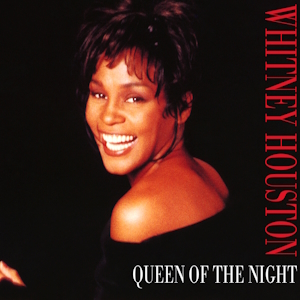
"Queen of the Night" is a song co-written by American singer and actress Whitney Houston along with L.A. Reid, Babyface and Daryl Simmons. Produced by Reid and Babyface along with…
"Queen of the Night" is a song co-written by American singer and actress Whitney Houston along with L.A. Reid, Babyface and Daryl Simmons. Produced by Reid and Babyface along with Simmons and Houston and performed by Houston, it was released on October 12, 1993 by Arista Records as the fifth and final single from the soundtrack album The Bodyguard (1992), and is played during the closing credits of the film of the same name.
The song was an uptempo hard rock number in which Houston expresses how she "rules the club scene" as the self-proclaimed "queen of the night". It was the fifth and last single released from the soundtrack. In the US, it was released as a radio-only single and the song became a top 40 hit on several Billboard airplay charts in early 1994. A house remix version by British remixer C.J. Mackintosh helped Houston earn her fifth number one single on the Billboard Hot Dance Club Songs chart.
It entered the top 40 in several countries such as Canada, Switzerland, Ireland and the Netherlands while finding its biggest success on the charts in Portugal, Iceland, Belgium and the UK, where it landed inside the top 20.
Background and development
Houston and the duo of Babyface and L.A. Reid began working together for the former's album, I'm Your Baby Tonight in March 1990. At the time, Houston had been accused of having her music catering to white audiences and her label Arista hired the duo to silence critics.
The album became a hit and the title track became the duo's first number one single on the Billboard Hot 100. The duo would have two more hits with Houston on the album including the soul ballad "Miracle" and "My Name Is Not Susan". It would start a lifelong collaboration and friendship between the three.
In April 1991, Houston announced that she would begin filming her debut leading role as Rachel Marron in The Bodyguard. After Clive Davis complained of the film not having accompanying music to explain Houston's role as a temperamental, talented diva being protected by a bodyguard she ends up falling in love with, Houston signed a deal to produce her first soundtrack album, agreeing to record the majority of the songs.
The soundtrack would be Houston's second as executive producer. Maureen Crowe was hired as the film's musical supervisor. Houston, who was attaining more control of her career after years of being guided and mentored by Davis, chose Babyface to contribute to the soundtrack.
Recording and composition
On November 9, 1991, weeks before filming commenced in Hollywood, Houston entered Larrabee Sound there to record the song. Babyface and frequent collaborator Daryl Simmons had been busy at work on the soundtrack to the Eddie Murphy vehicle, Boomerang, which led to delays in production on Houston's song.
According to Daryl Simmons, Kevin Costner suggested them to write the song giving them the title "Queen of the Night" but they were stuck on what to do with the song. In their insistence, Houston helped out with the lyrics, musical composition and arrangement of the song.
Said Crowe, "She felt like they had limited time and they wanted to make sure they were writing something she was comfortable with." Crowe continued: "she had been working on her character, so they wanted her to come in, ‘we’ll hammer this out together,’ with the idea of getting the rhythm right, the attitude right."
Reid, who was now busy as president of his and Babyface's record label LaFace and hadn't been musically active since the label began publishing records, became a fourth collaborator after suggesting a drum intro be used.
It would be the first song to be recorded for the soundtrack. The song played a pivotal role in the film where Houston, as Rachel Marron, performs the song at a rowdy dance nightclub (the Mayan Theater in Los Angeles) before audience members grabbed her offstage, causing a near-riot before she's saved by co-star Kevin Costner's character, bodyguard Frank Farmer.
The original soundtrack version of "Queen of the Night" is a hard rock and R&B song with funk, glam metal and new jack swing elements. It has a medium rock tempo with a time signature of 44 common time and 106 beats per minute and plays in the key of A major.
Part of the chorus was inspired by Michael Jackson's 1987 song "Dirty Diana". Vernon Reid of the heavy metal band Living Colour contributed a guitar solo. Houston contributed both lead and background vocals.
Later, Arista sent house music remixes of the song, mainly from British remixer C.J. Mackintosh, which was released to nightclubs and radio. Much like the original, the song starts in the key of A major and has a dance beat of 120 beats per minute.
Critical reception
A reviewer from AllMusic complimented "Queen of the Night" as "a first-rate urban pop song that skillfully captures Houston at her best." Larry Flick from Billboard magazine commented, "If anyone can successfully bring house music back to pop radio, it's Houston", describing it as "a wickedly catchy ditty, armed with a chorus that will stick in your mind like sinfully sweet brain candy." Troy J. Augusto from Cash Box named it Pick of the Week, writing that "it's actually one of Houston's least impressive single releases—but its aggressive vocal delivery and En Vogue-like flow will probably make for another chart-topper." A reviewer from CD Universe felt that Houston "continues to mine her rich vein of ornate balladry and pop-flavored dance workouts, [like] on her own 'Queen of the Night,' with its percolating upbeat production a la L.A. Reid & Babyface." Houston biographer Ted Cox called the song a "thumping metallic funk number" that he described as "uncharacteristic for Whitney, but perfectly fitting with Rachel [Marron], her character in [The Bodyguard]." He further wrote that the song "gives the impression that Whitney was letting a little of her 'raunchy' side show under the guise of playing a part."
Chris Willman of the L.A. Times assessed the song negatively, "The only obvious dud (on the album) is 'Queen of the Night,' a silly stab at hard-rock th