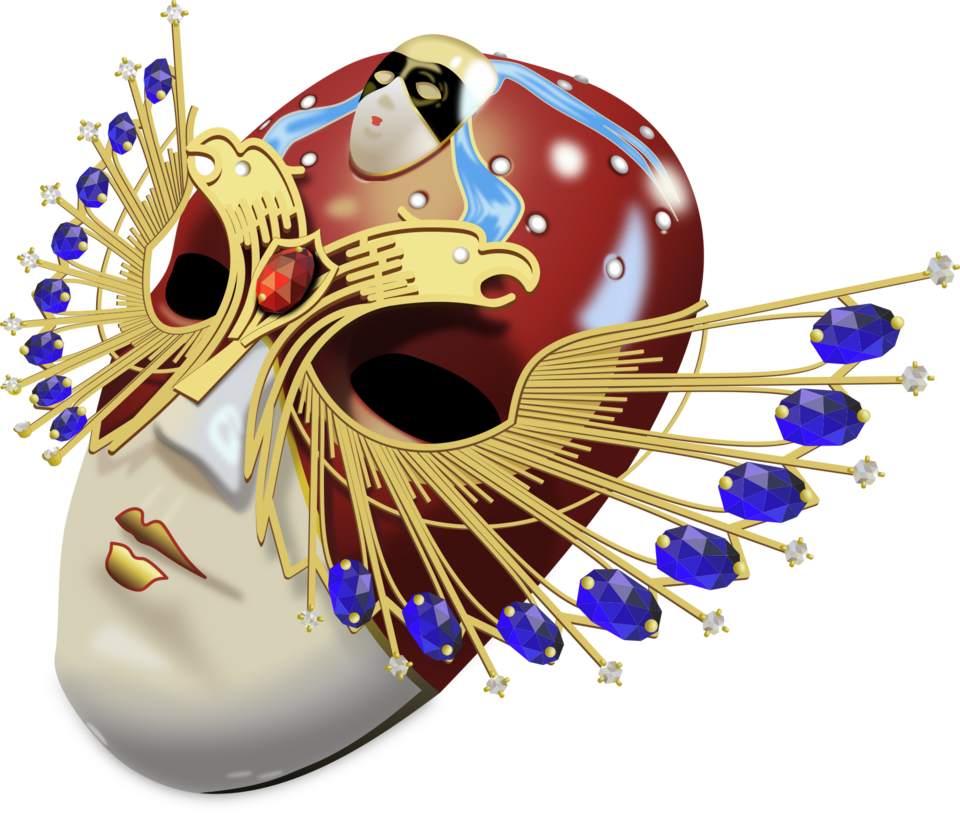
The establishment of the award was announced by Mikhail Ulyanov and Vladimir Urin at a press conference at the Union of Theatre Workers of Russia on the 14th of December, 1994. Georgy Taratorkin became the award's president (he served in this post until his death in 2017). The award was meant to be non-commercial, with the winners receiving only the trophy mask and a diploma. Ulyanov believed that it should be an independent professional award, given for theatrical achievements, "from colleagues to colleagues". Initially the award was focused only on Moscow theatre; the first awards (seven masks for the 1993–94 season) were presented in 1995.
The award was designed by Oleg Sheyncis in 1993. As stated by the artist, he took inspiration from masks of the Carnival of Venice and added to it an element of Russian state symbolism, the double-headed eagle. Sheyncis created the first seven pieces in papier-mâché for the first ceremony. Each mask took him a month to craft; later the masks were made of ceramic.
In 1996, Eduard Boyakov took over the management of the festival. As recalled by Natalia Nikolaeva, the award's director of public relations from 1998 to 2005, Boyakov was the main figure behind the future success of the Golden Mask. In 1996, drama, puppet theatre, opera and ballet were included in the award. During the 1998 Russian financial crisis, a team of only 10 people worked on sheer enthusiasm, organizing the award without any sponsorship or government support.
In February 1996, the Union of Theatre Workers announced the expansion of the award to an all-Russia level. However, it seemed impossible for the jury to attend the plays in remote areas of the country, while 250 premieres took place in Russia in the 1996–97 season alone. The management therefore decided to select all-Russian nominees for the award among the winners of regional and thematic festivals and from the repertoire of the Theatre of Nations. The results of the 1997 Golden Mask sparked a major scandal among critics, theatre professionals, and all parties involved, including the Ministry of Culture: four awards in main nominations went to The Woman in the Dunes by Omsk State Academic Drama Theater. The ceremony itself caused a wave of criticism. The idea of the ceremony, designed by Vladimir Mirzoyev, was "the funeral of the theatre in the 20th century". The hosts, Yuliya Rutberg and Sergei Makovetsky, were dressed as gravediggers, while Oksana Mysina delivered monologues on behalf of the ghost of Alisa Koonen. In an interview with the newspaper Izvestiya, Alexander Kalyagin, Chairman of the , admitted the fiasco with the 1997 ceremony but stressed that the Omsk theatre play had merited the awards it received. He said that he wanted "the Golden Masks to go further and further away from , and not only to settle in the capital's theatres. I wish that there would be discoveries, new names of talented artists, directors, and painters... I am sure there are such names in our vast country". Despite all criticism, in 2006 Boyakov confirmed that he considered the 1997 ceremony the best in the Golden Mask's history: after ten years everyone still remembered it and talked about it.