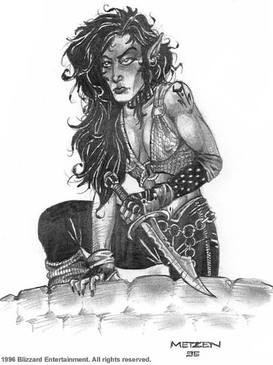
Garona Halforcen, or simply Garona, is a fictional character in Blizzard Entertainment's Warcraft media franchise. Introduced in the 1994 video game Warcraft: Orcs & Humans, she i…
Garona Halforcen, or simply Garona, is a fictional character in Blizzard Entertainment's Warcraft media franchise. Introduced in the 1994 video game Warcraft: Orcs & Humans, she is a spy of mixed orc ancestry from the world of Draenor.
Garona Halforcen, or simply Garona, is a fictional character in Blizzard Entertainment's Warcraft media franchise. Introduced in the 1994 video game Warcraft: Orcs & Humans, she is a spy of mixed orc ancestry from the world of Draenor. Originally described as half-human and half-orc, her background was repeatedly revised in later works, which included her ancestry being changed to the daughter of an orc and another native species of Draenor known as the draenei. Garona was enslaved and mentally conditioned by the orc warlock Gul'dan, who used her as an instrument of the Shadow Council and compelled her to infiltrate human society and assassinate the human ruler King Llane Wrynn.
Garona's story has been developed across video games, novels and comics. Her characterization centres on her uncertain ancestry, divided cultural identity and inability to trust her own body after years of coercion. Commentators have interpreted her as a victim who nevertheless assumes responsibility for actions imposed upon her and isolates herself from other people out of fear that she may again be controlled.
A separate version of Garona, portrayed by Paula Patton, appears in the 2016 film adaptation Warcraft. The film changes her ancestry to her original presentation as a half-human and half-orc individual, which positions her between the human and orc societies. Patton's performance was frequently identified as one of the film's strengths, although critics disagreed over whether Garona received meaningful development or was instead sexualized and inadequately explored. Her appearance also prompted discussion of the casting of women of colour as visually non-human characters in fantasy films.
Original introduction and revisions
Garona was introduced in Warcraft: Orcs & Humans, whose manual gives her a prominent role in presenting the setting's early history. Its section "The Destiny of the Orcish Hordes" is framed as an account written by "Garona of the Shadow Council". In its introduction, Garona contrasts her history with the crude records left by earlier orc chieftains, describes herself as being of both orc and human lineage, and states that the skills and schooling acquired during her travels elevated her to the position of chief interpreter to the Shadow Council. She subsequently narrates the Horde's conquests, internal conflicts and preparations for the invasion of the human lands in the first person.
During early development of Warcraft III: Reign of Chaos, producer Rob Pardo identified Garona and Thrall as examples of named heroes who would persist throughout the game and be controlled by the player. Garona was not included in the released version. At BlizzCon 2007, Blizzard creative director Chris Metzen said that he wanted to make Garona relevant to the Warcraft universe again. He proposed that she might become a senior maternal figure within orc society or a partner for Thrall, but emphasized that these were personal ideas that had not been approved for development. Neither proposal was used.
Blizzard subsequently returned to the character through the World of Warcraft comic series. In 2009, Blizzard writer Micky Neilson said that the comic's second story arc had been designed to answer questions about Garona's background and explain why she had committed certain acts. Metzen described Blizzard as having only recently begun to use the character again and said there was continued interest in developing her.
The comic revised Garona's non-orc ancestry from human to draenei, a species of extraterrestrial origin that lived in peace with the orcs of the world of Draenor for generations, and depicted her as the result of an experiment arranged by Gul'dan. It established that she had been magically aged, tortured and conditioned to obey the Shadow Council. World of Warcraft: Chronicle Volume 2 revised this account again. In the later version, Garona was naturally born to a captive draenei woman and an orc warrior and encountered Gul'dan only after surviving the destruction of her clan. Gul'dan then bound her mind, trained her as an assassin and used magic to accelerate her maturation.
Film adaptation
Director Duncan Jones sought to tell the film's conflict from both human and orc perspectives rather than depict either population as uniformly good or evil. He described the principal figures on each side as noble and empathetic, with their own cultures and understandable motivations. Garona's divided loyalties were made an important connection between the two narratives.
Patton accepted the part after reading the screenplay and meeting Jones. She had not played the Warcraft games and instead researched the character through books and other background material before creating her own interpretation. Patton said that she was drawn to Garona's position as a survivor who belonged fully to neither the human nor orc society.
For the film's separate continuity, Garona was changed from half-orc and half-draenei to half-orc and half-human. Patton said that Blizzard approved the change because it made sense for the film's treatment of her relationship with the human characters. She interpreted Garona's progression from Gul'dan's slave to a person able to determine her own allegiance as the character's central development. Patton also connected Garona's uncertainty about her identity with her own evolving understanding of being biracial and believed that the character could speak to people who felt that they did not belong within a single community.
Patton trained for approximately two and a half hours a day, six days a week, to acquire the physique requested by Jones. Her preparation included sword and knife fighting, boxing, horse riding and stunt work. She said that completing the physical training helped her understand Garona as a warrior rather than merely imitate one during filming.
Several shades of green, hairstyles and wigs were tested during pre-production. The filmmakers ultimately decided not to cover Patton with green makeup and instead altered her skin dig