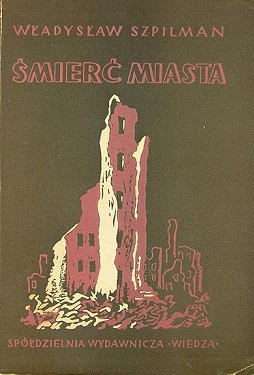
The Pianist, originally published as Śmierć Miasta. Pamiętniki Władysława Szpilmana 1939–1945, is a 1946 memoir by the Polish-Jewish pianist and composer Władysław Szpilman, in which he describes his life in Warsaw in occupied Poland during World War II. After being forced with his family to live in the Warsaw Ghetto, Szpilman manages to avoid deportation to the Treblinka extermination camp, and from his hiding places around the city witnesses the Warsaw Ghetto Uprising in 1943, as well as the Warsaw Uprising the following year. He survives in the ruined city with the help of friends and stran
The Pianist, originally published as Śmierć Miasta. Pamiętniki Władysława Szpilmana 1939–1945, is a 1946 memoir by the Polish-Jewish pianist and composer Władysław Szpilman, in which he describes his life in Warsaw in occupied Poland during World War II. After being forced with his family to live in the Warsaw Ghetto, Szpilman manages to avoid deportation to the Treblinka extermination camp, and from his hiding places around the city witnesses the Warsaw Ghetto Uprising in 1943, as well as the Warsaw Uprising the following year. He survives in the ruined city with the help of friends and stran
閱讀詳細介紹
The Pianist, originally published as Śmierć Miasta. Pamiętniki Władysława Szpilmana 1939–1945 ("Death of a City: Memoirs of Władysław Szpilman 1939–1945"), is a 1946 memoir by the Polish-Jewish pianist and composer Władysław Szpilman, in which he describes his life in Warsaw in occupied Poland during World War II. After being forced with his family to live in the Warsaw Ghetto, Szpilman manages to avoid deportation to the Treblinka extermination camp, and from his hiding places around the city witnesses the Warsaw Ghetto Uprising in 1943, as well as the Warsaw Uprising (the rebellion by the Polish resistance) the following year. He survives in the ruined city with the help of friends and strangers, including Wilm Hosenfeld, a German army captain who admires his piano playing.
The book was edited by Jerzy Waldorff, a Polish music critic and friend of Szpilman. In his introduction, Waldorff explained that he had written down the story as told by Szpilman. A 1950 Polish film based on the book was heavily censored by the Communist government.
A German translation by Karin Wolff in 1998, Das wunderbare Überleben: Warschauer Erinnerungen ("The Miraculous Survival: Warsaw Memories"), named Władysław Szpilman as the sole author, and in 1999 an English translation by Anthea Bell was published as The Pianist: The Extraordinary Story of One Man's Survival in Warsaw, 1939–45. Two years after Szpilman's death, Roman Polanski's film The Pianist (2002) won the Palme d'Or at the Cannes Film Festival, and the following year it won three Academy Awards (Best Adapted Screenplay, Best Actor and Best Director), and BAFTA Awards for Best Film and Best Direction.
Władysław Szpilman
Władysław Szpilman (1911–2000) was born in Sosnowiec, Poland, and studied piano in the early 1930s at the Fryderyk Chopin University of Music in Warsaw and at the Berlin Academy of Arts. In Berlin he was instructed by Leonid Kreutzer and Artur Schnabel. During his time at the academy he also studied composition with Franz Schreker.
In 1933, after Adolf Hitler and the Nazi Party rose to power in Germany, Szpilman returned to Warsaw, where he worked as a pianist for Polish Radio. During the invasion of Poland in September 1939, German bombs destroyed the power station that kept Polish Radio running. Szpilman played the station's last pre-war live recording (a Chopin recital) on 23 September 1939, the day it went off the air.
Days after Warsaw's surrender, German leaflets were hung on the walls of buildings, promising Poles the protection of the German state. A section of the leaflets were devoted to Jews, guaranteeing that their rights, property and lives would be secure. Decrees applying to Jews were posted around the city. From 1 December Jews over the age of 12 had to wear a blue Star of David on a white armband; they were given five days to comply. They had to hand real estate and valuables over to German officials. Jewish families were permitted to own just 2,000 zlotys; the rest had to be deposited in a bank in a blocked account. Very few people complied. Szpilman's family—he was living with his parents, his brother Henryk, and his sisters Regina and Halina—hid their money in the window frame, an expensive gold watch under a cupboard, and the watch's chain beneath the fingerboard of Szpilman's father's violin.
Creation of the ghetto
By 1940 many of the roads leading to the area set aside for the Warsaw Ghetto were being blocked off with walls. No reason was given for the construction work. Notices appeared in the streets that were to mark the ghetto's boundary announcing that the area was infected by typhus. Szpilman describes a newspaper article that appeared soon after the ghetto was announced:
[T]he only Warsaw newspaper published in Polish by the Germans provided an official comment on this subject: not only were the Jews social parasites, they also spread infection. They were not, said the report, to be shut up in a ghetto; even the word ghetto was not to be used. The Germans were too cultured and magnanimous a race, said the newspaper, to confine even parasites like the Jews to ghettos, a medieval remnant unworthy of the new order in Europe. Instead, there was to be a separate Jewish quarter of the city where only Jews lived, where they would enjoy total freedom, and where they could continue to practise their racial customs and culture. Purely for hygienic reasons, this quarter was to be surrounded by a wall so that typhus and other Jewish diseases could not spread to other parts of the city.
Life in the ghetto
By the time the Germans closed the gates of the ghetto on 15 November 1940, Szpilman's family had sold all their belongings, including their "most precious household possession", the piano. Szpilman found he was able to earn a living by playing piano, first in the ghetto's Café Nowoczesna in Nowolipki Street, then in a café in Sienna Street frequented by the Jewish intelligentsia, and later in the ghetto's largest café, the Sztuka in Leszno Street.
The Café Nowoczesna pandered to the ghetto's upper class, largely smugglers and their guests. The closure of the ghetto had made little difference to the trade. Food, drink and luxury goods arrived heaped on wagons; Kon and Heller, who ran the business (both in the service of the Gestapo), paid the guards to turn a blind eye. There were other, less organized, forms of smuggling too. Every afternoon carts would pass by the ghetto wall, a whistle would be heard, and bags of food would be thrown over the wall. Several smugglers were children who squeezed through the gutters that ran from the Aryan to the Jewish side. Szpilman describes watching such an operation in progress; the goods had been thrown ov
Szpilman's family was already living in the ghetto-designated area; other families had to find new homes within its confines. They were given just over a month's warning, and many had to pay exorbitant rents for tiny slums in bad areas. (By May 1941, 445,000 Jews were living in the ghetto, which covered 4.5 percent of the city's area.)