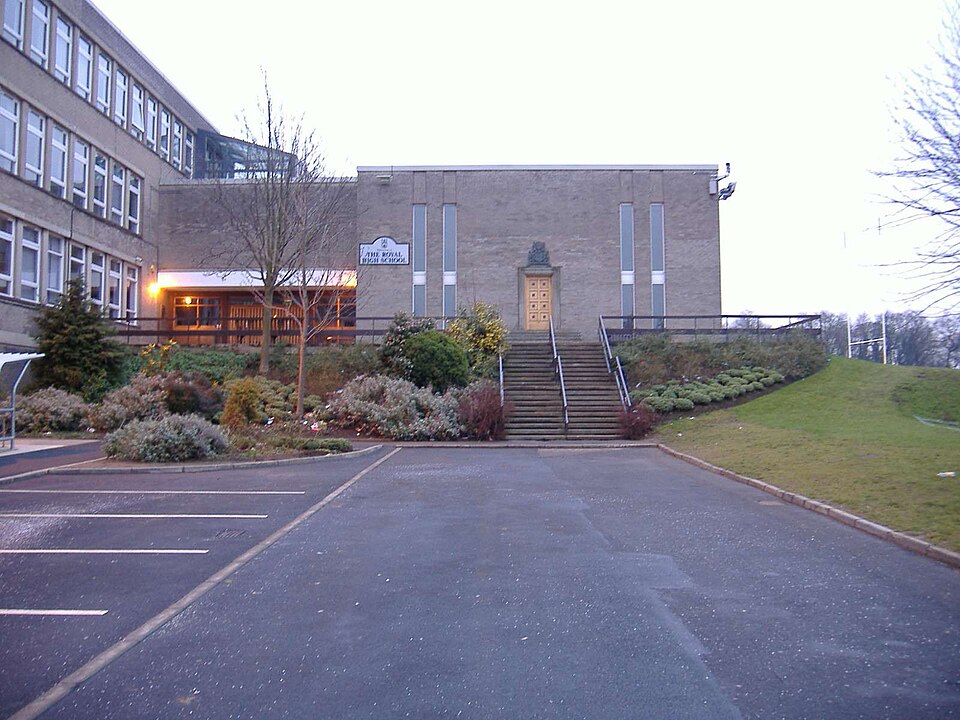
The Royal High School (RHS) of Edinburgh is a co-educational school administered by the City of Edinburgh Council. The school was founded in 1128 and is one of the oldest schools in Scotland. It serves around 1,400 pupils drawn from four feeder primaries in the north-west of the city: Blackhall primary school, Clermiston primary school, Cramond and Davidson's Mains.
The Royal High School (RHS) of Edinburgh is a co-educational school administered by the City of Edinburgh Council. The school was founded in 1128 and is one of the oldest schools in Scotland. It serves around 1,400 pupils drawn from four feeder primaries in the north-west of the city: Blackhall primary school, Clermiston primary school, Cramond and Davidson's Mains.
阅读详细介绍
The Royal High School (RHS) of Edinburgh is a co-educational school administered by the City of Edinburgh Council. The school was founded in 1128 and is one of the oldest schools in Scotland. It serves around 1,400 pupils drawn from four feeder primaries in the north-west of the city: Blackhall primary school, Clermiston primary school, Cramond and Davidson's Mains.
The school's profile has given it a flagship role in education, piloting such experiments as the introduction of the Certificate of Secondary Education, the provision of setting in English and mathematics, and the curricular integration of European Studies and the International Baccalaureate. The Royal High School was last inspected by Education Scotland in February 2023.
Pauline Walker is the current Rector, having taken on the role in 2014. She is the second woman to lead the school, following Jane Frith.
Academics
The most recent report was February 2023. Education Scotland found "very high standard of attainment for all young people", "Young people have a very strong understanding of diversity and equality," and "exceptional contribution of young people to bringing about positive changes to the school." Pupils scored highly in national examinations, consistently outperforming those in comparator schools as well as the Edinburgh and national averages.
130 university entrants from the Royal High School or 30.1% went to one of the ‘Sutton 13' top UK universities in the five years between 2002 and 2006, second among Scottish state schools and colleges. In 2006 the Royal High School's ranking for Higher grades was joint third in the Edinburgh state school league tables (joint seventeenth nationally in the state school rankings).
The school has dropped down 11 places, out of the top 20, in the Scottish schools rankings since 2009 since t
The Royal High School is, by one reckoning, the 18th-oldest school in the world, with a history of almost 900 years. Historians associate its birth with the flowering of the 12th century renaissance. It first enters the historical record as the seminary of Holyrood Abbey, founded for Alwin and the Augustinian canons by David I in 1128.
The Grammar School of the Church of Edinburgh, as it was known by the time Adam de Camis was rector in 1378, grew into a church-run burgh institution providing a Latin education for the sons of landed and burgess families, many of whom pursued careers in the church.
In 1505 the school was described as a high school, the first recorded use of this term in either Scotland or England. In 1566, following the Reformation, Mary, Queen of Scots, transferred the school from the control of Holyrood Abbey to the Town Council of Edinburgh. James Lawson was a big influence in building work for the school in 1578 and from about 1590 James VI accorded it royal patronage as the Schola Regia Edimburgensis, or King's School of Edinburgh.
In 1584 the Town Council informed the rector, Hercules Rollock, that his aim should be "to instruct the youth in pietie, guid maneris, doctrine and letteris". As far as possible, instruction was carried out in Latin. The study of Greek began in 1614, and geography in 1742. The egalitarian spirit of Scotland and the classical tradition exerted a profound influence on the school culture and the Scottish Enlightenment.
The Romantic era at the turn of the 19th century was for Scotland a golden age of literature, winning the Royal High School an international reputation and an influx of foreign students, among them French princes. The historian William Ross notes: "Walter Scott stood head and shoulders above his literary contemporaries; the rector, Alexander Adam, held a similar position in his own profession." By the end of the Napoleonic Wars, an old scholar remembered, 'there were boys from Russia, Germany, Switzerland, the United States, Barbadoes, St. Vincent, Demerara, the East Indies, besides England and Ireland.' The Royal High School was used as a model for the first public high school in the United States, the English High School of Boston, in 1821.
Learning Greek ceased to be compulsory in 1836, and the time allotted to its study was reduced in 1839 as mathematics became recognised. The curriculum was gradually broadened to include French (1834), after-hours fencing and gymnastics (1843), German (1845), science (1848), drawing (1853), military drill (1865), English (1866), gymnastics as a formal subject and swimming (1885), music (1908), and history (1909). In 1866 classical masters were confined to teaching Latin and Greek. A modern and commercial course was introduced in 1873. A school choir was instituted in 1895.
Through the centuries, the school has been located at many sites throughout the city, including the Vennel of the Church of St. Mary in the Fields (c. 1503 – c. 1516); Kirk o' Field Wynd (c. 1516–1555); Cardinal Beaton's House in Blackfriars Wynd (1555–1569); the Collegiate Church of St. Giles or St. Mary in the Fields (1569–1578); Blackfriars monastery (1578–1777); High School Yards (1777–1829); the famous Regent Road building on Calton Hill (1829–1968); and Jock's Lodge (1931–1972). The Jock's Lodge site is now the Royal High Primary, and is no longer associated with the secondary school.
For many years the school maintained a boarding facility for pupils from outside Edinburgh. The boarders ranged in age from six to eighteen. The House, as it was known, was located at 24 Royal Terrace and in later years moved to 13 Royal Terrace. When the boarding house was closed the records of all boarders, the artefacts such as the board with the names of head boys, and the memorial to boarders killed in the 1939–1945 war, were lost.
The Royal High School moved to its current site at Barnton in 1968, vacating the Old Royal High School buildings. In 1973 it became a co-educational state comprehensive. The school's premises underwent extensive refurbishment between 2001 and 2003, funded by a £10 million public-private partnership project with Amey plc.