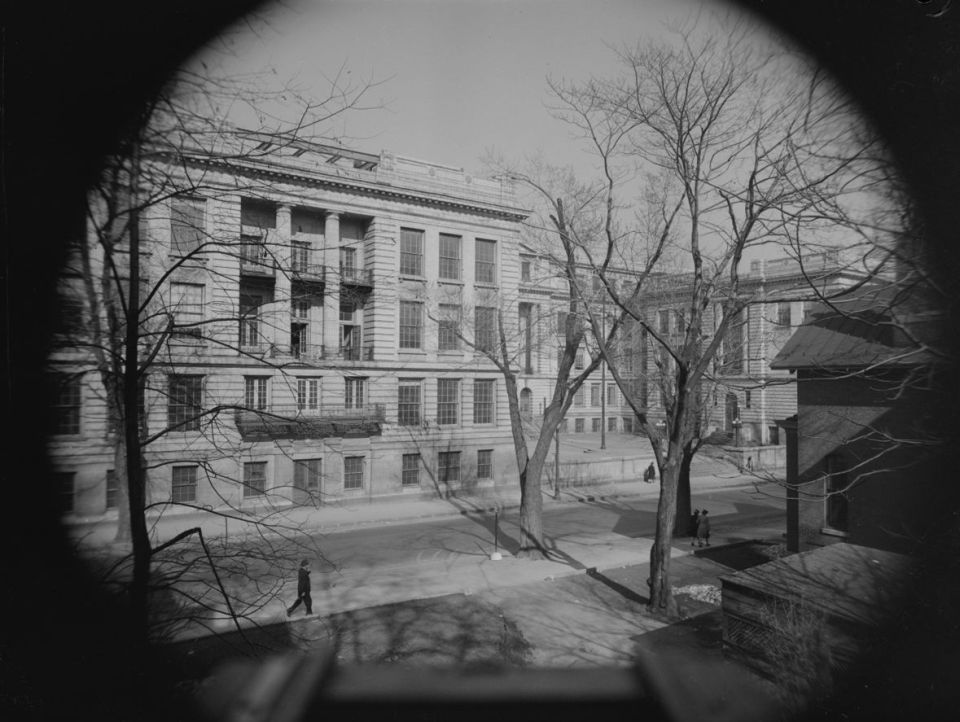
The High School of Montreal was an English-language high school founded in 1843, serving Montreal, Quebec, Canada, in the area eventually known as the Golden Square Mile. It was less formally known as Montreal High School and from 1853 to 1870 was called the High School of McGill College, or the High School Division.
The High School of Montreal was an English-language high school founded in 1843, serving Montreal, Quebec, Canada, in the area eventually known as the Golden Square Mile. It was less formally known as Montreal High School and from 1853 to 1870 was called the High School of McGill College, or the High School Division.
阅读详细介绍
The High School of Montreal was an English-language high school founded in 1843, serving Montreal, Quebec, Canada, in the area eventually known as the Golden Square Mile. It was less formally known as Montreal High School and from 1853 to 1870 was called the High School of McGill College, or the High School Division.
Founded as a school for boys only, girls were first admitted in 1875, although to a separate division called the High School for Girls, and a new building shared by both was opened in 1878. In its last century, the school took children from the first to the twelfth grades. In 1915, after occupying several different sites, the school moved into a new neoclassical building on University Street, near the campus of McGill University. Girls and boys were taught in separate wings of the building and were also apart for school sports, but came together for some activities. The two divisions were united into a single school in 1965.
The school closed in June 1979, largely as the result of a decline in the English-speaking population. Soon after, the mostly French-speaking F.A.C.E. School moved into its empty premises.
Origins
The school was founded in 1843 by a group of Montreal professionals and merchants who saw the need for a Protestant secondary school which respected 19th-century ideas of education. It was modelled on the Royal High School, Edinburgh. Several of the founders, led by James Ferrier, with William Lunn, William Collis Meredith, David Torrance, and the Rev. Henry Esson, were of Presbyterian Scottish origins, and one of their purposes in establishing the school was to provide a solution to the growing influence of Anglicanism in education at the time. In short, they saw a need for a means of access to McGill College not controlled by supporters of the Church of England.
In August 1843, The Gentleman's Magazine reported, under 'Civil Preferments', "Rev. G. F. Simpson to be Rector of the Public College of Canada, about to be established at Montreal", suggesting that the name of the school still remained to be decided.
The school was first organized as a private institution, under a board of directors.
The school's first Principal, the Rev. George Foster Simpson, M.A., was a young Englishman, a graduate and former scholar of Corpus Christi College, Cambridge, born in 1811. He opened the school in November 1843 at Bingham House, which had been leased by the directors of the school, and within a few months 167 boys had been enrolled. The end-of-year ceremony in the summer of 1844, presided over by Peter McGill, with Lord Metcalfe to present the prizes, was held in the large hall that had been the ballroom of Bingham House. The boys at the school in its early days included Thomas White, George Holt Henshaw, George Washington Stephens, Andrew Gault, later called the Cotton King of Canada, and Charles Hamilton, first Archbishop of Ottawa.
In 1846 the school moved into a new purpose-built building on La Gauchetière Street. The same year, on the death of the elderly Alexander Skakel, Master of the Royal Grammar School of Montreal, for many years the city's leading secondary school (founded in 1801 by the Royal Institution for the Advancement of Learning or RIAL), the high school's board petitioned successfully for Skakel's salary to be transferred to it, and thus absorbed the Royal Grammar School(and so the Principal of the new school was titled "Rector and Master of the Royal Grammar School" for over a century). Newton Bosworth, describing the school in a guide to Montreal of 1846, reported that it had accommodation for between three and four hundred pupils, that the Rector had several able assistants, and that the fees were £10 a year "in the higher branches" and £6 a year in "the preparatory branches". On 28 July 1847 a Provincial Statute was enacted which allocated the revenues from the Estates of the Late Order of Jesuits to educational institutions around Quebec, and the first item listed in the schedule was "For the Salary and Allowance for House Rent, heretofore paid to the Master of the Grammar School at Montreal, to be allowed to the Directors of the High School at Montreal, in consideration of their educating twenty free scholars of the poorer classes ... £282-4s-6d". Shortly afterwards the directors received £98-3s-6d as the balance of the grant for the year 1846, and also £141-2s-3d for the six months ended 30 June 1847.
In 1850, Foster resigned as Rector and returned to England, where he became headmaster of Lincoln Grammar School, but died suddenly in 1857. In 1853 control of the school was given to McGill College, and it was renamed as the High School of McGill College (governed by the Royal Institution for the Advancement of Learning). A McGill prospectus for 1863 states that "The High School Department offers a thorough English education, with the French and German languages, and the Classical and Mathematical training necessary for entering the College course."
In 1864, during the American Civil War, on hearing of the St Albans Raid from Montreal into the US by Confederate soldiers, the school organized a company called the Montreal High School Cadet Rifles. This continued to operate for some twenty years and was disappointed not to be mobilized at the time of the Fenian raids between 1866 and 1871.
In September 1870, control of the school was transferred again, this time to the Protestant Board of School Commissioners. Soon after that, J. W. Dawson, principal of McGill, began to press the Protestant Board to create a high school for girls, and in 1875 this came into being as a separate division, with its own "lady principal" and four other teachers, all trained at the McGill Normal School. This was made possible by a local school tax and was the spur for the planning of a new building, opened in 1878. To begin with, the girls' classes had been taught in private houses. The separate girls' school continued to exist in shared buildings until 1965, when for the first t