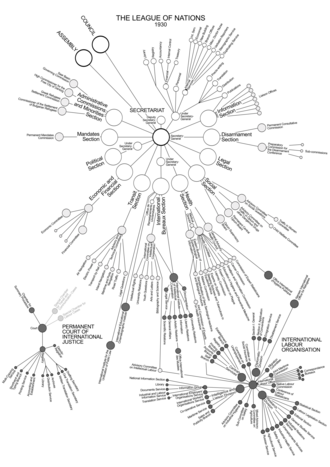
The League of Nations was established with three main constitutional organs: the Assembly; the council; the Permanent Secretariat. The two essential wings of the League were the Permanent Court of International Justice and the International Labour Organization.
The League of Nations was established with three main constitutional organs: the Assembly; the council; the Permanent Secretariat. The two essential wings of the League were the Permanent Court of International Justice and the International Labour Organization.
阅读详细介绍
The League of Nations was established with three main constitutional organs: the Assembly; the council; the Permanent Secretariat. The two essential wings of the League were the Permanent Court of International Justice and the International Labour Organization.
The relations between the Assembly and the council were not explicitly defined, and their competencies—with a few exceptions—were much the same. Each organ would deal with any matter within the sphere of competence of the League or affecting the peace in the world. Particular questions or tasks might be referred either to the council or the Assembly. Reference might be passed on from one body to another.
Constitutional organs
The League of Nations had three primary institutions: The secretariat, the assembly, and the council.
Permanent secretariat
The Permanent Secretariat—established at the seat of the League at Geneva—comprised a body of experts in various spheres under the direction of the General Secretary. According to historian Susan Pedersen, the League secretariat was something "entirely new: a truly international bureaucracy, structured by function and not by nationality, loyal to an international charter, and capable of efficiently managing a complex programme."
Assembly
The Assembly consisted of representatives of all Members of the League. Each state was allowed up to three representatives and one vote. The Assembly had its sessions at Geneva and met on yearly basis on the first Monday of September according to the Rules of Procedure of the Assembly, adopted at Its Eleventh Meeting, 30 November 1920. A special session of the Assembly might be summoned at the request of a Member, provided a majority of the Members concurred.
The Assembly had three forms of power:
Electoral college: the Assembly admits new members to the League, elects non-permanent members to the council, and elects judges of the Permanent Court
President
The President of the Assembly was Paul Hymans of Belgium and the honorary president was Giuseppe Motta of Switzerland. The Assembly at its Fifth Plenary Meeting elected the six vice-presidents. Thirty-nine states have taken part in the ballot, so the required majority was 20 votes.
The sixth vice-president was elected at a second ballot with 22 votes. The Vice-presidents ex officio as Chairmen of the Committees were Arthur Balfour, British Empire; Tommaso Tittoni, Italy; Léon Bourgeois, France; Jose Maria Quiñones de León, Spain; Antonio Huneeus Gana, Chile; and Hjalmar Branting, Sweden.
Committees
The General Committee of the Assembly was constituted of the President and the 12 vice-presidents with Sir Eric Drummond, the Secretary-General. There were six committees: (1) Constitutional questions
The principal Sections of the Secretariat were: Political; Financial and Economics; Communications and Transit; Minorities and Administration (Saar and Danzig); Mandates; Disarmament; Health; Social (Opium and Traffic in Women and Children); Intellectual Cooperation and International Bureaux; Legal; and Information. Each Section was responsible for all official secretarial work related to its particular subject and prepared and organized all meetings and conferences held in that connection.
The staff of the League's secretariat was responsible for preparing the agenda for the Council and Assembly and publishing reports of the meetings and other routine matters, effectively acting as the civil service for the League. The secretariat was often considered to be too small to handle all of the League's administrative affairs. For example, the total number of officials classed as members of the Secretariat was 75 in September 1924. The total staff, including all the clerical services, comprised about 400 persons in 1925.
In general, the League documents may be classified into the following categories: document on public sale, documents not on public sale, and classified, e.g., confidential and secret. The specific feature of the documents emanating from the League of Nations was their classification according to the persons they were addressed to and not according to their subjects.
The Covenant specifically named the secretary general as Britain's Eric Drummond, without indicating the length of his term. Drummond served until July 1933 and was succeeded by France's Joseph Avenol, who in turn was succeeded in August 1940 by Ireland's Seán Lester. Jean Monnet was the League's influential deputy secretary-general from June 1919 to January 1923, when he was succeeded by the comparative lacklustre Avenol. Pablo de Azcárate served as Avenol's successor as deputy secretary-general from 1933 to 1936.
Constituent power: the Assembly discusses and proposes amendments to the Covenant.
Deliberative power: the Assembly can discuss any issue pertaining to the Covenant or to international peace more generally.
The special functions of the Assembly included the admission of new Members, the periodical election on non-permanent Members of the council, the election with the Council of the judges of the Permanent Court, and the control of the budget. In practice the Assembly had become the general directing force of League activities.
The Plenary Meetings of the First Assembly were held from 15 November to 18 December in Geneva, Switzerland. At the opening session, there were 41 states (out of 42 Member states). Six states were admitted during the meetings and consequently were represented during the session (Albania, Austria, Bulgaria, Costa Rica, Finland and Luxembourg). In total, thirty one plenary meetings were held. The principal questions during the first session were: organization of the Secretariat, establishment of a new Organization to deal with Health question, new organism to deal with Communication and transit, and a new Economic and Financial Organization, admission of new Member states, relations between the Council and the Assembly, nomination of the non-permanent Members of the council, establishment of the Permanent Court of International Justice, the first and second budgets of the League, conflict between Poland and Soviet Russia, and repatriation of prisoners of war.