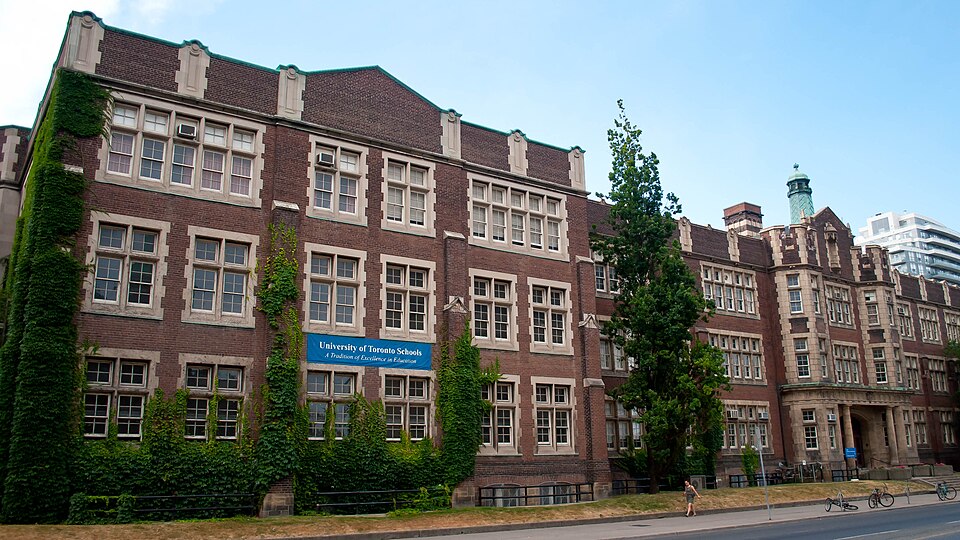
University of Toronto Schools was founded in 1910 as a "practice school", also known as a laboratory school, for the University of Toronto's Faculty of Education. As originally conceived and reflected in its present name, UTS was intended to be a collection of at least two schools, one of which would enroll female students. The original plan was to recruit 200 teachers and 1200 students, but financial constraints limited the number of students to 375 boys.
The school operated a junior ice hockey team during the 1910s and 1920s in the Ontario Hockey Association. The school won the J. Ross Robertson Cup as the playoffs champions in 1919, and were finalists in 1914 and 1923. The Memorial Cup was established as the junior hockey championship of Canada in 1919. The school defeated Montreal Melville by an 8–2 score in a single game playoff to qualify as the Eastern Canada representative at the 1919 Memorial Cup. They defeated the Regina Patricias in two games, by scores of 14-3 and 15–5. Memorial Cup alumnus Dunc Munro later played as a defenceman in the National Hockey League.
UTS's first headmaster was H. J. "Bull" Crawford, who also taught classics at the school. Crawford was responsible for most administrative tasks, which, until a secretary was hired in 1921, included signing admit slips. In 1925, Mike Rodden coached the UTS Rugby team to an undefeated season, culminating in the Canadian Interscholastic Championship.
In 1934, A.C. Lewis succeeded John Althouse to become the third headmaster. In 1944, W. B. "Brock" MacMurray, a 1924 graduate of the school, became the fourth headmaster; his 28-year term at UTS remains the longest in school history. In 1957, the House System was established, with three of four houses named after the school's first three headmasters - Crawford, Althouse, and Lewis. The fourth house, Cody, was named after a former president of the University of Toronto.
The 1960s were a "turbulent" decade in the history of UTS. Prior to the 1960s, the Ontario Ministry of Education required seniors to complete a number of matriculation exams in order to graduate. The student who scored highest on the province-wide exams would be awarded the Prince of Wales Scholarship; during the matriculation era, UTS students won thirteen Prince of Wales Scholarships.
Although matriculation exams would eventually be abolished in the 1960s, UTS students had been calling for change since the late 1930s in the form of valedictory addresses and protests. Addresses in 1963 and 1966 targeted the tendency for matriculations to reduce "a tangible desire for knowledge", producing instead "a mind that cannot think for itself". In 1967 the valedictory address lambasted a number of teachers and administrators who had been responsible for rigidly holding UTS to its past. The speech was not published in The Twig the following year, but was still circulated among students. Discontent with the school's inability to reform climaxed in the "Protest for Nothing" in May 1969, which was led by Brian Blugerman, Michael Eccles, Paul Eprile and David Glennie. Unlike most protests, the placards that the protesters held were blank; when headmaster MacMurray asked for their demands, a student famously showed him a blank sheet of paper and stated, "This is a list of our demands." The protest was front-page news in Toronto newspapers and was widely reported in the U.S. media, including the New York Times.