
人物1595
约翰·费尔顿
John Felton
英国刺客
在包含此条目的事件档案中探索信息与关系。
还没有包含此条目的事件档案。
从此条目开始调查等待第一条评论。
英国刺客
Lieutenant John Felton (c. 1595 – 29 November 1628) was an English army officer who assassinated George Villiers, 1st Duke of Buckingham by stabbing him to death in the Greyhound Pub at Portsmouth on 23 August 1628. Charles I of England trusted Buckingham, who made himself rich in the process but proved a failure at foreign and military policy. Charles gave him command of a military expedition against Spain in 1625 (the Cádiz expedition). It was a total fiasco with many dying from disease and starvation. He led another disastrous military campaign in 1627 (the siege of La Rochelle). Buckingham was hated and the damage to the king's reputation was irreparable. Buckingham's assassination by Felton was widely celebrated by the English public even after Felton's execution.
John Felton was born c. 1595, possibly in Suffolk, to ‘a very ancient family of gentry in Suffolk, very valorous and of astout spirit’, related to the Feltons of Playford and distantly related to Thomas Howard, 21st Earl of Arundel. His father, Thomas Felton, prospered as a pursuivant, one appointed to the task of hunting down those who refused to attend Anglican church services. His mother, Elanor, was the daughter of William Wight, the one-time mayor of Durham.
The family's fortunes declined when Thomas' lucrative position was given to Henry Spiller in 1602. Thomas died around 1611, while he was imprisoned in the Fleet Prison for debt, although his widow was later able to secure a £100 per annum pension from the crown. Felton's brother Edmund Felton also fell into debt trying to right the wrongs done against his father by Spiller, through petitions and printing and distribution of books and pamphlets.
Nothing is known of John Felton's life until the mid-1620s, when he was an army officer. He served in the Cádiz Expedition of 1625, an attempt to capture the Spanish city of Cádiz that was backed by Buckingham. This resulted in a decisive Spanish victory, with 7,000 English troops and 62 out of 105 ships lost. Felton then served as a lieutenant in Ireland in 1626, during which time his commanding officer died and Felton tried, but failed, to be appointed as his replacement.
Buckingham was hugely unpopular in the land for the national disgrace of defeat by the French, although with the help of the king, Charles I, he had avoided legal moves against him by Parliament for corruption and incompetence. By August 1628 Felton had come to believe that his personal grievances against Buckingham were part of a larger picture of treacherous and wicked governance of England by the Duke. He resolved to kill Buckingham and after saying goodbye to his family travelled to Portsmouth. Buckingham was staying there while trying to organise a new military campaign.
On the morning of Saturday 23 August Buckingham left his lodgings, the Greyhound Inn in Portsmouth, after having breakfast. Felton was able to make his way through the crowd that surrounded Buckingham and stabbed him in the chest with a dagger. He missed a chance of escape in the ensuing chaos and shortly after the murder he presented himself before the crowd that had gathered and, expecting to be well received, announced his guilt. He was immediately arrested and taken before magistrates, who sent him to London for interrogation.
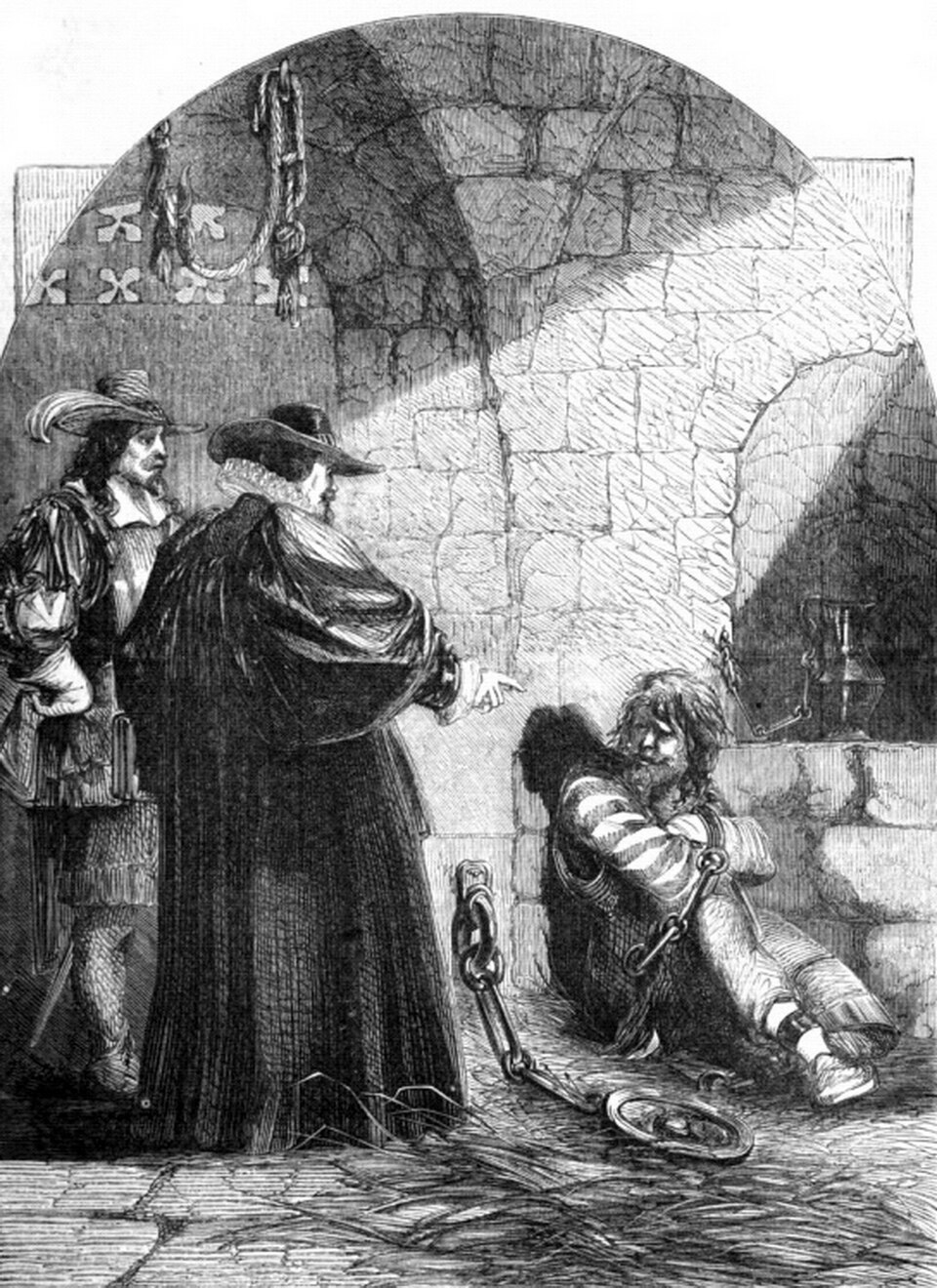
The authorities were convinced Felton had not acted alone and were anxious to get from him the names of any accomplices. The Privy Council attempted to have Felton questioned under torture on the rack but the judges resisted, unanimously declaring its use to be contrary to the laws of England.
While the truth of this story is contested, and indeed widely doubted, it remains the case that the Privy Council never issued a torture warrant again, and the last warrant under the Royal Signet was issued in 1640. Indeed in 1641 the Star Chamber was abolished by the Habeas Corpus Act 1640.
The unpopularity of the Duke meant Felton's action was met with widespread approval. While he was awaiting trial it was celebrated in poems and pamphlets. Copies of written statements he carried in hi
来源:John Felton (assassin) (CC BY-SA)
结构化信息、用户意见与 AI 提取的关系会分别标注。
In May or June 1627 Felton petitioned to be appointed a captain on Buckingham's military expedition of 1627, part of the Anglo-French War of 1627 to 1629. The purpose of the expedition was to capture the French fortress of Saint-Martin-de-Ré on the Île de Ré. This would secure the sea-approaches to the city of La Rochelle and encourage the Huguenot population of the city to rebel against the French Crown.
Felton had connections in political circles but despite help from two Members of Parliament, Sir William Uvedale and Sir William Beecher, his initial request to join the expedition was turned down. Two months later he was appointed a lieutenant with the second wave of troops that left for the Île de Ré in August 1627.
The expedition was a disaster for the English; the troops were ill-supplied and lacked the large artillery needed for the siege they laid at Saint-Martin-de-Ré. Many were lost on 27 October, during a final, desperate assault on the fortress of Saint-Martin, which failed because the attackers' siege ladders were shorter than the walls of the fortress. The English evacuated soon after, losing 5,000 out of 7,000 troops during the campaign.
After returning to England Felton lived in London for nine months. Although his mother, brother and sister lived in the city he did not stay with them but lived in a lodging house. Those who encountered him during this time later described him as being taciturn and melancholic. His sister recalled that, since his return from Ré, Felton had been "much troubled by dreams of fighting". This was possibly indicative of what would be described as post-traumatic stress disorder in modern terms. During this time Felton submitted petitions to members of the Privy Council over two matters, £80 of back-pay he believed he was owed and his promotion to captain, which he believed he had been unfairly denied. He had no success in resolving these grievances and came to believe the Duke of Buckingham was responsible for both of them.