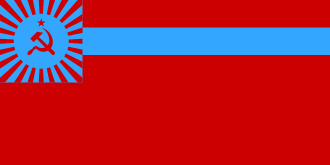
The Georgian Soviet Socialist Republic, also known as Soviet Georgia, the Georgian SSR, or simply Georgia, was one of the republics of the Soviet Union from its occupation by the Red Army in 1921 to its independence in 1991. Coterminous with the present-day republic of Georgia including the contested regions of Abkhazia and South Ossetia, it was based on the traditional territory of Georgia, which had existed as a series of states in the Caucasus prior to the annexation by the Russian Empire in the course of the 19th century and from 1918 to 1921 as the Democratic Republic of Georgia. The Geor
The Georgian Soviet Socialist Republic, also known as Soviet Georgia, the Georgian SSR, or simply Georgia, was one of the republics of the Soviet Union from its occupation by the Red Army in 1921 to its independence in 1991. Coterminous with the present-day republic of Georgia including the contested regions of Abkhazia and South Ossetia, it was based on the traditional territory of Georgia, which had existed as a series of states in the Caucasus prior to the annexation by the Russian Empire in the course of the 19th century and from 1918 to 1921 as the Democratic Republic of Georgia. The Geor
阅读详细介绍
The Georgian Soviet Socialist Republic, also known as Soviet Georgia, the Georgian SSR, or simply Georgia, was one of the republics of the Soviet Union from its occupation by the Red Army in 1921 to its independence in 1991. Coterminous with the present-day republic of Georgia including the contested regions of Abkhazia and South Ossetia, it was based on the traditional territory of Georgia, which had existed as a series of states in the Caucasus prior to the annexation by the Russian Empire in the course of the 19th century and from 1918 to 1921 as the Democratic Republic of Georgia. The Georgian SSR was formed in 1921 and subsequently incorporated in the Soviet Union in 1922. Until 1936 it was a part of the Transcaucasian Socialist Federative Soviet Republic, which existed as a union republic within the USSR. From November 18, 1989, the Georgian SSR declared its sovereignty over Soviet laws. The republic was renamed the Republic of Georgia on November 14, 1990, and subsequently became independent before the dissolution of the Soviet Union on April 9, 1991, whereupon each former SSR became a sovereign state.
Geographically, the Georgian SSR was bordered by Turkey to the south-west and the Black Sea to the west. Within the Soviet Union it bordered the Russian SFSR to the north, the Armenian SSR to the south and the Azerbaijan SSR to the south-east.
Establishment
On November 28, 1917, after the October Revolution in Russia, there was a Transcaucasian Commissariat established in Tiflis. On April 22 the Transcaucasian Democratic Federative Republic was formed, though it only lasted for a month before being replaced by three new states:
the Georgian Democratic Republic, the First Republic of Armenia and the Azerbaijan Democratic Republic. The 1919 parliamentary elections saw the Social Democratic Party come to power in Georgia. It tried to establish a moderate left, multi-party system, but faced some internal and external problems. Georgia was dragged into wars against Armenia and remnants of the Ottoman Empire, while the rapid spread of ideas of revolutionary socialism in rural regions accounted for some Soviet-backed peasants' revolts in Racha, Samegrelo and Dusheti. In 1921, the crisis came to a head. The 11th Red Army invaded Georgia from the south and headed to Tbilisi. On 25 February, after a one-week offensive by the Red Army, Tbilisi fell to the Bolsheviks. Georgian Bolsheviks took over the country and proclaimed the establishment of the Georgian SSR. Some small-scale battles between Bolshevik troops and Georgian Army also took place in Western Georgia. In March 1921 the government of the Georgian Democratic Republic was forced into exile. On March 2 of the following year the first constitution of Soviet Georgia was accepted.
In 1922 the Georgian SSR was incorporated into Soviet Union. From March 12, 1922, to December 5, 1936, it was part of the Transcaucasian SFSR together with the Armenian SSR and the Azerbaijan SSR. During this period the province was led by Lavrentiy Beria, the first secretary of the Georgian Central Committee of the Communist Party of Georgia.
In 1936, the TSFSR was dissolved and Georgia became the Georgian Soviet Socialist Republic.
Lavrentiy Beria became the People's Commissar for Internal Affairs of the Soviet Union and was transferred to Moscow in 1938.
Purges
The exact number of Georgians executed during the Great Purges is not available, but some scholars suggest it varies from 30,000 to 60,000. During the purges, many eminent Georgian intellectuals such as Mikheil Javakhishvili, Evgeni Mikeladze, Vakhtang Kotetishvili, Paolo Iashvili, Titsian Tabidze and Dimitri Shevardnadze were executed or sent to the Gulag. Party officials also suffered the purges. Many prominent Georgian Bolsheviks, such as Mikheil Kakhiani, Mamia Orakhelashvili, Sergo Ordzhonikidze, Budu Mdivani, Mikheil Okujava and Samson Mamulia were removed from office and killed.
World War II
Reaching the Caucasus oilfields was one of the main objectives of Adolf Hitler's invasion of the USSR in June 1941, but the armies of the Axis powers never reached as far as Georgia. The country contributed almost 700,000 fighters (350,000 were killed) to the Red Army, and was a vital source of textiles and munitions. Joseph Stalin, an ethnic Georgian, led the USSR during the World War II. He ordered the deportation of the Chechen, German, Ingush, Karachay, Karapapakh, Meskhetian Turk and Balkarian peoples from the Caucasus, accusing them of collaboration with the Nazi German forces; they were transported to Siberia and Central Asia. He also abolished their respective autonomous republics. The Georgian SSR was briefly granted some of their territory until 1957.
Post-Stalin period
On March 9, 1956, about a hundred Georgian students were killed when they demonstrated against Nikita Khrushchev's policy of de-Stalinization that was accompanied by an offhanded remark he made about Georgians at the end of his anti-Stalin speech.
The decentralisation program introduced by Khrushchev in the mid-1950s was soon exploited by Georgian Communist Party officials to build their own regional power base. A thriving pseudo-capitalist shadow economy emerged alongside the official state-owned economy. Some entrepreneurs ("commersants") produced and sold goods outside of the state sector while others ("speculators") obtained "deficit" goods through their connections and re-sold them at higher prices. The unofficial economy accounted for over 25% of the republic's GNP. While the official growth rate of the economy of the Georgia was among the lowest in the USSR, such indicators as savings level, rates of car and house ownership were the
On 13 October 1921 the Treaty of Kars was signed, which established the common borders between Turkey and the three Transcaucasian republics of the Soviet Union. The Georgian SSR was forced to cede the Georgian-dominated Artvin Okrug to Turkey in exchange for keeping Adjara, which was granted political autonomy within the Georgian SSR under Soviet rule.