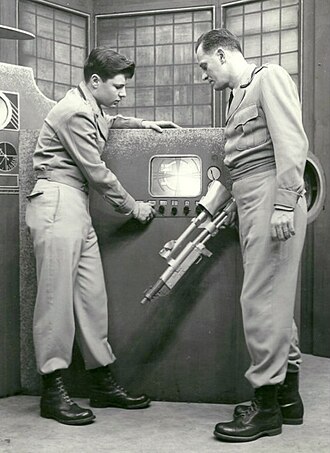
Science fiction (Sci-fi) first appeared in television programming in the late 1930s, during what is called the Golden Age of Science Fiction. Special effects and other production techniques allow creators to present a living visual image of an imaginary world not limited by the constraints of reality.
Science fiction (Sci-fi) first appeared in television programming in the late 1930s, during what is called the Golden Age of Science Fiction. Special effects and other production techniques allow creators to present a living visual image of an imaginary world not limited by the constraints of reality.
阅读详细介绍
Science fiction (Sci-fi) first appeared in television programming in the late 1930s, during what is called the Golden Age of Science Fiction. Special effects and other production techniques allow creators to present a living visual image of an imaginary world not limited by the constraints of reality.
Visual production process and methods
The need to portray imaginary settings or characters with properties and abilities beyond the reach of current reality obliges producers to make extensive use of specialized techniques of television production.
Through most of the 20th century, many of these techniques were expensive and involved a small number of dedicated craft practitioners, while the reusability of props, models, effects, or animation techniques made it easier to keep using them. The combination of high initial cost and lower maintenance cost pushed producers into building these techniques into the basic concept of a series, influencing all the artistic choices.
By the late 1990s, improved technology and more training and cross-training within the industry made all of these techniques easier to use, so that directors of individual episodes could make decisions to use one or more methods, so such artistic choices no longer needed to be baked into the series concept.
Special effects
Special effects (or "SPFX") have been an essential tool throughout the history of science fiction on television: small explosives to simulate the effects of various rayguns, squibs of blood and gruesome prosthetics to simulate the monsters and victims in horror series, and the wire-flying entrances and exits of George Reeves as Superman.
The broad term "special effects" includes all the techniques here, but more commonly there are two categories of effects. Visual effects ("VFX") involve photographic or digital manipulation of the onscreen image, usually done in post-production. Mechanical or physical effects involve props, pyrotechnics, and other physical methods used during principal photography itself. Some effects involved a combination of techniques; a ray gun might require a pyrotechnic during filming, and then an optical glowing line added to the film image in post-production. Stunts are another important category of physical effects. In general, all kinds of special effects must be carefully planned during pre-production.
Computer-generated imagery
Babylon 5 was the first series to use computer-generated imagery, or "CGI", for all exterior space scenes, even those with characters in space suits. The technology has made this more practical, so that today models are rarely used. In the 1990s, CGI required expensive processors and customized applications, but by the 2000s (decade), computing power has pushed capabilities down to personal laptops running a wide array of software.
Models and puppets
Models have been an essential tool in science fiction television since the beginning, when Buck Rogers took flight in spark-scattering spaceships wheeling across a matte backdrop sky. The original Star Trek required a staggering array of models; the USS Enterprise had to be built in several different scales for different needs. Models fell out of use in filming in the 1990s as CGI became more affordable and practical, but even today, designers sometimes construct scale models which are then digitized for use in animation software.
Models of characters are puppets. Gerry Anderson created a series of shows using puppets living in a universe of models and miniature sets, notably Thunderbirds. ALF depicted an alien living in a family, while Farscape included two puppets as regular characters. In Stargate SG-1, the Asgard characters are puppets in scenes where they are sitting, standing, or lying down. In Mystery Science Theater 3000, the characters of Crow T. Robot and Tom Servo, two of the show's main (and most iconic) characters, are puppets constructed from random household items.
Animation
As animation is completely free of the constraints of gravity, momentum, and physical reality, it is an ideal technique for science fiction and fantasy on television. In a sense, virtually all animated series allow characters and objects to perform in unrealistic ways, so they are almost all considered to fit within the broadest category of speculative fiction (in the context of awards, criticism, marketing, etc.) The artistic affinity of animation to comic books has led to a large amount of superhero-themed animation, much of this adapted from comics series, while the impossible characters and settings allowed in animation made this a preferred medium for both fantasy and for series aimed at young audiences.
Originally, animation was all hand-drawn by artists, though in the 1980s, beginning with Captain Power, computers began to automate the task of creating repeated images; by the 1990s, hand-drawn animation became defunct.
Animation in live-action
In recent years as technology has improved, this has become more common, notably since the development of the Massive software application permits producers to include hordes of non-human characters to storm a city or space station. The robotic Cylons in the new version of Battlestar Galactica are usually animated characters, while the Asgard in Stargate SG-1 are animated when they are shown walking around or more than one is on screen at once.
Science fiction television economics and distribution
In general, science fiction series are subject to the same financial constraints as other television shows. However, high production costs increase the financial risk, while limited audiences further complicate the business case for continuing production. Star Trek had a per episode budget of $175,000-$190,000, while Star Trek: The Next Generation had a $1.3 million budget per episode - one of the highest at the time.
Media fandom
One of the earliest forms of media fandom was Star Trek fandom. Fans of the series became known to each other through the science fiction fandom. In 1968, NBC decided to cancel Star Trek. Bjo Trimble wrote letters to contacts in the National Fantasy Fan Foundation, asking people to organize their local friends to write to the network to demand the show remain on