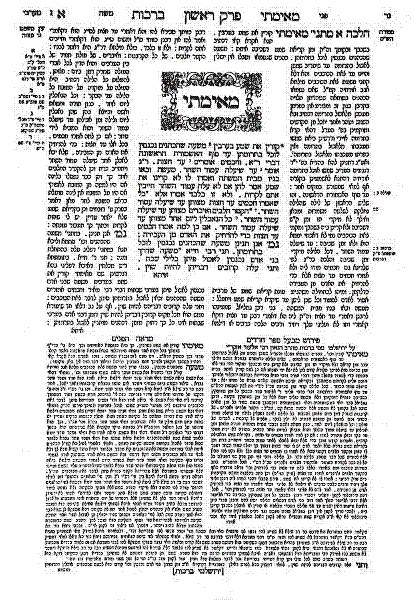
The Jerusalem Talmud, also known as the Talmud of the Land of Israel or Palestinian Talmud, is a collection of rabbinic commentary on the Mishnah, a codification of Jewish oral traditions believed to have been revealed by Moses alongside the Written Torah. Since this Talmud originated in Galilee, in the Byzantine province Palaestina Secunda, rather than in Jerusalem, many prefer calling it the Palestinian Talmud.
The Jerusalem Talmud, also known as the Talmud of the Land of Israel or Palestinian Talmud, is a collection of rabbinic commentary on the Mishnah, a codification of Jewish oral traditions believed to have been revealed by Moses alongside the Written Torah. Since this Talmud originated in Galilee, in the Byzantine province Palaestina Secunda, rather than in Jerusalem, many prefer calling it the Palestinian Talmud.
阅读详细介绍
The Jerusalem Talmud (Hebrew: תַּלְמוּד יְרוּשַׁלְמִי, romanized: Talmud Yerushalmi, often Yerushalmi for short), also known as the Talmud of the Land of Israel or Palestinian Talmud, is a collection of rabbinic commentary on the Mishnah, a codification of Jewish oral traditions ("Oral Torah") believed to have been revealed by Moses alongside the Written Torah. Since this Talmud originated in Galilee, in the Byzantine province Palaestina Secunda, rather than in Jerusalem (where Jews were prohibited from living since the time of Hadrian), many prefer calling it the Palestinian Talmud.
The Jerusalem Talmud predates its counterpart, the Babylonian Talmud (known in Hebrew as the Talmud Bavli), by about a century. It was written primarily in Galilean Aramaic. It was compiled between the late fourth century to the first half of the fifth century. Both versions of the Talmud have two parts, the Mishnah (of which there is only one version), which was finalized by Judah the Prince around the year 200 CE, and the respective commentary tradition on the Mishnah from each region, known as a Gemara. The Gemara is what differentiates the Jerusalem Talmud from its Babylonian counterpart. The Jerusalem Gemara contains the written discussions of generations of rabbis of the Talmudic academies in Syria Palaestina at Tiberias and Caesarea.
Name
This Talmud is commonly known as the Jerusalem Talmud or the Palestinian Talmud. Academics prefer to speak of the "Palestinian Talmud" because of the texts origins mainly from the Galilee region of Palestine (or the Land of Israel) in the Byzantine province, Palaestina Secunda, rather than from Jerusalem.
Both names were being used in the geonim period (6th–11th century CE), alongside other names such as "Talmud of the Land of Israel", "Talmud of the West", and "Talmud of the Western Lands".
Origins and historical context
The Jerusalem Talmud probably originated in Tiberias in the School of Johanan bar Nappaha as a compilation of teachings of the schools of Tiberias, Caesarea, and Sepphoris. It is written largely in Galilean Aramaic, a Western Aramaic dialect that differs from its Babylonian counterpart.
This Talmud is a commentary on the Mishnah. Before being compiled, this commentary tradition on the Mishnah grew for nearly 200 years among the Talmudic academies in Syria Palaestina (principally those of Tiberias and Caesarea).
Manuscripts
The Leiden Jerusalem Talmud (Or. 4720) is today the only surviving complete manuscript of the Jerusalem Talmud. It was copied in 1289 by the Jewish scholar Jehiel ben Jekuthiel Anav and shows elements of a later recension. Today, it is held at Leiden University Libraries. The manuscript has biblical glosses which are absent from the Yemeni fragments of the same tractates (perhaps owing to the isolation of the Yemenite community).
The Leiden manuscript is important in that it preserves some earlier variants to textual readings, such as in Tractate Pesachim 10:3 (70a), which brings down the old Hebrew word for charoset (the sweet relish eaten at Passover), viz. dūkeh (Hebrew: דוכה), instead of rūbeh/rabah (Hebrew: רובה), saying with a play on words: "The members of Isse's household would say in the name of Isse: Why is it called dūkeh? It is because she pounds [the spiced ingredients] with him." The Hebrew word for "pound" is dakh (דך), which rules out the spelling of rabah (רבה), as found in the printed editions. Yemenite Jews still call it dūkeh.
Premodern estimates
Traditionally, the redaction of this Talmud was thought to have been brought to an abrupt end around 425, when Theodosius II suppressed the Nasi of the Sanhedrin and put an end to the practice of semikhah (formal scholarly ordination). The redaction of the Jerusalem Talmud was done to codify the laws of the Sanhedrin as the redaction of the Mishnah had similarly done during the time of Judah ha-Nasi. It was thought that the compilers of the Jerusalem Talmud worked to collect the rulings of the Sanhedrin and lacked the time to produce a work of the quality they had intended and that this is the reason why the Gemara do not comment upon the whole Mishnah, or that certain sections were lost.
Modern estimates
Current perspectives on the dating of the closure of the text of the Palestinian Talmud rely on an understanding of activity of rabbinic scholarship and literary production, identifying datable historical datapoints mentioned by the text, and its reliance on and citation by other datable (or roughly datable) texts. Broadly, the Palestinian Talmud is dated at some time from the second half of the fourth century to the first half of the fifth century.
Christine Hayes has argued that a lack of evidence for Amoraim activity in Syria Palaestina after the 370s implies that the text was closed by around 370. However, reference to historical events from around or even slightly after 370 may push the earliest possible date to the late 4th century. For example, the Roman general Ursicinus, who had a public role between 351 and 359, is mentioned several times in a legendary context, suggesting that these references are somewhat later than his public career. Furthermore, there is also a reference to the Persian campaign of the Roman emperor Julia
Leiden University Libraries has digitised both volumes of the manuscript and made it available in its Digital Collections.
Among the Hebrew manuscripts held in the Vatican Library is a late 13th-century – early 14th-century copy of Tractate Sotah and the complete Zeraim for the Jerusalem Talmud (Vat. ebr. 133): Berakhot, Peah, Demai, Kilayim, Sheviit, Terumot, Maaserot, Maaser Sheni, Ḥallah and Orlah (without the Mishnah for the Tractates, excepting only the Mishnah to the 2nd chapter of Berakhot). Several sources have printed the variant readings from this manuscript (L. Ginzberg, Fragments of the Yerushalmi (New York 1909), pp. 347–372 and in the end of Saul Lieberman's essay ʿAl ha-Yerushalmi (Hebrew), Jerusalem 1929). Both editors noted that this manuscript is full of gross errors but also retains some valuable readings.