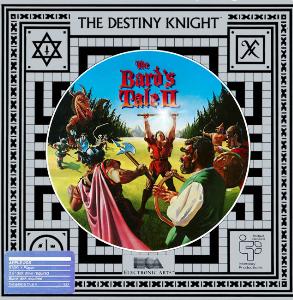
The Bard's Tale II: The Destiny Knight is a fantasy role-playing video game created by Interplay Productions in 1986. It is the first sequel to The Bard's Tale, and the last game of the series that was designed and programmed by Michael Cranford.
The Bard's Tale II: The Destiny Knight is a fantasy role-playing video game created by Interplay Productions in 1986. It is the first sequel to The Bard's Tale, and the last game of the series that was designed and programmed by Michael Cranford.
阅读详细介绍
The Bard's Tale II: The Destiny Knight (or The Bard's Tale 2) is a fantasy role-playing video game created by Interplay Productions in 1986. It is the first sequel to The Bard's Tale, and the last game of the series that was designed and programmed by Michael Cranford.
The game features Dungeons & Dragons-style characters and follows in the footsteps of its predecessor, The Bard's Tale, also created by Michael Cranford. The Bard's Tale II takes place on a larger scale with an explorable wilderness, six cities, and multiple dungeons that give this game its dungeon crawl character. The game has new features such as casinos and banks, and introduces a new magic user called an Archmage, among other changes from the first game in the series.
Although it received mixed reviews upon release, The Bard's Tale II won the Origins Award for Best Fantasy or Science Fiction Computer Game of 1986.
In 2018, Krome Studios published a "remastered edition" as part of The Bard's Tale Remastered Trilogy.
Plot
In The Bard's Tale II, players lead a band of adventurers searching for seven pieces of the broken Destiny Wand in The Realm. Mercenaries roaming the land stand in the way. Players achieve victory after finding the pieces, defeating the Archmage Lagoth Zanta, and reforging the Wand. The character who successfully reforges the Wand becomes the immortal Destiny Knight.
After the optional "starter dungeon" in Tangramayne—available to develop fledgling characters—players pursue the segments of the Destiny Wand. Parties progress through dungeons, to include The Tombs, Fanskar's Fortress, Dargoth's Castle, the Maze of Dread, Oscon's Fortress, the Grey Crypt, and the Destiny Stone. Players can obtain segments in a Snare in each dungeon. After acquiring the seventh segment, players are ready to assemble the Destiny Wand and face their final battle with Lagoth Zanta.
Setting and characters
The Bard's Tale II is set in "The Realm", which has been peaceful for 700 years. Peace was maintained by the Destiny Wand, forged by the Archmage Turin, until it was stolen and broken. The game features a large wilderness area and six cities—Colosse, Corinth, Ephesus, Philippi, Tangramayne, and Thessalonica. Each city comprises similar features such as taverns and banks. Cities also contain dungeon entrances.
Players can assemble a party of up to seven active characters at the Adventurer's Guild in each city. Characters can be imported or created. They can be imported from The Bard's Tale, Wizardry: Proving Grounds of the Mad Overlord (on Apple II versions), or Ultima III: Exodus. Characters can be created as a human, elf, dwarf, hobbit, half-elf, half-orc, or gnome. Players can also include monsters indefinitely in the party—only a temporary feature in The Bard's Tale.
Character classes available at the start are the warrior, paladin, rogue, bard, hunter, monk, conjurer, and magician. The sorcerer, wizard, and archmage classes are not available at the start. Archmages are a new class. Creating an archmage requires at least three levels in the four other magic-user classes. Character attributes (strength, intelligence, dexterity, constitution, and luck) are generated randomly during character creation (with values from 1–18) and affect gameplay. Empty character slots can also be filled with players or creatures through random encounters, spells, or the use of figurines. The game's namesake, the Bard, retains magical singing abilities. The seven available songs assist the party while exploring or fighting.
Gameplay
The Destiny Knight shares a similar interface with the first game. Besides the character list, there is a visual interface on the left with interactive text on the right. Graphics are similar, with some updates such as animated character images. Sounds such as Bard songs also have more depth. Gameplay has similar aspects to Dungeons & Dragons. It appeals to players who enjoy dungeon crawling and mapping.
Combat has more depth than Bard's Tale I. Range extends to 90 feet. Handheld weapons are useful at close range. Extended ranges involve ranged weapons like bow and arrows and spells which change effects over distance. In the early stages of the game, the party's fighters are important in combat, while spellcasters are dominant later due to monster strength. Some powerful monsters have over 1,000 hit points.
Magic is part of gameplay. The game features 79 spells. These include battle magic as well as other spells such as teleport, the reliable "Scry Site" spell (providing the party's location), light spells, and summoning monsters as allies. The party's spellcasters typically occupy the bottom character slots, allowing them to use magic with the fighters in front. Besides magic users, some items also cast spells. Parties must develop an archmage to achieve game success.
Parties can explore the wilderness, cities, and dungeons. The wilderness contains monsters not seen in The Bard's Tale. Players can also discover non-player characters such as the Sage who provides useful advice, for a price. Players can avoid wilderness movement by teleporting between cities with a spell.
Cities vary only in their internal layout. They feature various establishments, two of which did not appear in The Bard's Tale—banks and casinos. At Garth's Equipment Shoppe, players can buy, sell, or identify items. Parties can withdraw saved money from an account at Bedder's Bank for the Bold and gamble it at a casino. They can lament their gambling losses at a tavern over a drink with bartender advice available, for a price. When ready, a party can venture into a dungeon to explore, fight monsters, and gain the experience to advance levels and complete their quest. After returning to town, parties can heal or revive characters at a temple. Roscoe's Energy Emporium allows spell unit restoration at exorbitant fees. Characters advance levels and magical ability at the Review Board. There are also "unmarked buildings", most with little but a possible monster encounter.