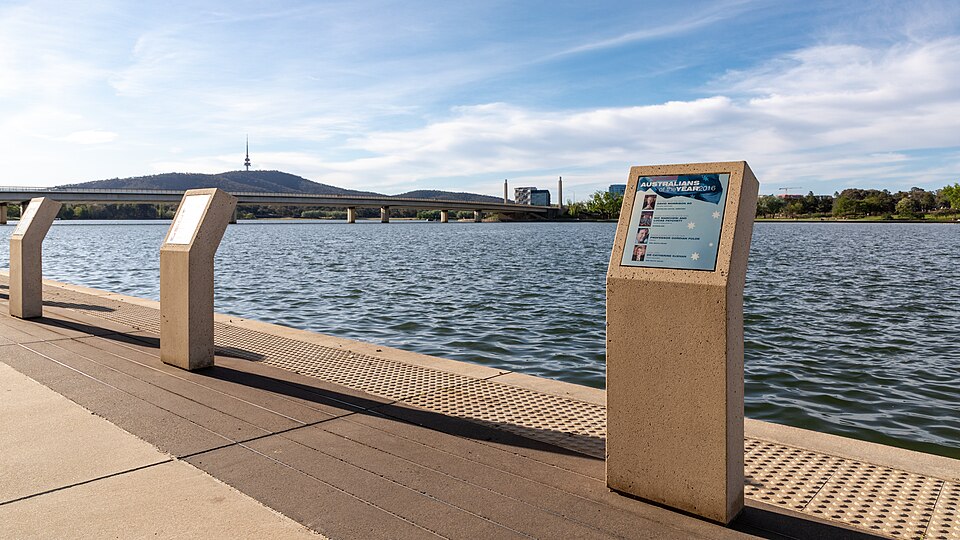
The Australian of the Year is a national award conferred on an Australian citizen by the National Australia Day Council, a not-for-profit Australian Government-owned social enterprise. Similar awards are also conferred at the state and territory level.
The Australian of the Year is a national award conferred on an Australian citizen by the National Australia Day Council, a not-for-profit Australian Government-owned social enterprise. Similar awards are also conferred at the state and territory level.
阅读详细介绍
The Australian of the Year is a national award conferred on an Australian citizen by the National Australia Day Council, a not-for-profit Australian Government-owned social enterprise. Similar awards are also conferred at the state and territory level.
History
Since 1960 the award for the Australian of the Year has been bestowed as part of the celebrations surrounding Australia Day, during which time it has grown steadily in significance to become one of the nation's pre-eminent awards. The Australian of the Year announcement has become a notable part of the annual Australia Day celebrations. The official announcement has grown to become a public event, and the Canberra ceremony is televised nationally. The award offers an insight into Australian identity, reflecting the nation's evolving relationship with world, the role of sport in Australian culture, the impact of multiculturalism, and the special status of Indigenous Australians. It has also provoked spirited debate about the fields of endeavour that are most worthy of public recognition.
The award program promotes active citizenship and seeks to elevate certain people as role models. Three companion awards have been introduced, recognising both Young and Senior Australians, and proclaiming the efforts of those who work at a grass roots level through the "Australia's Local Hero" award.
Sponsorship
The Australian of the Year award receives substantial sponsorship from private companies, including a relationship in excess of thirty years with the Commonwealth Bank. The close relationship with the Australian Government ensures that the award's profile and reputation is significantly enhanced.
1960s
During the 1960s, a network of state-based organisations worked hard to increase the profile of Australia Day. The most active and best resourced of these was the Victorian Australia Day Council, which had grown out of the Australian Natives' Association. In January 1960 the council's chairman, the unabashed patriot Sir Norman Martin, announced the introduction of a new annual award for the 'Australian of the Year'. He explained that Australia Day was a fitting occasion on which to give proper recognition to a leading citizen, whose contribution to the nation's culture, economy, sciences or arts was particularly outstanding.
1970s and 1980s
During its first two decades, the Australian of the Year award grew steadily in national prominence, but it increasingly suffered from its close association with the Victorian Australia Day Council. A competing Australian of the Year award was established by newspaper The Australian in 1971. In 1975 the newly formed Canberra Australia Day Council also began to name a rival Australian of the Year. The Canberra council was run by a vibrant group of local inhabitants, who pursued a more progressive agenda than their Victorian counterparts. In particular, the Canberra council was sympathetic to the emerging republican movement, while the Victorian council was staunchly committed to constitutional ties with Britain. The Victorian council also battled a common perception that it was an exclusive organisation that represented the Melbourne Establishment. Australia's turbulent political climate nourished this division, and the Australian of the Year award was embroiled in a wider debate about Australian nationalism.
For the first two decades the Australian of the Year was chosen by a panel of five, which included the Victorian Premier, the Anglican Archbishop of Melbourne, the vice-chancellor of Melbourne University, the Lord Mayor of Melbourne and the president of the National Council for Women. Although the panel was certainly distinguished, it would in time become too closely associated with Melbourne to be appropriate for a national award. The panel's first choice of Nobel Prize winning immunologist Sir Macfarlane Burnet gained general approval. The editors of The Age proclaimed the new honour was symptomatic of Australia's growing confidence as a nation: 'We are beginning to count for something in the world and we should be intensely proud of this fact.'
International achievement remained a key criterion during the award's first decade. Several sporting heroes were honoured, from America's Cup skipper Jock Sturrock and swimmer Dawn Fraser, to world champion motor racer Sir Jack Brabham and boxer Lionel Rose. The pioneering neurologist Sir John Eccles followed Burnet's example, becoming the second of five Australians to take out the Nobel Prize/Australian of the Year double. Achievers in the artistic realm were also well represented, including opera singer Joan Sutherland, renowned dancer and choreographer Robert Helpmann and the four members of the chart-topping singing group The Seekers – Judith Durham, Athol Guy, Keith Potger and Bruce Woodley. The focus on international achievement reflected the philosophy of the award organisers, who described the Australian of the Year as 'the person who has brought the greatest honour to Australia in the year under review.'
Between 1975 and 1979, the Canberra Australia Day Council named four Australians of the Year. Prime Minister Gough Whitlam lent his support to the Canberra award when he presented the inaugural honour to Major General Alan Stretton, the commander of the emergency response to Cyclone Tracy. The Canberra council also made good use of the federal parliamentary press boxes to promote its award to the national media. The Victorian council was singularly unimpressed that a rival Australia Day organisation had copied its idea – in 1977 it described its own winner, Dame Raigh Roe, as 'the real Australian of the Year'. The impasse was only resolved when the Fraser government created the National Australia Day Council (NADC) in 1979. The Victorian council willingly transferred responsibility for its award to the new national body, while the Canberra council agreed to discontinue its rival program. In 1982, the Victorian council was further sidelined when that state's Australian Labor Party government led