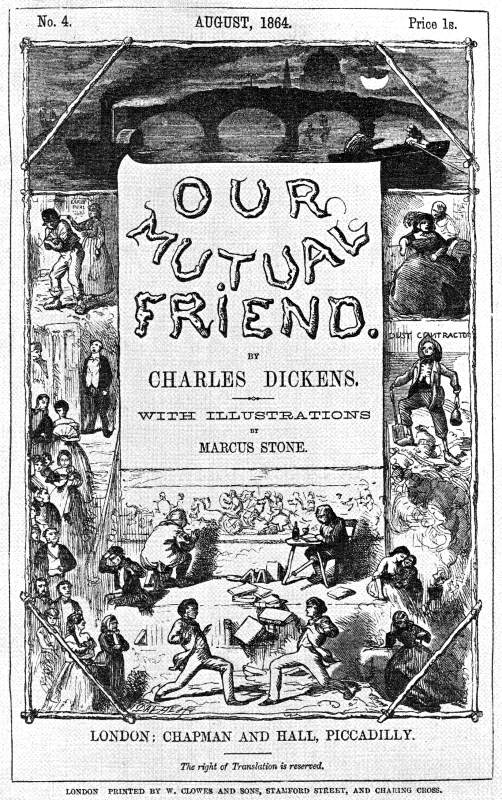
Our Mutual Friend, published in 1864–1865, is the fourteenth and final novel completed by English author Charles Dickens and is one of his most sophisticated works, combining savage satire with social analysis. It centres on, in the words of critic J. Hillis Miller, quoting the book's character Bella Wilfer, "money, money, money, and what money can make of life".
Our Mutual Friend, published in 1864–1865, is the fourteenth and final novel completed by English author Charles Dickens and is one of his most sophisticated works, combining savage satire with social analysis. It centres on, in the words of critic J. Hillis Miller, quoting the book's character Bella Wilfer, "money, money, money, and what money can make of life".
阅读详细介绍
Our Mutual Friend, published in 1864–1865, is the fourteenth and final novel completed by English author Charles Dickens and is one of his most sophisticated works, combining savage satire with social analysis. It centres on, in the words of critic J. Hillis Miller, quoting the book's character Bella Wilfer, "money, money, money, and what money can make of life".
Most reviewers in the 1860s continued to praise Dickens's skill as a writer in general, but did not review this novel in detail. Some found the plot both too complex and not well laid out. The Times of London found the first few chapters did not draw the reader into the characters. In the 20th century, however, reviewers began to find much to approve in the later novels of Dickens, including Our Mutual Friend. In the late 20th and early 21st centuries, some reviewers suggested that Dickens was, in fact, experimenting with structure, and that the characters considered somewhat flat and not recognized by the contemporary reviewers were meant rather to be true representations of the Victorian working class and the key to understanding the structure of the society depicted by Dickens in the novel.
John Harmon – is heir to the Harmon estate, under the condition that he marry Bella Wilfer. He is presumed dead throughout most of the novel, though he is living under the name John Rokesmith, and working as a secretary for the Boffins in an attempt to better get to know Bella, the Boffins, and people's general reaction to John Harmon's "death". Harmon also uses the alias Julius Handford upon first returning to London. Harmon's "death" and subsequent resurrection as Rokesmith/Handford is consistent with Dickens's recurring theme in the novel of rebirth from the water. His upward social mobility through his own efforts is presented as favourable, in contrast with Headstone, Hexam, and the Lammles.
"Bella" Wilfer – is a beautiful young woman born into a poor family, who learns upon the death of Old Mr Harmon that she is the intended wife for his son, a condition of his inheritance. When her intended husband, John Harmon, is reported to have been killed, she is left without future prospects. She learns of the trouble money can bring when taken in by the newly rich Boffins. Bella rejects Rokesmith's proposal at first but later accepts it. Initially described as a "mercenary young woman", who describes herself upon meeting Lizzie Hexam as having "no more character than a canary bird", Bella undergoes a significant moral change in the novel. Although originally completely preoccupied with money, her complexity is eventually displayed in her ability to defy the societal pressures to achieve happiness unrelated to wealth. She is praised for her "vivacity and lifelikeness", with greater complexity than some of the other, more static characters. Her relationship with her father is more like that of a mother and son, as she consistently dotes upon him, calling him her "cherub". Her open and warm relationship with her father contrasts with her strained and resentful relationships with her mother and sister.
Nicodemus "Noddy" Boffin, the Golden Dustman (the dust from the ashes of coal fires dominated in waste materials at this period, so “dust” became a term used for waste or rubbish generally) – becomes a member of the nouveaux riches when Old Mr Harmon's heir is considered dead. He is illiterate, but wants to fit the image of a wealthy man, and so hires Silas Wegg to read to him in hopes of gaining more intelligence and worldliness. He is nearly blackmailed by Wegg. He assumes the role of a miser to show Bella the dangers of wealth, but eventually admits this behaviour was an act and gives his money to Bella and John. Boffin's innocence, naïve curiosity, and desire to learn in his new position in life contrast with his "elaborate performances as Boffin the miser". Critics speculate that Dickens's decision to have Boffin playing a part may not have been planned, as it was not very convincing for a man who has shown his simplistic ignorance on several occasions. Boffin's inheritance of Old Harmon's money is appropriate because Harmon had attained it by combing the dust heaps, because this suggests social mobility. Boffin represents a wholesome contrast to such wealthy characters as the Veneerings and Podsnaps, and may have been based on Henry Dodd, a ploughboy who made his fortune removing London's rubbish.
Mrs Henrietta Boffin – is Noddy Boffin's wife, and a very motherly woman, who convinces Mr Boffin to take in an orphan boy called Johnny. This indicates "another progressive development for Dickens as his female characters undertake a more active role in social reform".
Elizabeth "Lizzie" Hexam – is a daughter of Gaffer Hexam and sister of Charley Hexam. She is an affectionate daughter, but knows that Charley must escape their living circumstances if he is to succeed in life, so she gives Charley her money and helps him leave while their father is away. Later she is rejected by Charley after she remains in poverty. Pursued romantically by both Bradley Headstone and Eugene Wrayburn, she fears Headstone's violent passion and yearns for Wrayburn's love, while acutely aware of the social gap between them. Lizzie saves Wrayburn after Headstone's attack. Wrayburn marries her as he is expected to die after the attack. She in effect acts as the moral centre of the story and is by far the "most wholly good character […] almost bereft of ego". Dickens carries over her moral superiority into her physical characterisation. Her "capacity for self-sacrifice […] is only slightly more credible than her gift for refined speech", making her slightly unbelievable in comparison to her uneducated father and Jenny Wren. Lizzie's concern about social class reveals her reasoning for ensuring her brother's escape from poverty and ignorance, though she remains humble about her own situation. However, her moral character attracts Wrayburn and her inherent goodness is rewarded