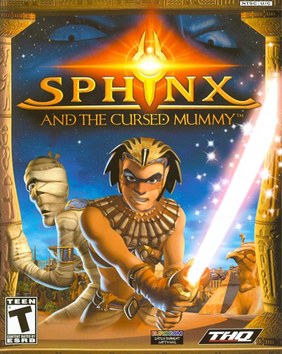
Sphinx and the Cursed Mummy is a 2003 action-adventure video game developed by Eurocom and published by THQ for GameCube, PlayStation 2, and Xbox. A version for mobile phones was released in 2004. THQ Nordic published a high-definition remaster for PC in 2017 and Nintendo Switch in 2019.
Sphinx and the Cursed Mummy is a 2003 action-adventure video game developed by Eurocom and published by THQ for GameCube, PlayStation 2, and Xbox. A version for mobile phones was released in 2004. THQ Nordic published a high-definition remaster for PC in 2017 and Nintendo Switch in 2019.
阅读详细介绍
Sphinx and the Cursed Mummy is a 2003 action-adventure video game developed by Eurocom and published by THQ for GameCube, PlayStation 2, and Xbox. A version for mobile phones was released in 2004. THQ Nordic published a high-definition remaster for PC in 2017 and Nintendo Switch in 2019.
Set in a fantasy world based on Ancient Egypt, the plot follows the demigod Sphinx and now-undead mummy Tutankhamun working against the schemes of the evil god Set. Gameplay features each character navigating environments which incorporate platforming and puzzles. Sphinx's sections incorporate combat and exploring open areas, while Tutankhamun's sections focus on elemental puzzles in Set's stronghold.
Beginning as an animated film concept in 1999, the project was picked up as a video game and began production in 2000. The team wanted a focus on exploration and puzzles with an Egyptian aesthetic for its world and characters, with its gameplay being compared by its developers to The Legend of Zelda. Some gameplay elements and several areas were cut from the final game. These elements were restored to the remaster via fan-created mods. Sphinx was generally well received for its gameplay and art design, but sold poorly.
Gameplay
Sphinx and the Cursed Mummy is an action-adventure video game in which players take on the role of two characters; the demigod Sphinx, and the undead mummy Tutankhamun. Transitions between the two are story driven, with cutscenes marking the shift between Sphinx and Tutankhamun. Both characters can interact with switches and pick up items.
As Sphinx, the player explores town environments, open areas, and dungeons. Sphinx primarily fights with a sword and gains several additional tools throughout the story, including a shield, a blowpipe, a double jump, gauntlets that enable him to move heavy objects, beetles that can capture weakened enemies, and Ankhs that increase his health. In some areas, Sphinx can play minigames based on memorising color and symbol sequences. Scarabs found in the environment act as currency.
Tutankhamun cannot die or battle enemies, with gameplay instead focusing on puzzle solving and stealth. Taking damage and being exposed to certain elements enables him to solve puzzles and activate switches in otherwise inaccessible places. These effects are cancelled through contact with water. Puzzles involve activating switches and navigating dungeons by platforming.
Plot
Sphinx is set in a land once united, now splintered by an ancient war into multiple kingdoms connected by ancient portals. The priest Imhotep sends his two apprentices, the demigods Sphinx and Horus, into the hostile land of Uruk to retrieve a weapon dubbed the Blade of Osiris. The arrogant Horus is seemingly killed after the two are attacked by a beam weapon from the fortress of the god Set, and Sphinx retrieves the Blade. In the human kingdom of Luxor, the young Tutankhamun discovers a conspiracy seemingly being hatched by his brother Akhenaten−in reality Akhenaten is the disguised Set, who transforms him into a mummy. Sphinx arrives and disrupts the ritual, and escaping to the city of Abydos finds the kingdoms under attack. Travelling to Heliopolis, Sphinx is met by Horus, later revealed to have been suborned by Set. Guided by Imhotep, Sphinx seeks out help from Anubis, who instructs Sphinx to retrieve four Sacred Crowns left among the kingdoms by the gods.
Development
British developer Eurocom had made a name for themselves developing licensed video games, with the team deciding to begin creating self-owned original properties. The first major attempt at this was Sphinx. The original Sphinx concept began as an animated film pitch created in 1999 by Spanish animation group Anibyte, which had worked with Eurocom on the CGI cutscenes for 40 Winks. When they failed to find funding, Anibyte brought the project to Eurocom and it was redesigned as a game. Already present were a Sphinx character, Anubis, and some monsters. Production began in 2000, lasting three years including a pre-production period lasting six months to a year. The title was picked up by publisher THQ, who had worked with Eurocom on a number of their earlier projects.
The team wanted an exotic setting, briefly considering an "Arabian-style" design before settling on Ancient Egypt after the mummy design received positive feedback from the staff. The characters and enemies were designed by Julian Romero. Composer Steve Duckworth described the music as having a "Western orchestral sound" blended with Arabian elements. Voice acting was wanted by staff, but THQ turned it down as unnecessary, something staff members felt was a mistake and alienated some players unused to the Zelda-style voiceless cutscenes. According to staff member Mat Sneap, Sphinx was being designed as the start of a potential franchise, with both sequels and multimedia expansions under consideration.
The Crowns of Abydos, Uruk and Heliopolis are recovered from disguised agents of Set seeking to cripple the kingdoms. In parallel, Imhotep sends Canopic jars containing Tutankhamun's life force to the castle of Uruk via the animated Basket, where briefly reanimated he is able to retrieve key items and sabotage some of Set's plans. It is revealed that Set and his banished brother Osiris were once one being, the deity Ra, but split apart and triggered the war. By collecting the crowns, Anubis has the means to summon Osiris and merge the two again, which Set opposes. Tutankhamun retrieves the Crown of Set, but is discovered and captured. Sphinx travels to Uruk and fights Set. With Set defeated, Osiris merges with him and reunites as Ra, who gives Tutankhamun the final jar. Tutankhamun accidentally breaks the jar, but Imhotep assures him they will restore his human form.
A dual character system was different gameplay styles was present from early production. The gameplay was compared by staff member Rob Loftus to The Legend of Zelda, with the aim being for a similar experience on other consoles. The t