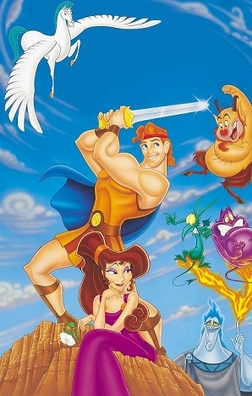
The following are fictional characters from Disney's franchise Hercules, which includes its 1997 animated film and its derived TV series. These productions are adaptations of Greek mythology, and as such, differ greatly from the classical versions.
The following are fictional characters from Disney's franchise Hercules, which includes its 1997 animated film and its derived TV series. These productions are adaptations of Greek mythology, and as such, differ greatly from the classical versions.
詳しい紹介を読む
The following are fictional characters from Disney's franchise Hercules, which includes its 1997 animated film and its derived TV series. These productions are adaptations of Greek mythology, and as such, differ greatly from the classical versions.
Hercules
Hercules is the titular character of the franchise, who is based on the mythological Heracles, commonly referred to by the Roman spelling, Hercules. In the 1997 animated film, Josh Keaton voices Hercules as a teenager, Tate Donovan voices him as an adult, and Roger Bart provides his singing voice in "Go the Distance". He is a young man with orange hair and eyebrows and blue eyes. Young Hercules wears a one-sleeved Greek tunic with brown sandals. As a teenager, Hercules is a country boy depicted as tall and thin, with exaggerated proportions, such as a staggering pigeon-toed stance. After completing his hero training, Hercules physically changes from being slender to being top-heavy and muscular, having larger biceps and pectorals and a thicker neck, as well as a more confident stance. However, Hercules still retains some of his teenage flaws, such as being shy, awkward, clumsy and inept with a lack of coordination, occasionally taking a stance that is pigeon-toed or staggering as well as an instinctive reaction to scream loudly or run away. As a hero, Hercules wears a brown-orange brass Cuirass-like tank armor tunic with brown wristbands, matching warrior sandals, and a blue cape.
In creating the design for the infant version of Hercules used in the 1997 film, animator Randy Haycock drew inspiration by videotaping a friend's six-month-old and by renting films with babies in them, while the curly hairstyle for baby Hercules was derived from the appearance of Haycock's infant daughter. He stated that "Hercules' mannerisms come right off things I've picked up from her", even though Hercules is more caricatured than a real baby. The inspiration for teenage Hercules came from Haycock's experiences as an adolescent: he stated that "I was too tall and skinny for my age, and I was a lousy athlete. At home I broke just about everything..". Teenage Hercules has big hands and feet that the animator remembers having himself, as well as a lack of coordination. Andreas Deja was supervising animator for the adult version of Hercules. He studied photographs of Olympic athletes, specifically swimmers, who have long necks and natural musculature. He wanted to emulate the Greek tradition of character drawing, which he explains means "straight nose, pursed lips – almost cherubic, large eyes, a lidded look...The classic style you find on Greek vases or drawings".
In the original film, Hercules is born on Mount Olympus as a god and son of Zeus and Hera. However, Hercules' evil uncle Hades, who wants to take control of Olympus and the world, along with all of creation, is enraged at this. Knowing that, as a god, Hercules is immortal and invulnerable to harm, Hades sends his lackeys Pain and Panic to kidnap Hercules and turn him mortal using a magic potion. However, the arrival of two mortals, Amphitryon and Alcmene, causes Hercules to miss the final drop of the potion, causing him to retain his superhuman strength despite becoming mortal. The couple then adopts the child, considering his arrival a gift from the gods since they are childless. Zeus and the other gods discover the kidnapping too late, and because Hercules is now mortal, he cannot return to Mount Olympus.
Over the years, Hercules is raised as a farmer until his awkward teenage years where he is unable to control his godlike strength and struggles to be accepted by others, which worsens when the teenager's clumsiness and uncoordinated strength leads to him accidentally destroying a marketplace. Shortly afterward, Amphitryon and Alcmene inform Hercules that he is adopted, inspiring him to visit the temple of Zeus, where he learns of his godhood. Zeus tells Hercules that he must prove himself a true hero and instructs him to find the trainer of heroes Philoctetes (or "Phil"), while giving him the winged horse Pegasus to assist him in his journey. Phil initially declines returning to the hero training business, unconvinced that Hercules was the son of Zeus, but is convinced after Zeus strikes him with lightning. Having reached adulthood and passed his training, Hercules sets off with Phil to become a hero in Thebes. Along the way, Hercules saves a "damsel in distress" named Meg from Nessus, a centaur acting as the river guardian, and though Meg doesn't believe Hercules' "innocent farm-boy routine" he falls in love with her. Unbeknownst to Hercules, Meg is working unwillingly for Hades and relates the events to him; through this, Hades learns that Hercules is still alive and plots again to kill him at the start of his career. Meanwhile, Hercules arrives in Thebes and announces himself as a hero, only for the Thebans to dismiss the young man as an amateur and refuse to give him a chance to prove himself. Meg appears and lures Hercules to a rocky canyon outside of town, where he saves two boys, who are actually Pain and Panic in disguise, trapped in a cave. As an unimpressed crowd of Thebans watch Hercules rescue the trapped boys, the young hero also inadvertently releases a giant serpent-like creature, the Hydra, and bravely faces the monster with just a sword and his wits. Although he struggles in the fight, in which the beast initially swallows him whole, he cuts his way out by decapitation. However, Hercules is forced on the defensive, flying around on Pegasus as the Hydra's heads multiply and grows three heads every time one is cut off, the snarling heads overwhelming him until he smashes his fists into the mountainside, causing an avalanche that buries the multi-headed monster under a mountain of rocks. His victory earns him newfound fame and adoration from the citizens of Thebes as well as the anger of Hades. After defeating the Hydra, Hercules continues his heroics and becomes famous throughout Greece. U